
Alibaba's Qwen3.6-35B-A3B Model Surpasses Google's Gemma 4 in AI Coding Benchmarks
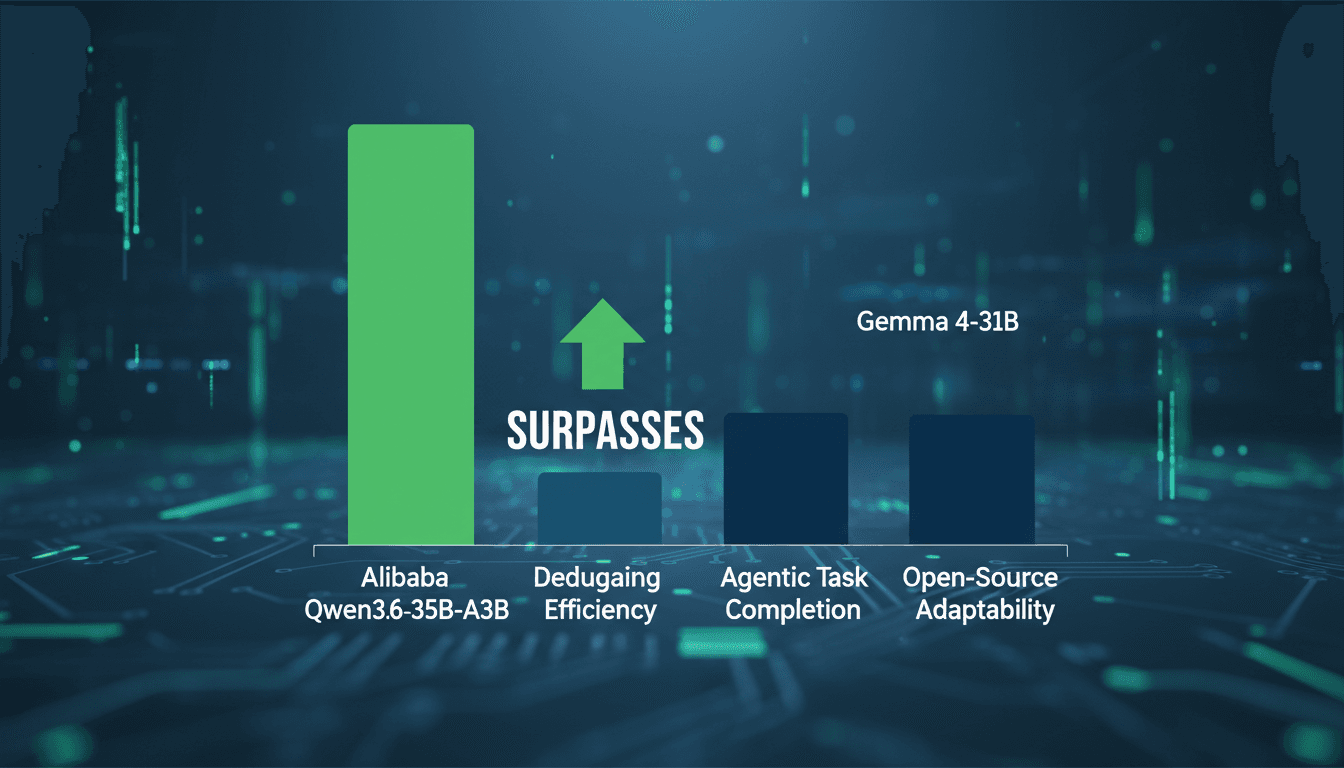
Here's what it means for you.
If you're a developer or tech professional, this shift in AI model performance could enhance your coding efficiency and project outcomes.
Why it matters
This development signals a significant competitive shift in the AI landscape, particularly in open-source models, which could redefine software engineering practices.
What happened (in 30 seconds)
- Alibaba's Qwen3.6-35B-A3B was released on April 14, 2026, and outperformed Google's Gemma 4-31B in key coding benchmarks.
- Benchmark results showed Qwen3.6 achieving 73.4% on SWE-bench Verified, compared to Gemma's 52.0%.
- The open-source model is now available on platforms like Hugging Face and ModelScope, integrated into developer tools.
The context you actually need
- Geopolitical AI race: The release follows a series of advancements by Alibaba amid increasing competition with U.S. tech giants like Google.
- Agentic coding benchmarks: These benchmarks assess AI's ability to autonomously handle real-world software tasks, driving demand for efficient models.
- Open-source trend: The push for open-source AI models is gaining traction, as developers seek cost-effective and efficient solutions for software engineering.
What's really happening
Alibaba's Qwen3.6-35B-A3B model represents a strategic response to the escalating competition in the AI sector, particularly in the realm of open-source solutions. Released shortly after Alibaba's Qwen3.6-Plus and Google's Gemma 4, this model's performance on agentic coding benchmarks highlights a pivotal moment in AI development.
The Qwen team has focused on creating a mixture-of-experts (MoE) model, which allows for more efficient processing by activating only a subset of its parameters during tasks. This design choice not only enhances performance but also reduces computational costs, making it an attractive option for developers facing budget constraints. The model's superior performance on benchmarks like SWE-bench Verified and Terminal-Bench 2.0 indicates its potential to handle complex coding tasks more effectively than its competitors.
The implications of this development extend beyond mere performance metrics. As open-source models gain traction, they democratize access to advanced AI capabilities, allowing smaller companies and individual developers to leverage powerful tools that were previously the domain of larger corporations. This shift could lead to a more diverse ecosystem of AI applications, fostering innovation and creativity in software engineering.
Moreover, the integration of Qwen3.6 into popular developer tools signifies a broader trend towards embedding AI capabilities directly into the software development lifecycle. This could streamline workflows, reduce time spent on mundane coding tasks, and ultimately enhance productivity across the industry.
As the competition heats up, both Alibaba and Google are likely to continue refining their models, pushing the boundaries of what AI can achieve in coding and software development. The focus on agentic workflows suggests that future iterations of these models will prioritize autonomy and efficiency, further reshaping the landscape of software engineering.
Who feels it first (and how)
- Developers: They will experience improved coding efficiency and productivity through enhanced AI tools.
- Tech startups: Smaller companies can leverage open-source models to compete with larger firms without significant investment in proprietary technology.
- Educational institutions: They may adopt these models for teaching coding and AI, providing students with access to cutting-edge technology.
What to watch next
- Adoption rates of Qwen3.6: Monitoring how quickly developers integrate this model into their workflows will indicate its impact on the market.
- Benchmark updates: Future performance comparisons between Qwen3.6 and other models will reveal ongoing shifts in AI capabilities.
- Regulatory responses: Watch for any governmental or institutional reactions to the rapid advancements in AI, particularly regarding open-source technologies.
Qwen3.6-35B-A3B outperforms Gemma 4-31B in agentic coding benchmarks.
Increased adoption of open-source AI models among developers and startups.
The long-term impact of this competition on the overall AI landscape and regulatory frameworks.
Frequently Asked Questions
- Why it matters?
- This development signals a significant competitive shift in the AI landscape, particularly in open-source models, which could redefine software engineering practices.
- What happened (in 30 seconds)?
- Alibaba's Qwen3.6-35B-A3B was released on April 14, 2026, and outperformed Google's Gemma 4-31B in key coding benchmarks. Benchmark results showed Qwen3.6 achieving 73.4% on SWE-bench Verified, compared to Gemma's 52.0%. The open-source model is now available on platforms like Hugging Face and ModelScope, integrated into developer tools.
- What's really happening?
- Alibaba's Qwen3.6-35B-A3B model represents a strategic response to the escalating competition in the AI sector, particularly in the realm of open-source solutions. Released shortly after Alibaba's Qwen3.6-Plus and Google's Gemma 4, this model's performance on agentic coding benchmarks highlights a pivotal moment in AI development. The Qwen team has focused on creating a mixture-of-experts (MoE) model, which allows for more efficient processing by activating only a subset of its parameters duri
- Who feels it first (and how)?
- Developers: They will experience improved coding efficiency and productivity through enhanced AI tools. Tech startups: Smaller companies can leverage open-source models to compete with larger firms without significant investment in proprietary technology. Educational institutions: They may adopt these models for teaching coding and AI, providing students with access to cutting-edge technology.
- What to watch next?
- Adoption rates of Qwen3.6: Monitoring how quickly developers integrate this model into their workflows will indicate its impact on the market. Benchmark updates: Future performance comparisons between Qwen3.6 and other models will reveal ongoing shifts in AI capabilities. Regulatory responses: Watch for any governmental or institutional reactions to the rapid advancements in AI, particularly regarding open-source technologies.
Daily AI news: models, tools, and policy.
"Independent outlet tracking the fast pace of AI."
— A47 Editor
Alibaba's open model Qwen3.6 leads Google's Gemma 4 across agentic coding benchmarks
Alibaba's open-source model Qwen3.6-35B-A3B has demonstrated superior performance over Google's Gemma 4 across various coding and reasoning benchmarks, activating only three of its 35 billion parameters at a time. This achievement highlights the effi...
Curated tech headlines including AI stories.
"Influential aggregator surfacing the day’s top tech/AI links."
— A47 Editor
Alibaba unveils Qwen3.6-35B-A3B, an open-weight MoE model with 35B total and 3B active parameters, saying it rivals larger dense models in agentic coding tasks (Qwen)
Alibaba has introduced Qwen3.6-35B-A3B, an open-weight mixture of experts (MoE) model featuring a total of 35 billion parameters, with 3 billion active parameters, claiming it competes effectively with larger dense models in agentic coding tasks.
News for senior developers on AI/ML and data engineering.
"Conference-linked outlet for practitioner news and Q&As."
— A47 Editor
Google Opens Gemma 4 Under Apache 2.0 with Multimodal and Agentic Capabilities
Google has officially launched Gemma 4, a suite of open-weight AI models available under the Apache 2.0 license, featuring variants with 2B, 4B, 26B, and 31B parameters. This release enhances capabilities in video and image processing, audio input fo...