
EU and US Near Agreement on Critical Minerals to Reduce Chinese Dependence
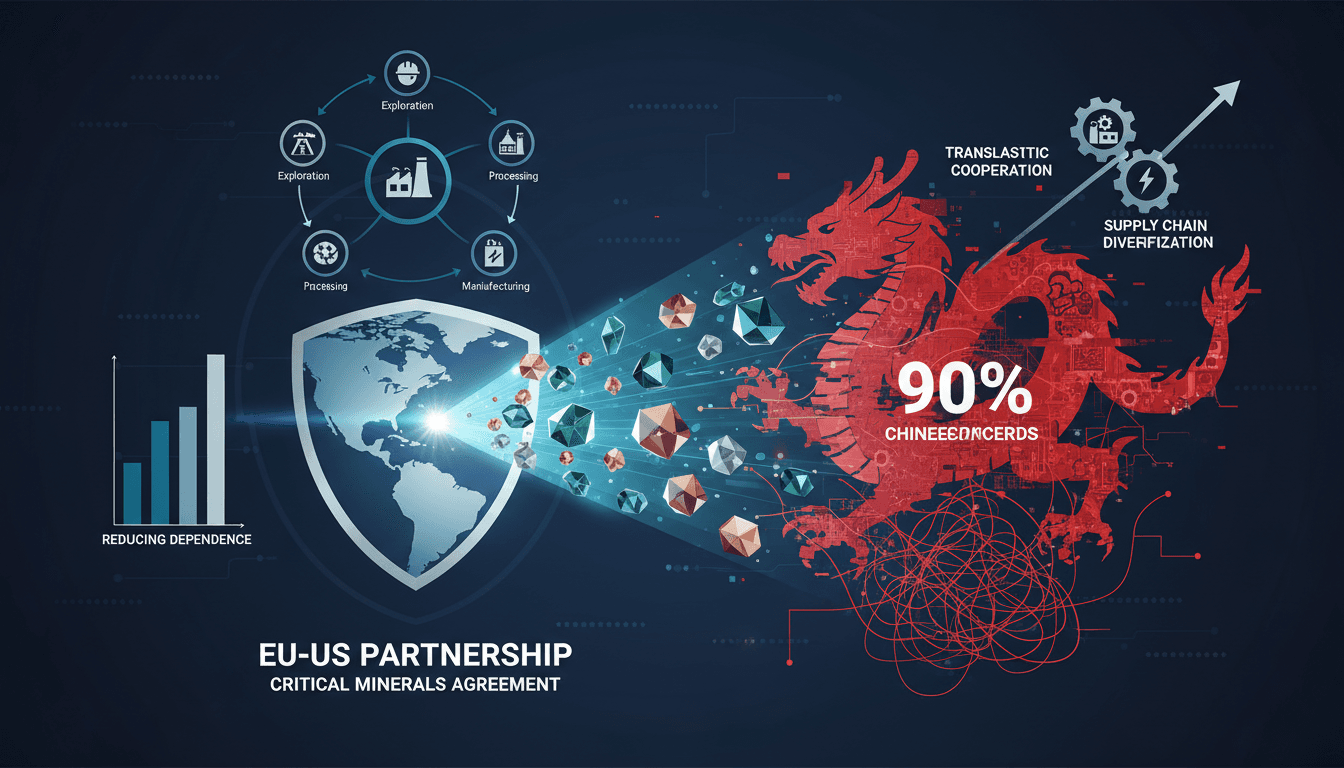
Here's what it means for you.
If you rely on technology or defense sectors, this agreement could reshape supply chains and pricing structures.
Why it matters
This strategic partnership aims to reduce Western reliance on Chinese dominance in critical minerals, impacting global supply chains.
What happened (in 30 seconds)
- The EU and US are finalizing a strategic agreement to coordinate production and secure critical minerals.
- The pact includes incentives like minimum prices for non-Chinese suppliers and joint investments.
- The agreement builds on prior efforts to counter China's control over 70-90% of global processing for rare earths and other key materials.
The context you actually need
- China dominates the critical minerals market, controlling approximately 85% of global rare earth processing capacity.
- The EU's Critical Raw Materials Act mandates significant domestic benchmarks for extraction, processing, and recycling by 2030.
- Geopolitical tensions and Chinese export controls have intensified the urgency for the US and EU to collaborate on supply chain security.
What's really happening
As of April 10, 2026, the European Union and the United States are on the brink of finalizing a strategic agreement aimed at enhancing cooperation in critical minerals production. This pact is not just a response to current market pressures but a proactive measure to counteract China's overwhelming dominance in the sector. With China controlling an estimated 85% of the global rare earth processing capacity, the EU and US are motivated to secure their supply chains against potential disruptions.
The agreement is expected to include a range of incentives designed to bolster non-Chinese suppliers. These incentives may involve establishing minimum prices for minerals sourced outside of China, which could help stabilize prices and encourage investment in alternative supply chains. Additionally, the pact aims to facilitate joint investments in critical minerals projects, aligning standards between the two regions and coordinating responses to any supply disruptions that may arise.
This strategic partnership builds on previous transatlantic efforts, including a February 2026 announcement of a trilateral partnership involving Japan, which further underscores the urgency of diversifying supply chains. The EU's Critical Raw Materials Act, enacted in 2024, sets ambitious benchmarks for domestic production by 2030, aiming for 10% domestic extraction, 40% processing, and 25% recycling of annual consumption. Meanwhile, the US is pursuing diversification through the Inflation Reduction Act and various bilateral frameworks.
The geopolitical landscape, characterized by rising tensions and Chinese export controls, has prompted both the EU and US to intensify their cooperation. The recent meetings between EU Trade Commissioner Maroš Šefčovič and US Trade Representative Jamieson Greer have advanced discussions on this critical minerals agreement, indicating a strong commitment to addressing vulnerabilities in supply chains.
As the agreement nears completion, it signals a significant shift in how Western nations approach critical minerals. By fostering collaboration and reducing reliance on China, the EU and US are positioning themselves to better navigate the complexities of global supply chains, ultimately benefiting sectors reliant on these essential materials.
Who feels it first (and how)
- Technology companies: Increased access to diversified mineral sources may stabilize supply chains and pricing.
- Defense contractors: Enhanced security of critical minerals will support defense technology production.
- Investors in mining and processing: New joint investments could create opportunities in the critical minerals sector.
- Workers in processing and logistics: Job growth may occur in regions involved in the expanded supply chain.
- UAE residents: The parallel US-UAE framework may boost local investments and job opportunities in critical minerals.
What to watch next
- Implementation of the agreement: Monitor how quickly and effectively the EU and US put this pact into action, as it will set the tone for future collaborations.
- Market response to pricing incentives: Watch for shifts in mineral prices as minimum pricing structures are introduced, which could affect various industries.
- Geopolitical developments: Keep an eye on China's reactions and any potential retaliatory measures that could impact global supply chains.
The EU and US are nearing a strategic agreement on critical minerals.
The agreement will lead to increased investment in non-Chinese mineral sources and processing capabilities.
The long-term market impact on mineral prices and supply chain stability remains uncertain.
Frequently Asked Questions
- Why it matters?
- This strategic partnership aims to reduce Western reliance on Chinese dominance in critical minerals, impacting global supply chains.
- What happened (in 30 seconds)?
- The EU and US are finalizing a strategic agreement to coordinate production and secure critical minerals. The pact includes incentives like minimum prices for non-Chinese suppliers and joint investments. The agreement builds on prior efforts to counter China's control over 70-90% of global processing for rare earths and other key materials.
- What's really happening?
- As of April 10, 2026, the European Union and the United States are on the brink of finalizing a strategic agreement aimed at enhancing cooperation in critical minerals production. This pact is not just a response to current market pressures but a proactive measure to counteract China's overwhelming dominance in the sector. With China controlling an estimated 85% of the global rare earth processing capacity, the EU and US are motivated to secure their supply chains against potential disruptions.
- Who feels it first (and how)?
- Technology companies: Increased access to diversified mineral sources may stabilize supply chains and pricing. Defense contractors: Enhanced security of critical minerals will support defense technology production. Investors in mining and processing: New joint investments could create opportunities in the critical minerals sector. Workers in processing and logistics: Job growth may occur in regions involved in the expanded supply chain. UAE residents: The parallel US-UAE framework may bo
- What to watch next?
- Implementation of the agreement: Monitor how quickly and effectively the EU and US put this pact into action, as it will set the tone for future collaborations. Market response to pricing incentives: Watch for shifts in mineral prices as minimum pricing structures are introduced, which could affect various industries. Geopolitical developments: Keep an eye on China's reactions and any potential retaliatory measures that could impact global supply chains.
Arabic-language digital news outlet covering UAE, regional, and international developments with broad general-news coverage.
"Al Ain News coverage typically blends UAE-focused reporting with wider Arab regional and international news."
— A47 Editor
تأمين المعادن الحيوية.. فرصة نادرة لتقارب استراتيجي بين أمريكا وأوروبا
The European Union and the United States are nearing a joint agreement aimed at coordinating the production and securing vital minerals. This development highlights a significant step towards strategic collaboration between the two regions.
Arabic-language coverage of political affairs and current events.
"Okaz political coverage typically follows mainstream Saudi framing on national and regional affairs."
— A47 Editor
تحالف غربي جديد لمواجهة هيمنة الصين على المعادن النادرة
The European Union and the United States are nearing a joint agreement aimed at coordinating efforts in the production and securing of critical minerals, as reported by Bloomberg. The potential agreement includes economic incentives such as guarantee...
Regional and international reporting focused on Middle Eastern politics, diplomacy, and economics.
"Asharq Al-Awsat is a Saudi-owned international newspaper reflecting mainstream Gulf political perspectives."
— A47 Editor
EU, US Reportedly Near Critical Minerals Deal to Combat Chinese Control
The European Union (EU) and the United States (US) are reportedly nearing a critical minerals deal aimed at reducing Chinese dominance in the sector. This agreement is seen as a strategic move to secure supply chains for essential materials used in v...