
UAE Banking Assets Reach 5.47 Trillion Dirhams by February 2026
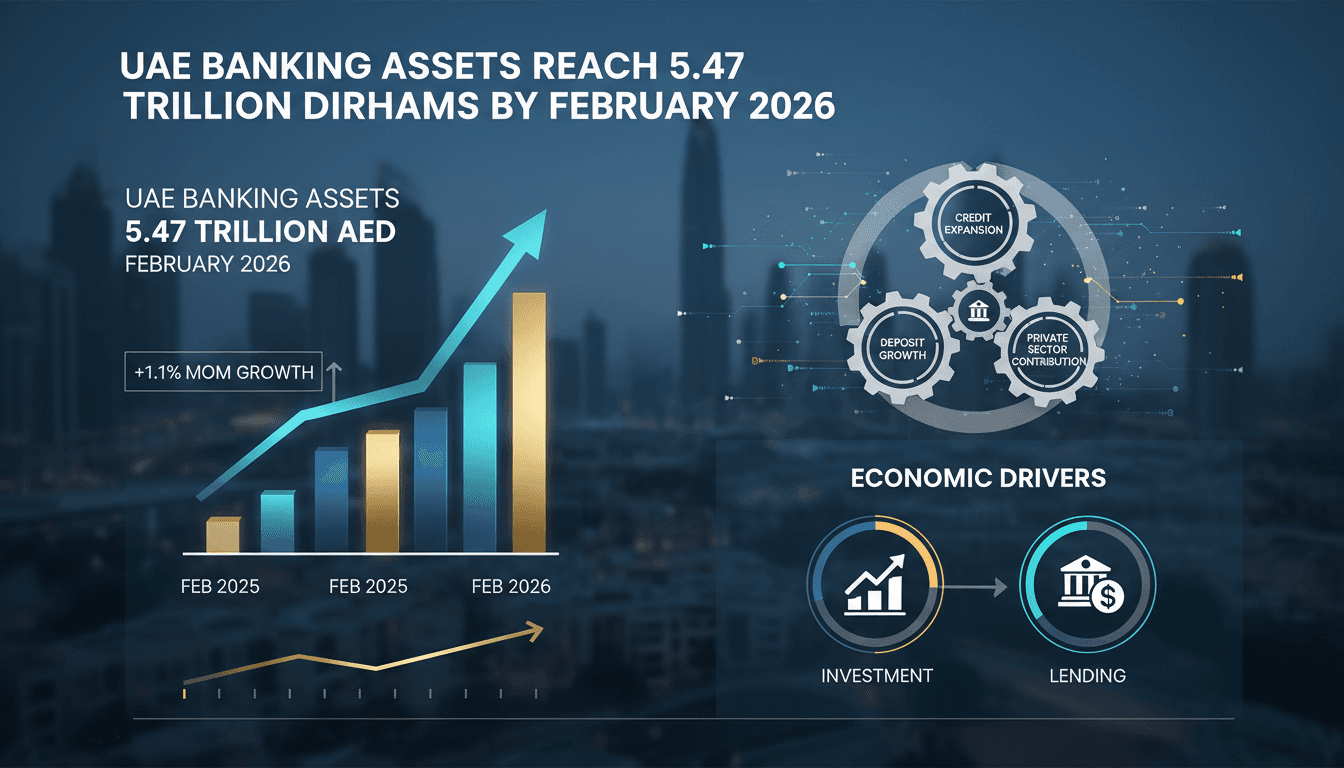
Here's what it means for you.
The increase in banking assets in the UAE signals a more robust financial environment, potentially leading to better lending conditions for individuals and businesses.
Why it matters
This growth reflects the resilience of the UAE's banking sector and its capacity to support economic expansion.
What happened (in 30 seconds)
- Total banking assets in the UAE reached 5.472 trillion dirhams by the end of February 2026, marking a 1.1% increase from January.
- Credit growth was a key driver, with total credit rising by 1.2% to 2.63 trillion dirhams, while deposits grew by 1.9% to 3.4 trillion dirhams.
- The Central Bank of the UAE (CBUAE) reported these figures, highlighting a positive trajectory despite a slight decline in government credit.
The context you actually need
- Sustained growth: The UAE banking sector has shown consistent growth, with a 1.4% increase in gross assets noted in January 2026.
- Private sector influence: The expansion in credit and deposits is primarily driven by private sector activities, indicating a healthy economic environment.
- Foreign investment: The UAE's economy benefits from strong foreign investment and stable monetary policies, contributing to the banking sector's resilience.
What's really happening
The recent report from the CBUAE indicates a healthy banking sector in the UAE, with total banking assets surpassing 5.47 trillion dirhams. This growth is not merely a number; it represents a significant shift in the financial landscape of the UAE, driven primarily by private sector activities. The 1.1% month-on-month increase in total banking assets from January to February 2026 can be attributed to a notable rise in both credit and deposits, with private sector contributions playing a pivotal role.
The total credit in the banking sector grew by 1.2%, reaching 2.63 trillion dirhams. This increase is crucial as it reflects banks' willingness to lend, which is essential for economic growth. More lending means that businesses can invest in expansion, and individuals can access financing for homes, cars, and other personal needs. The rise in deposits, which grew by 1.9% to 3.4 trillion dirhams, further underscores the public's confidence in the banking system.
Moreover, the monetary base expanded by 2% to 918.6 billion dirhams, indicating that the Central Bank is actively managing liquidity in the economy. The growth in money supply aggregates (M1, M2, M3) also suggests that more money is circulating in the economy, which can lead to increased consumer spending and investment.
The banking sector's strength is further reinforced by the positive sentiment among investors, as evidenced by the elevated foreign assets exceeding 1.095 trillion dirhams. This influx of foreign capital not only stabilizes the financial system but also enhances the UAE's position as a financial hub in the region. The overall financial stability, coupled with a robust national economy supported by diversification efforts, positions the UAE banking sector for continued growth.
However, it is essential to note that while the private sector is driving this expansion, there has been a slight dip in government credit. This shift indicates a potential reallocation of resources towards the private sector, which could lead to more dynamic economic growth in the long term.
Who feels it first (and how)
- Small and Medium Enterprises (SMEs): Increased access to credit for business expansion and operational financing.
- Real estate developers: More lending opportunities for property development projects.
- Consumers: Enhanced personal financing options for loans and mortgages.
- Investors: Positive market sentiment leading to potential investment opportunities in banking stocks.
What to watch next
- Private sector lending trends: Monitoring the growth in credit to the private sector will indicate the overall health of the economy.
- Foreign investment flows: Continued foreign investment will be a key indicator of the UAE's attractiveness as a financial hub.
- Regulatory changes: Any adjustments by the CBUAE in monetary policy could impact liquidity and lending conditions.
Total banking assets have surpassed 5.47 trillion dirhams.
Continued growth in private sector lending and deposits.
The long-term impact of reduced government credit on overall economic stability.
Frequently Asked Questions
- Why it matters?
- This growth reflects the resilience of the UAE's banking sector and its capacity to support economic expansion.
- What happened (in 30 seconds)?
- Total banking assets in the UAE reached 5.472 trillion dirhams by the end of February 2026, marking a 1.1% increase from January. Credit growth was a key driver, with total credit rising by 1.2% to 2.63 trillion dirhams, while deposits grew by 1.9% to 3.4 trillion dirhams. The Central Bank of the UAE (CBUAE) reported these figures, highlighting a positive trajectory despite a slight decline in government credit.
- What's really happening?
- The recent report from the CBUAE indicates a healthy banking sector in the UAE, with total banking assets surpassing 5.47 trillion dirhams. This growth is not merely a number; it represents a significant shift in the financial landscape of the UAE, driven primarily by private sector activities. The 1.1% month-on-month increase in total banking assets from January to February 2026 can be attributed to a notable rise in both credit and deposits, with private sector contributions playing a pivotal
- Who feels it first (and how)?
- Small and Medium Enterprises (SMEs): Increased access to credit for business expansion and operational financing. Real estate developers: More lending opportunities for property development projects. Consumers: Enhanced personal financing options for loans and mortgages. Investors: Positive market sentiment leading to potential investment opportunities in banking stocks.
- What to watch next?
- Private sector lending trends: Monitoring the growth in credit to the private sector will indicate the overall health of the economy. Foreign investment flows: Continued foreign investment will be a key indicator of the UAE's attractiveness as a financial hub. Regulatory changes: Any adjustments by the CBUAE in monetary policy could impact liquidity and lending conditions.
Arabic-language digital news outlet covering UAE, regional, and international developments with broad general-news coverage.
"Al Ain News coverage typically blends UAE-focused reporting with wider Arab regional and international news."
— A47 Editor
ارتفاع الأصول المصرفية في الإمارات إلى 5.47 تريليون درهم
The banking assets in the UAE have continued their positive trend, increasing by 1.1% in February, surpassing 5.472 trillion dirhams compared to 5.414 trillion dirhams at the end of January, according to data from the Central Bank.
Arabic-language economic and business reporting with strong UAE market relevance.
"Emarat Al Youm business coverage often centers UAE property, banking, consumer issues, and economic policy."
— A47 Editor
ارتفاع الأصول المصرفية إلى 5.472 تريليون درهم بنهاية فبراير ارتفاع الأصول المصرفية إلى 5.472 تريليون درهم بنهاية فبراير
The banking assets in the UAE have reached 5.472 trillion dirhams by the end of February 2026, continuing a positive trend in monetary and banking indicators observed throughout the month. This growth reflects the resilience and stability of the fina...
Arabic-language UAE newspaper coverage focused on domestic affairs, public institutions, business, society, and regional developments.
"Al Khaleej coverage generally reflects a mainstream UAE editorial lens with strong attention to public affairs, institutions, and regional developments."
— A47 Editor
191 مليار درهم زيادة ميزانية المصرف المركزي في عام
The Central Bank of the UAE announced in its February balance sheet report that its total assets increased by 191 billion dirhams over the past year. This significant rise reflects the bank's growing financial strength and stability in the region.