
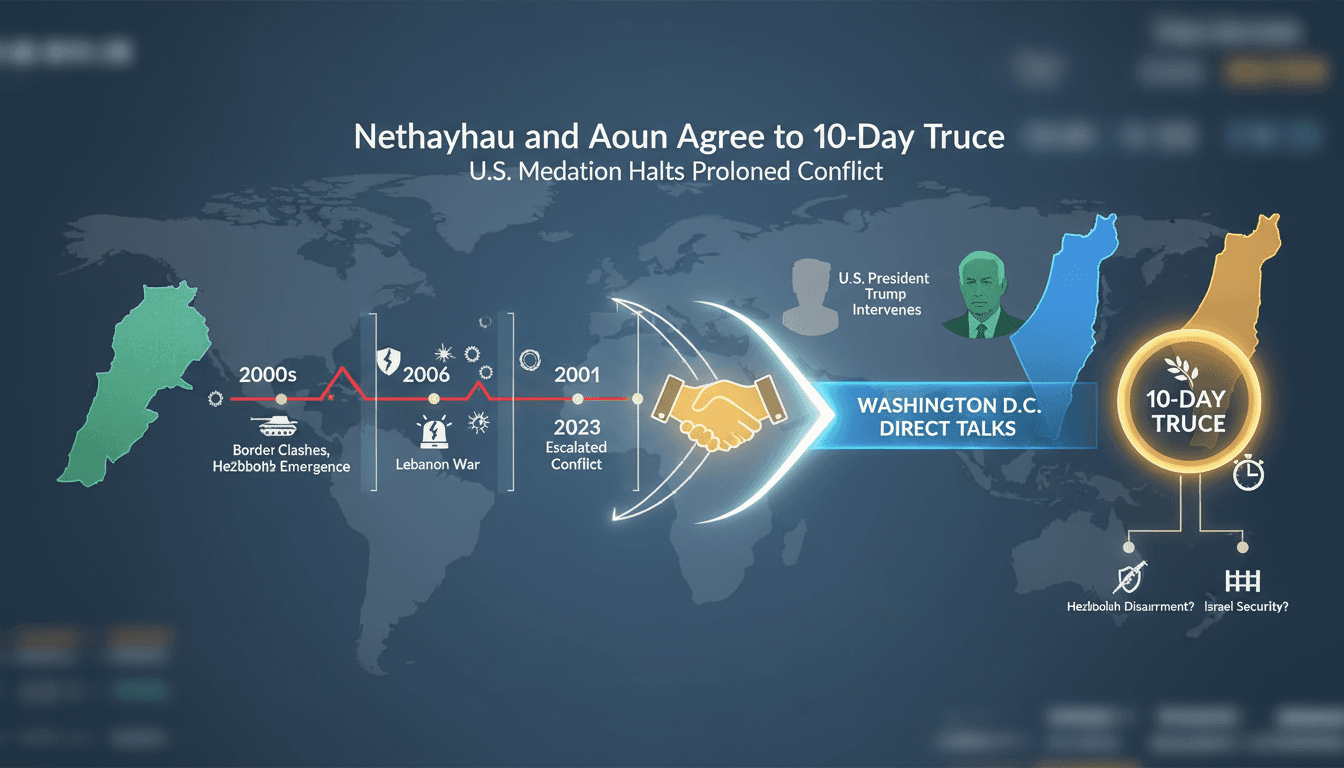
Netanyahu and Aoun Agree to 10-Day Truce Amid U.S. Mediation Efforts
Here's what it means for you.
The recent truce between Israel and Lebanon could influence market stability and investment opportunities across the Middle East.
Why it matters
This ceasefire is a critical step toward reducing regional tensions that can impact global markets and energy prices.
What happened (in 30 seconds)
- On April 16, 2026, Israeli Prime Minister Benjamin Netanyahu confirmed a 10-day truce with Lebanon, facilitated by U.S. President Donald Trump.
- The truce aims to pause hostilities along the Israel-Lebanon border amid a war that has displaced over one million Lebanese civilians.
- Celebrations erupted in Beirut, but Hezbollah expressed skepticism, indicating ongoing resistance to Israeli presence.
The context you actually need
- The conflict escalated after Hezbollah launched rockets into Israel in response to the killing of Iranian Supreme Leader Ali Khamenei, leading to significant military operations by Israel.
- Over 2,100 people have died in the conflict, with more than one million displaced, highlighting the humanitarian crisis and urgency for diplomatic solutions.
- U.S. involvement marks a significant shift, as direct talks between Israel and Lebanon have not occurred in decades, indicating a potential thaw in relations.
What's really happening
The recent agreement for a 10-day truce between Israel and Lebanon is a pivotal moment in a long-standing conflict that has seen escalating violence and humanitarian crises. The ceasefire, brokered by U.S. President Donald Trump, is not merely a pause in hostilities but a strategic maneuver aimed at facilitating broader peace negotiations. The backdrop of this truce is a complex web of geopolitical tensions involving Israel, Lebanon, Iran, and the United States, each with their own interests and stakes in the outcome.
The conflict reignited in March 2026 when Hezbollah retaliated against Israel for the assassination of Iranian Supreme Leader Ali Khamenei. This act intensified military operations, resulting in significant casualties and displacement. The U.S. has taken a proactive role, with Trump’s administration pushing for direct talks, which could reshape the dynamics of Middle Eastern politics. Netanyahu's insistence on maintaining a security buffer zone and disarming Hezbollah reflects Israel's long-standing security concerns, while Lebanon's leadership, particularly Prime Minister Nawaf Salam, views the truce as a necessary step toward addressing the humanitarian crisis.
The implications of this ceasefire extend beyond immediate military concerns. Markets are already reacting, with positive movements in stock indices and commodities like gold, indicating investor optimism about potential stability. However, the skepticism expressed by Hezbollah suggests that the truce may not hold without significant concessions and guarantees. The situation remains fluid, with initial reports of ceasefire violations indicating that the path to lasting peace is fraught with challenges.
As the ceasefire takes effect, the international community will be closely monitoring the situation. The potential for extended negotiations could lead to a more comprehensive peace agreement, but this will require navigating the complex interests of regional players, including Iran's influence over Hezbollah. The outcome of these discussions will likely have far-reaching consequences for regional stability, energy markets, and international relations.
Who feels it first (and how)
- Investors: Market fluctuations in response to geopolitical stability or instability.
- Lebanese civilians: Directly impacted by the humanitarian crisis and potential for improved living conditions.
- Israeli defense sectors: Security policies and military operations may shift based on the truce's outcomes.
What to watch next
- Ceasefire violations: Monitoring reports of any breaches will indicate the truce's fragility and potential for escalation.
- U.S. diplomatic efforts: The success of Trump's invitation for direct talks could signal a new phase in Middle Eastern diplomacy.
- Market reactions: Watch for shifts in stock indices and commodities, particularly oil and gold, as they reflect investor sentiment regarding regional stability.
The truce is currently in effect and has been welcomed by Lebanese leadership.
Continued skepticism from Hezbollah may lead to challenges in maintaining the ceasefire.
The long-term impact of U.S. involvement on regional dynamics and peace negotiations remains uncertain.
Frequently Asked Questions
- Why it matters?
- This ceasefire is a critical step toward reducing regional tensions that can impact global markets and energy prices.
- What happened (in 30 seconds)?
- On April 16, 2026, Israeli Prime Minister Benjamin Netanyahu confirmed a 10-day truce with Lebanon, facilitated by U.S. President Donald Trump. The truce aims to pause hostilities along the Israel-Lebanon border amid a war that has displaced over one million Lebanese civilians. Celebrations erupted in Beirut, but Hezbollah expressed skepticism, indicating ongoing resistance to Israeli presence.
- What's really happening?
- The recent agreement for a 10-day truce between Israel and Lebanon is a pivotal moment in a long-standing conflict that has seen escalating violence and humanitarian crises. The ceasefire, brokered by U.S. President Donald Trump, is not merely a pause in hostilities but a strategic maneuver aimed at facilitating broader peace negotiations. The backdrop of this truce is a complex web of geopolitical tensions involving Israel, Lebanon, Iran, and the United States, each with their own interests and
- Who feels it first (and how)?
- Investors: Market fluctuations in response to geopolitical stability or instability. Lebanese civilians: Directly impacted by the humanitarian crisis and potential for improved living conditions. Israeli defense sectors: Security policies and military operations may shift based on the truce's outcomes.
- What to watch next?
- Ceasefire violations: Monitoring reports of any breaches will indicate the truce's fragility and potential for escalation. U.S. diplomatic efforts: The success of Trump's invitation for direct talks could signal a new phase in Middle Eastern diplomacy. Market reactions: Watch for shifts in stock indices and commodities, particularly oil and gold, as they reflect investor sentiment regarding regional stability.
Jordanian news and regional updates.
"Roya News is a Jordanian outlet focused on breaking news and local affairs."
— A47 Editor
نتنياهو يوافق على “هدنة الـ10 أيام” مع لبنان وسط ترقب لاجتماعه بالرئيس اللبناني في البيت الأبيض
Israeli Prime Minister Benjamin Netanyahu announced a historic opportunity for a 10-day ceasefire with Lebanon, coinciding with his anticipated meeting with the Lebanese president at the White House. This development marks a significant diplomatic ef...
Arabic-language digital news outlet covering UAE, regional, and international developments with broad general-news coverage.
"Al Ain News coverage typically blends UAE-focused reporting with wider Arab regional and international news."
— A47 Editor
نزع سلاح حزب الله وإحلال السلام.. مطالب نتنياهو في المفاوضات مع لبنان
Following U.S. President Donald Trump's announcement of a ceasefire starting midnight Thursday-Friday, Israeli Prime Minister Benjamin Netanyahu revealed two key demands for Israel in negotiations with Lebanon. These demands focus on disarming Hezbol...
Pan-Arab news coverage spanning politics, business, sports, and regional affairs.
"Asharq Al-Awsat reflects a broad Arab editorial perspective with strong attention to regional geopolitics."
— A47 Editor
ترمب يتصل بعون ملتزماً بوقف إطلاق النار في أسرع وقت
International communications are intensifying to contain the escalation in Lebanon, highlighted by a call between President Joseph Aoun and U.S. Secretary of State Marco Rubio, emphasizing a commitment to ceasefire as soon as possible.
Jordanian news and regional updates.
"Roya News is a Jordanian outlet focused on breaking news and local affairs."
— A47 Editor
ترمب: محادثات مباشرة بين تل أبيب ولبنان الجمعة لخلق مساحة لالتقاط الأنفاس
U.S. President Donald Trump announced that direct talks between Tel Aviv and Lebanon are scheduled for Friday, aimed at creating a breathing space amid ongoing tensions in the region. This initiative reflects the United States' efforts to mediate and...
Pan-Arab news coverage spanning politics, business, sports, and regional affairs.
"Asharq Al-Awsat reflects a broad Arab editorial perspective with strong attention to regional geopolitics."
— A47 Editor
مجلس الوزراء الإسرائيلي المصغر يجتمع لبحث إمكانية وقف النار في لبنان
The Israeli Security Cabinet, led by Prime Minister Benjamin Netanyahu, is set to convene on Wednesday to discuss the possibility of achieving a ceasefire in Lebanon. This meeting highlights ongoing tensions in the region and the Israeli government's...