
Israeli Air Force Launches Largest Airstrikes on Hezbollah in Lebanon Amid Ceasefire Dispute
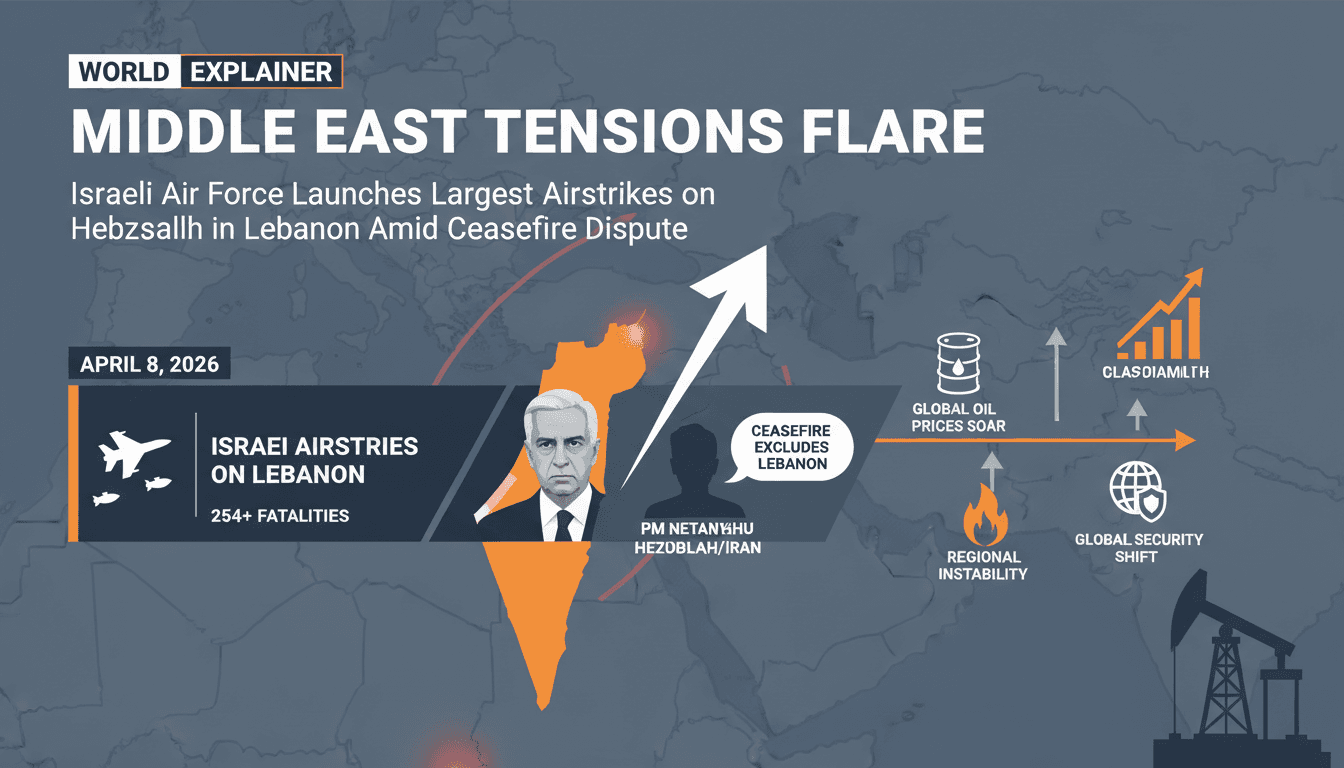
Here's what it means for you.
The latest military escalation in Lebanon could impact global oil prices and economic stability, affecting markets and industries worldwide.
Why it matters
This conflict highlights the fragility of Middle Eastern geopolitics and its direct influence on global energy markets.
What happened (in 30 seconds)
- On April 8, 2026, Israeli Prime Minister Netanyahu declared that a U.S.-Iran ceasefire agreement excluded Lebanon, leading to extensive airstrikes.
- The Israeli Defense Forces (IDF) deployed 50 fighter jets, dropping 160 bombs on 100 Hezbollah targets, resulting in at least 254 fatalities.
- The strikes have escalated tensions, with Iran closing the Strait of Hormuz in response, raising concerns over oil supply disruptions.
The context you actually need
- The 2026 Lebanon war resumed on March 2, 2026, following Hezbollah's attacks on northern Israel, escalating after a year of ceasefire violations.
- A U.S.-Israel-Iran ceasefire was announced on April 7-8, but disputes arose over its applicability to Lebanon, with Netanyahu asserting Hezbollah's actions warranted exclusion.
- Operation Eternal Darkness targeted key Hezbollah infrastructure, marking the deadliest day of the ongoing conflict and prompting international condemnation.
What's really happening
The recent airstrikes by Israel represent a significant escalation in the ongoing Lebanon war, which reignited after Hezbollah's projectiles were launched at northern Israel in early March 2026. This conflict is rooted in a complex web of regional tensions, particularly between Israel and Iran, which has supported Hezbollah militarily and politically. The U.S.-Iran ceasefire agreement, brokered by Pakistan, aimed to halt direct hostilities but did not encompass Lebanon, leading to Netanyahu's declaration that Hezbollah's actions justified continued military operations.
The Israeli airstrikes, executed with precision and speed, targeted critical Hezbollah command centers and military assets, reflecting Israel's strategy of preemptive strikes to neutralize perceived threats. The scale of the operation—50 jets and 160 bombs in just 10 minutes—underscores Israel's commitment to countering Hezbollah's military capabilities, which have been rebuilt over the years following previous conflicts and ceasefire violations.
The immediate aftermath saw a tragic toll, with over 250 fatalities and more than 1,100 injuries reported, including civilian casualties. This escalation has prompted a strong response from Hezbollah, which condemned the strikes and vowed to retaliate, potentially leading to further violence in the region. Iran's closure of the Strait of Hormuz in response to the strikes signifies a broader regional escalation, as this waterway is crucial for global oil shipments. The closure raises the specter of supply disruptions, which could lead to volatility in global oil prices, impacting economies worldwide, particularly those reliant on oil imports.
The international community's reaction has been swift, with calls for restraint and adherence to international law. The United Nations has urged all parties to cease hostilities and implement Resolution 1701, which aims to maintain peace and security in the region. However, the effectiveness of these calls remains uncertain, as the underlying tensions between Israel and Hezbollah, as well as the broader U.S.-Iran conflict, continue to simmer.
Who feels it first (and how)
- Oil markets: Fluctuations in oil prices due to supply concerns from the Strait of Hormuz closure.
- Middle Eastern economies: Countries reliant on oil exports may face economic instability.
- Global investors: Stock markets may react to geopolitical tensions, impacting investment strategies.
- Humanitarian organizations: Increased need for aid in Lebanon due to civilian casualties and displacement.
What to watch next
- Oil price movements: Monitor fluctuations in oil prices, particularly if tensions escalate further, as this could impact global markets.
- Hezbollah's response: Watch for any retaliatory actions from Hezbollah, which could lead to further military engagements.
- International diplomatic efforts: Observe the effectiveness of U.N. calls for ceasefire and how major powers respond to the evolving situation.
The airstrikes resulted in significant casualties and heightened tensions in the region.
Continued military operations and potential for further escalation in Lebanon and surrounding areas.
The long-term implications for U.S.-Iran relations and the effectiveness of international diplomatic efforts.
Frequently Asked Questions
- Why it matters?
- This conflict highlights the fragility of Middle Eastern geopolitics and its direct influence on global energy markets.
- What happened (in 30 seconds)?
- On April 8, 2026, Israeli Prime Minister Netanyahu declared that a U.S.-Iran ceasefire agreement excluded Lebanon, leading to extensive airstrikes. The Israeli Defense Forces (IDF) deployed 50 fighter jets, dropping 160 bombs on 100 Hezbollah targets, resulting in at least 254 fatalities. The strikes have escalated tensions, with Iran closing the Strait of Hormuz in response, raising concerns over oil supply disruptions.
- What's really happening?
- The recent airstrikes by Israel represent a significant escalation in the ongoing Lebanon war, which reignited after Hezbollah's projectiles were launched at northern Israel in early March 2026. This conflict is rooted in a complex web of regional tensions, particularly between Israel and Iran, which has supported Hezbollah militarily and politically. The U.S.-Iran ceasefire agreement, brokered by Pakistan, aimed to halt direct hostilities but did not encompass Lebanon, leading to Netanyahu's de
- Who feels it first (and how)?
- Oil markets: Fluctuations in oil prices due to supply concerns from the Strait of Hormuz closure. Middle Eastern economies: Countries reliant on oil exports may face economic instability. Global investors: Stock markets may react to geopolitical tensions, impacting investment strategies. Humanitarian organizations: Increased need for aid in Lebanon due to civilian casualties and displacement.
- What to watch next?
- Oil price movements: Monitor fluctuations in oil prices, particularly if tensions escalate further, as this could impact global markets. Hezbollah's response: Watch for any retaliatory actions from Hezbollah, which could lead to further military engagements. International diplomatic efforts: Observe the effectiveness of U.N. calls for ceasefire and how major powers respond to the evolving situation.
U.S. national news with a West Coast perspective.
"The Los Angeles Times is a major West Coast newspaper offering in-depth reporting with a liberal editorial tone and strong regional focus."
— A47 Editor
Netanyahu says ceasefire doesn't include Lebanon. Then 50 Israeli jets drop 160 bombs
Israeli Prime Minister Benjamin Netanyahu stated that the recent U.S.-brokered ceasefire does not apply to Lebanon, leading to a significant escalation in military operations as Israeli jets dropped 160 bombs on Hezbollah positions. This marks one of...
International news with cultural insight.
"The Los Angeles Times is a major West Coast newspaper offering in-depth reporting with a liberal editorial tone and strong regional focus."
— A47 Editor
Netanyahu says ceasefire doesn't include Lebanon. Then 50 Israeli jets drop 160 bombs
Israeli Prime Minister Benjamin Netanyahu stated that the recent U.S.-brokered ceasefire does not apply to Lebanon, leading to a significant escalation in military operations as Israeli jets dropped 160 bombs on Hezbollah positions. This marks one of...
Comprehensive coverage of Middle Eastern and global issues.
"Al Jazeera is a prominent voice from the Global South, especially the Middle East, with an emphasis on underreported stories."
— A47 Editor
Netanyahu: A ‘ceasefire with Iran will not include Hezbollah’
Israeli Prime Minister Benjamin Netanyahu stated that the recent ceasefire agreement between the United States and Iran will not include Hezbollah, following the announcement of a two-week truce aimed at de-escalating military tensions in the region.
Global news coverage with extensive reporting on Middle Eastern conflicts and geopolitics.
"Al Jazeera is a Qatar-based broadcaster known for wide regional coverage and alternative perspectives."
— A47 Editor
Netanyahu: A ‘ceasefire with Iran will not include Hezbollah’
Israeli Prime Minister Benjamin Netanyahu stated that the recent ceasefire agreement between the United States and Iran will not include Hezbollah, following the announcement of a two-week truce aimed at de-escalating military tensions in the region.
Focused political reporting and governmental affairs.
"NBC News is a mainstream media outlet known for comprehensive national and international news coverage with a centrist to slightly left-leaning editorial tone."
— A47 Editor
Israel Says Iran Ceasefire Agreement Does Not Apply to Lebanon
Following the announcement of a two-week ceasefire agreement between the United States and Iran, Israeli Prime Minister Benjamin Netanyahu confirmed that Israel would halt bombing operations in Iran but would continue military actions against Hezboll...
English-language reporting on Saudi politics, policy, and society.
"Saudi Gazette reflects mainstream Saudi institutional perspectives."
— A47 Editor
Israeli army renews strikes on southern Lebanon after Iran truce
Israel has resumed airstrikes on southern Lebanon, with Prime Minister Benjamin Netanyahu asserting that the recent US-Iran ceasefire agreement does not extend to Lebanon. The strikes follow a period of relative calm from Hezbollah, which has not con...
Global news coverage with extensive reporting on Middle Eastern conflicts and geopolitics.
"Al Jazeera is a Qatar-based broadcaster known for wide regional coverage and alternative perspectives."
— A47 Editor
Lebanon excluded from ceasefire as Israeli strikes continue
Israel has confirmed that the recent ceasefire agreement between the United States and Iran does not apply to Lebanon, where Israeli airstrikes continue unabated. This announcement comes amid escalating military operations in Lebanon, which have resu...
Comprehensive coverage of Middle Eastern and global issues.
"Al Jazeera is a prominent voice from the Global South, especially the Middle East, with an emphasis on underreported stories."
— A47 Editor
Lebanon excluded from ceasefire as Israeli strikes continue
Israel has confirmed that the recent ceasefire agreement between the United States and Iran does not apply to Lebanon, where Israeli airstrikes continue unabated. This announcement comes amid escalating military operations in Lebanon, which have resu...
UAE-based English-language newspaper covering regional politics, economics, and global affairs.
"The National reflects Emirati policy perspectives while maintaining international editorial standards."
— A47 Editor
Ceasefire does not include Lebanon, Netanyahu says
Israeli Prime Minister Benjamin Netanyahu has stated that the recent ceasefire agreement involving the United States and Iran does not extend to Lebanon, emphasizing ongoing military tensions in the region. This declaration comes amid Israel's milita...
Comprehensive coverage of Middle Eastern and global issues.
"Al Jazeera is a prominent voice from the Global South, especially the Middle East, with an emphasis on underreported stories."
— A47 Editor
Netanyahu says US-Iran ceasefire ‘does not include Lebanon’
Israeli Prime Minister Benjamin Netanyahu has welcomed the recent US decision to suspend military actions against Iran, while clarifying that this ceasefire does not extend to Lebanon. This statement comes amid heightened tensions in the region, part...
Global news coverage with extensive reporting on Middle Eastern conflicts and geopolitics.
"Al Jazeera is a Qatar-based broadcaster known for wide regional coverage and alternative perspectives."
— A47 Editor
Netanyahu says US-Iran ceasefire ‘does not include Lebanon’
Israeli Prime Minister Benjamin Netanyahu has welcomed the recent US decision to suspend military actions against Iran, while clarifying that this ceasefire does not extend to Lebanon. This statement comes amid heightened tensions in the region, part...