
European nations launch multinational mission for Strait of Hormuz navigation security
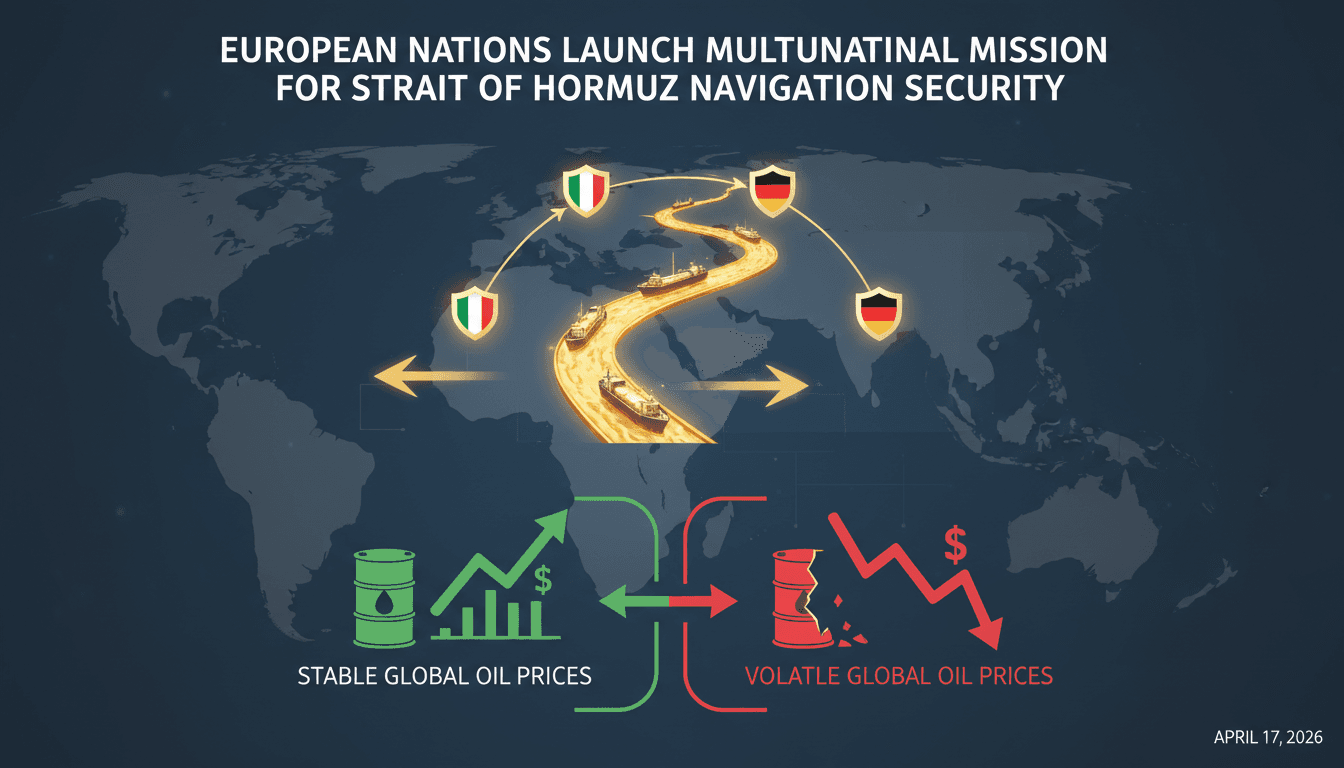
Here's what it means for you.
If you rely on global oil markets or maritime trade, the security of the Strait of Hormuz directly impacts your costs and supply chains.
Why it matters
The Strait of Hormuz is a critical chokepoint for global oil trade, with 21% of the world's petroleum passing through its waters.
What happened (in 30 seconds)
- On April 17, 2026, European leaders announced a defensive multinational mission to secure navigation in the Strait of Hormuz, involving over 50 nations.
- The initiative focuses on mine clearance and intelligence sharing amid a fragile ceasefire following Iran's conditional reopening of the strait after a U.S. naval blockade.
- Military planning is underway, with a conference scheduled in London for April 24, 2026, to finalize operational details.
The context you actually need
- The Strait of Hormuz crisis began on February 28, 2026, when U.S. and Israeli airstrikes on Iranian targets led to Iran's retaliation, including a blockade and attacks on vessels.
- This disruption halted approximately 20-25% of global seaborne oil trade, causing Brent crude prices to spike to $126 per barrel and Dubai crude to $166 per barrel.
- Failed diplomatic efforts resulted in a U.S. blockade of Iranian ports, prompting European nations to seek an independent framework for ensuring navigational freedom.
What's really happening
The recent announcement of a European-led multinational mission to secure the Strait of Hormuz is a direct response to escalating tensions and disruptions in one of the world's most vital maritime corridors. The Strait of Hormuz is not just a geographical feature; it is the artery through which approximately 21 million barrels of oil flow daily, representing 21% of global petroleum liquids consumption. The crisis began with U.S. and Israeli airstrikes on Iranian targets, which triggered Iran's aggressive military responses, including laying mines and attacking vessels, effectively halting non-Iranian shipping.
The European initiative, led by France, the UK, Germany, and Italy, aims to create a non-belligerent framework that reassures commercial operators while addressing the immediate threats posed by mines and hostile actions in the strait. This mission is open to all nations, emphasizing collective security and intelligence sharing. The planning phase is crucial, as it involves coordinating military assets and strategies among over 50 participating countries, including key Gulf states like Saudi Arabia and Qatar.
The economic implications of this mission are significant. The spike in oil prices due to the crisis has already strained global markets, and any further disruptions could exacerbate inflationary pressures worldwide. The mission's focus on mine clearance and escorting commercial vessels is designed to restore confidence in maritime trade routes, which is essential for stabilizing oil prices and ensuring the smooth flow of goods.
Moreover, the geopolitical landscape is shifting. The U.S. has maintained its blockade on Iranian ports, rejecting European assistance, which could lead to a more fragmented approach to security in the region. This divergence in strategy may create opportunities for other nations to assert influence, potentially complicating the already delicate balance of power in the Middle East.
As military planning advances toward the London conference, the stakes are high. The success of this multinational mission will depend on effective coordination and the willingness of participating nations to commit resources. The outcome will not only affect oil prices but also the broader dynamics of international trade and security in the region.
Who feels it first (and how)
- Oil companies: Increased operational costs and potential disruptions in supply chains.
- Shipping firms: Heightened risks and insurance costs for navigating the strait.
- Consumers: Potential increases in fuel prices and goods due to oil price volatility.
- Gulf states: Economic stability at risk due to reliance on oil exports and tourism.
- Investors: Market volatility affecting stock values, particularly in energy and trade sectors.
What to watch next
- Military conference outcomes: The decisions made at the London conference on April 24 will shape the operational framework and effectiveness of the mission.
- Iran's response: Watch for any escalations or retaliatory actions from Iran, particularly regarding the U.S. blockade and its control over the strait.
- Oil price trends: Monitor fluctuations in oil prices as the situation evolves, which will impact global markets and consumer costs.
The Strait of Hormuz is critical for global oil trade, with significant economic implications.
The multinational mission will face challenges in coordination and execution amid ongoing tensions.
The long-term effectiveness of the mission in ensuring navigational security and stabilizing oil prices.
Frequently Asked Questions
- Why it matters?
- The Strait of Hormuz is a critical chokepoint for global oil trade, with 21% of the world's petroleum passing through its waters.
- What happened (in 30 seconds)?
- On April 17, 2026, European leaders announced a defensive multinational mission to secure navigation in the Strait of Hormuz, involving over 50 nations. The initiative focuses on mine clearance and intelligence sharing amid a fragile ceasefire following Iran's conditional reopening of the strait after a U.S. naval blockade. Military planning is underway, with a conference scheduled in London for April 24, 2026, to finalize operational details.
- What's really happening?
- The recent announcement of a European-led multinational mission to secure the Strait of Hormuz is a direct response to escalating tensions and disruptions in one of the world's most vital maritime corridors. The Strait of Hormuz is not just a geographical feature; it is the artery through which approximately 21 million barrels of oil flow daily, representing 21% of global petroleum liquids consumption. The crisis began with U.S. and Israeli airstrikes on Iranian targets, which triggered Iran's a
- Who feels it first (and how)?
- Oil companies: Increased operational costs and potential disruptions in supply chains. Shipping firms: Heightened risks and insurance costs for navigating the strait. Consumers: Potential increases in fuel prices and goods due to oil price volatility. Gulf states: Economic stability at risk due to reliance on oil exports and tourism. Investors: Market volatility affecting stock values, particularly in energy and trade sectors.
- What to watch next?
- Military conference outcomes: The decisions made at the London conference on April 24 will shape the operational framework and effectiveness of the mission. Iran's response: Watch for any escalations or retaliatory actions from Iran, particularly regarding the U.S. blockade and its control over the strait. Oil price trends: Monitor fluctuations in oil prices as the situation evolves, which will impact global markets and consumer costs.
UAE-based English-language newspaper covering regional politics, economics, and global affairs.
"The National reflects Emirati policy perspectives while maintaining international editorial standards."
— A47 Editor
European Hormuz mission open to 'all nations' as leaders look to protect ships
The European Hormuz mission has been announced as open to participation from all nations, as leaders seek to enhance maritime security and protect shipping routes in the region. This initiative reflects a collaborative approach to address ongoing sec...
Regional and international reporting focused on Middle Eastern politics, diplomacy, and economics.
"Asharq Al-Awsat is a Saudi-owned international newspaper reflecting mainstream Gulf political perspectives."
— A47 Editor
Over a Dozen Countries Offer to Play Role in Hormuz Mission, Starmer Says
British Prime Minister Keir Starmer announced that over a dozen countries have expressed willingness to participate in a mission aimed at securing the Strait of Hormuz, a crucial maritime route for global oil shipments. This initiative comes amid ris...