
OpenAI Enhances Codex with Agentic Capabilities to Compete with Anthropic
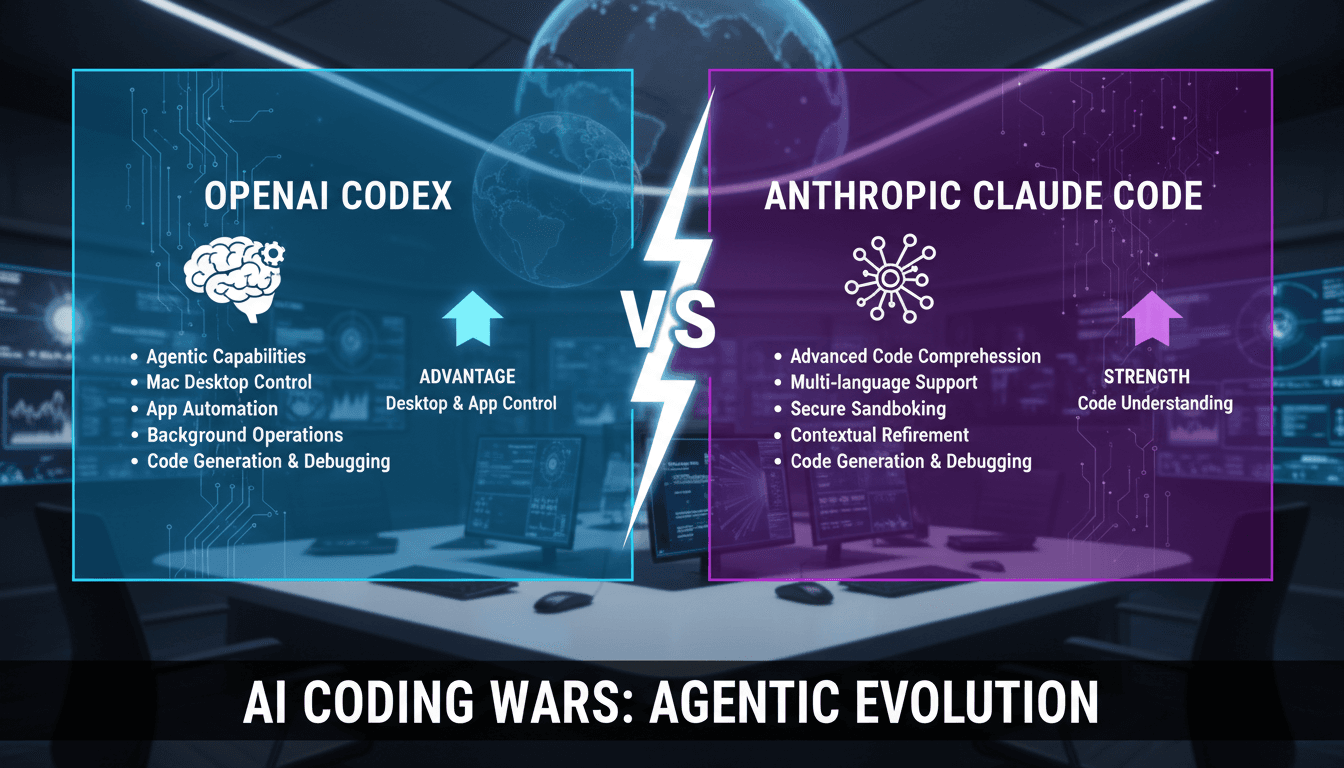
Here's what it means for you.
As a developer, this upgrade could significantly enhance your productivity and coding efficiency.
Why it matters
The competition between OpenAI and Anthropic is reshaping the landscape of enterprise AI tools, impacting how developers interact with coding assistants.
What happened (in 30 seconds)
- OpenAI released a major update to its Codex AI coding assistant on April 16, 2026, introducing agentic capabilities for Mac desktops.
- The update allows Codex to control apps in the background, manipulate cursors, and deploy multiple parallel agents, enhancing its functionality.
- This move positions Codex as a direct competitor to Anthropic's Claude Code, which recently gained traction with similar features.
The context you actually need
- Anthropic's Claude Code recently redesigned its desktop app, emphasizing remote desktop control and parallel sessions, which spurred OpenAI's response.
- OpenAI's Codex now integrates with over 90 plugins and features memory for context retention, making it more versatile for developers.
- The enterprise AI coding market is rapidly evolving, with both companies vying for dominance as consumer AI faces challenges.
What's really happening
The recent update to OpenAI's Codex reflects a strategic response to the competitive pressures exerted by Anthropic's Claude Code. As both companies push the boundaries of agentic AI capabilities, the focus has shifted toward enhancing user experience and operational efficiency in coding environments. OpenAI's Codex now boasts the ability to operate applications in the background, which allows developers to multitask effectively without switching contexts. This feature is particularly valuable in fast-paced development settings where time is of the essence.
The integration of over 90 plugins, including popular tools like GitLab and Microsoft Suite, further enhances Codex's utility. Developers can now automate tasks across various platforms, streamlining workflows and reducing the cognitive load associated with managing multiple applications. The introduction of a native in-app browser for web development also signifies a shift towards a more integrated coding environment, where developers can seamlessly transition between coding and testing.
Moreover, the memory feature allows Codex to retain context from previous interactions, enabling personalized suggestions and automations. This capability not only improves the user experience but also positions Codex as a more intelligent assistant that learns and adapts to individual developer needs over time.
The competitive landscape is intensifying, with both OpenAI and Anthropic making significant investments in their respective AI coding tools. As Codex rolls out its new features, it is likely to attract a larger user base, particularly among the 3 million weekly active developers already utilizing its capabilities. The rivalry between these two firms is not just about technological advancements; it also reflects a broader trend in the enterprise AI sector, where companies are increasingly seeking tools that enhance productivity and collaboration.
As the market evolves, developers will benefit from the innovations driven by this competition. The enhancements to Codex are indicative of a larger shift towards more capable and intelligent coding assistants, which could redefine how software development is approached in the coming years.
Who feels it first (and how)
- Developers: Increased productivity and efficiency through enhanced coding tools.
- Tech companies: Competitive pressure to adopt or develop similar AI capabilities.
- Freelancers: Potential for improved project turnaround times and client satisfaction.
- Enterprises: Opportunities for streamlined workflows and reduced operational costs.
What to watch next
- User adoption rates: Monitoring how quickly developers embrace the new Codex features will indicate its market impact.
- Competitive responses from Anthropic: Any new features or updates from Claude Code could shift the balance in the enterprise AI coding market.
- Integration with emerging technologies: Watch for how Codex and similar tools adapt to incorporate advancements in AI and machine learning.
OpenAI's Codex has been updated with significant new features.
Increased competition will drive further innovations in AI coding tools.
The long-term market share dynamics between OpenAI and Anthropic remain to be seen.
Frequently Asked Questions
- Why it matters?
- The competition between OpenAI and Anthropic is reshaping the landscape of enterprise AI tools, impacting how developers interact with coding assistants.
- What happened (in 30 seconds)?
- OpenAI released a major update to its Codex AI coding assistant on April 16, 2026, introducing agentic capabilities for Mac desktops. The update allows Codex to control apps in the background, manipulate cursors, and deploy multiple parallel agents, enhancing its functionality. This move positions Codex as a direct competitor to Anthropic's Claude Code, which recently gained traction with similar features.
- What's really happening?
- The recent update to OpenAI's Codex reflects a strategic response to the competitive pressures exerted by Anthropic's Claude Code. As both companies push the boundaries of agentic AI capabilities, the focus has shifted toward enhancing user experience and operational efficiency in coding environments. OpenAI's Codex now boasts the ability to operate applications in the background, which allows developers to multitask effectively without switching contexts. This feature is particularly valuable i
- Who feels it first (and how)?
- Developers: Increased productivity and efficiency through enhanced coding tools. Tech companies: Competitive pressure to adopt or develop similar AI capabilities. Freelancers: Potential for improved project turnaround times and client satisfaction. Enterprises: Opportunities for streamlined workflows and reduced operational costs.
- What to watch next?
- User adoption rates: Monitoring how quickly developers embrace the new Codex features will indicate its market impact. Competitive responses from Anthropic: Any new features or updates from Claude Code could shift the balance in the enterprise AI coding market. Integration with emerging technologies: Watch for how Codex and similar tools adapt to incorporate advancements in AI and machine learning.
Startup news with frequent AI coverage.
"Covers launches, funding, and product updates in AI."
— A47 Editor
OpenAI takes aim at Anthropic with beefed-up Codex that gives it more power over your desktop
OpenAI has significantly upgraded its Codex tool, enhancing its capabilities to function as an always-on coding agent that can autonomously control a desktop, generate images, and remember user preferences. This transformation positions Codex as a mo...
Focuses on transformative tech, AI, gaming, and startup innovation.
"VentureBeat is respected for its in-depth reporting on AI, startups, and disruptive technologies in Silicon Valley and beyond."
— A47 Editor
OpenAI drastically updates Codex desktop app to use all other apps on your computer, generate images, preview webpages
OpenAI has announced a significant update to its Codex desktop application, enabling it to interact with all other applications on users' computers, generate images, and preview webpages. This update aims to transform Codex into a comprehensive 'Supe...
Daily AI news: models, tools, and policy.
"Independent outlet tracking the fast pace of AI."
— A47 Editor
OpenAI turns Codex into an always-on coding agent that watches your screen
OpenAI has significantly upgraded its Codex tool, transforming it into an always-on coding agent capable of autonomously controlling a Mac, generating images, and remembering user preferences for extended periods. This enhancement positions Codex as ...
Curated tech headlines including AI stories.
"Influential aggregator surfacing the day’s top tech/AI links."
— A47 Editor
OpenAI updates its Codex desktop app with features like computer control, an in-app browser, image generation, automation memory, plugin support, and more (David Gewirtz/ZDNET)
OpenAI has updated its Codex desktop application, introducing features such as computer control, an in-app browser, image generation, automation memory, and plugin support, thereby expanding its capabilities beyond coding into full productivity workf...
Business tech news, enterprise IT, and innovation analysis.
"ZDNet offers enterprise IT news, reviews, and strategy guidance."
— A47 Editor
OpenAI's Codex Desktop can run your computer now - and has its own browser
OpenAI has launched Codex Desktop, a new tool that extends the capabilities of its coding application by allowing users to control their computers, automate tasks, and utilize plugins, marking a significant evolution from a coding tool to a comprehen...
Latest tech news, product reviews, and analysis for consumers and professionals.
"CNET delivers accessible and detailed technology reporting, including trusted product reviews and how-to guides."
— A47 Editor
These New Codex Updates Are the 'First Phase' of OpenAI's Dream Super App
OpenAI has announced significant updates to its Codex coding tool, marking the initial phase of its vision for a comprehensive super app that can operate multiple agents across various applications on users' computers. This enhancement allows Codex t...
Covers consumer technology, electronics, gadgets, and product reviews.
"Engadget is a trusted source for gadget reviews and consumer tech news, known for its hands-on analysis and industry coverage."
— A47 Editor
OpenAI's latest Codex update builds the groundwork for its upcoming super app
OpenAI has confirmed its development of a desktop super app that will integrate ChatGPT, the Codex coding agent, and the Atlas web browser into a single platform, enhancing user experience and accessibility. This announcement follows previous reports...
Consumer technology news with AI coverage.
"Gadget and tech site reporting on AI in products."
— A47 Editor
OpenAI's latest Codex update builds the groundwork for its upcoming super app
OpenAI has confirmed its development of a desktop super app that will integrate ChatGPT, the Codex coding agent, and the Atlas web browser into a single platform, enhancing user experience and accessibility. This announcement follows previous reports...