
Trump's military campaign against Iran reshapes Middle East alliances and economic dynamics
Here's what it means for you.
The ongoing conflict and its economic fallout could reshape energy prices and geopolitical stability, impacting global markets.
Why it matters
The conflict is realigning Middle Eastern alliances and affecting global oil supply chains, which could lead to higher energy costs for consumers worldwide.
What happened (in 30 seconds)
- U.S. and Israeli forces launched aerial strikes on Iran on February 28, 2026, targeting its nuclear program.
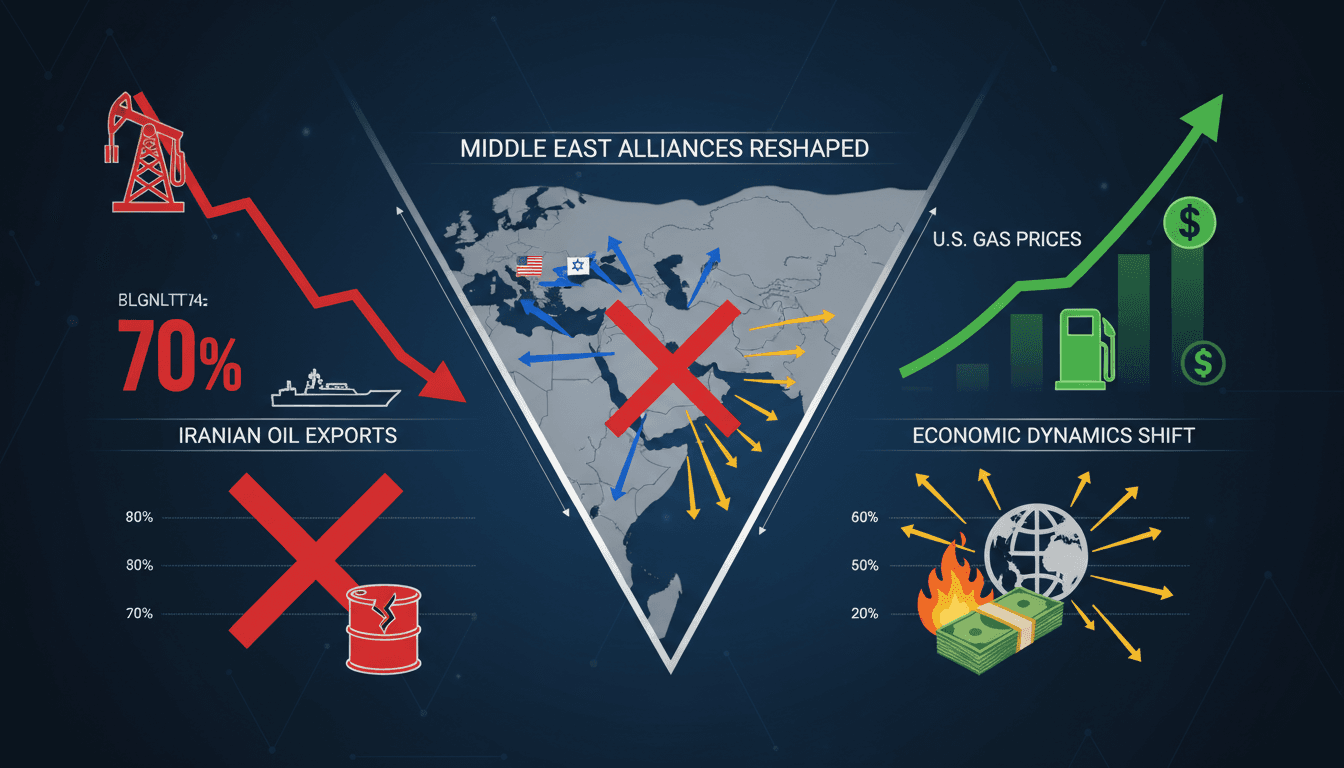
- Iran's oil exports plummeted by 70% due to a U.S. naval blockade, severely disrupting its economy.
- Peace talks mediated by Pakistan are stalled, despite a temporary ceasefire established in April 2026.
The context you actually need
- Preceding tensions escalated after President Trump set a 60-day deadline for nuclear negotiations, leading to military action when Iran did not comply.
- Iran retaliated by closing the Strait of Hormuz and launching drone strikes, prompting the U.S. to enforce a naval blockade.
- Regional dynamics shifted as Gulf states like the UAE and Saudi Arabia adjusted their diplomatic and economic strategies, including the UAE's exit from OPEC.
What's really happening
The conflict initiated by President Trump's military actions against Iran has profound implications for the geopolitical landscape of the Middle East. The U.S. and Israel's coordinated strikes on Iranian nuclear facilities were a direct response to Iran's non-compliance with nuclear negotiations, which had been a point of contention since late 2025. The military buildup preceding the strikes indicated a serious commitment to curtail Iran's nuclear ambitions, but it also set off a chain reaction of retaliatory measures from Iran.
Iran's immediate response included closing the Strait of Hormuz, a critical chokepoint for global oil shipments, and launching drone attacks on UAE facilities. This escalation prompted the U.S. to impose a naval blockade, which has drastically reduced Iranian oil exports from 1.85 million barrels per day in March to just 567,000 barrels per day. The blockade not only aims to cripple Iran's economy but also serves as a strategic maneuver to pressure Tehran into compliance with international demands regarding its nuclear program.
The economic ramifications are significant. The blockade has forced Iran to rely on alternative methods for oil transportation, such as rail shipments to China and floating storage, which are less efficient and more costly. Meanwhile, the U.S. has seen a spike in gasoline prices, surpassing $4 per gallon, reflecting the interconnectedness of global oil markets. The UAE's withdrawal from OPEC and Saudi Arabia's funding cuts for initiatives like LIV Golf further illustrate the shifting alliances and priorities in the region.
As the conflict continues, the humanitarian toll is also rising, with over 2,000 casualties reported among Hezbollah militants and civilians. The ongoing ceasefire, mediated by Pakistan, has provided a temporary respite, but peace talks remain stalled, indicating a complex and protracted conflict ahead. The situation is fluid, with Gulf states exploring alternative oil export routes to mitigate reliance on the Strait of Hormuz, which could reshape energy dynamics in the region.
Who feels it first (and how)
- Consumers: Higher gasoline prices impact daily commuting and transportation costs.
- Oil-dependent economies: Countries reliant on Iranian oil exports face economic strain and potential recession.
- Tourism and retail sectors: In Dubai, slashed tourism and canceled bookings lead to reduced spending and economic slowdown.
- Expat families: Relocations due to schooling issues affect local economies and community stability.
What to watch next
- Iran's economic resilience: Monitor how Iran adapts to the blockade and its impact on global oil prices.
- U.S. gasoline prices: Watch for fluctuations in fuel costs as the conflict evolves and supply chains are affected.
- Gulf state alliances: Observe how regional powers continue to realign diplomatically and economically in response to the ongoing conflict.
Iranian oil exports have declined by 70% due to the blockade.
Continued economic strain on Iran will lead to further regional realignments among Gulf states.
The long-term effectiveness of the U.S. blockade in achieving its strategic goals remains uncertain.
This article was generated by AI from 10 verified sources and reviewed by A47 editorial systems.
Right-of-center views on political news.
"The Washington Times is a conservative-leaning newspaper known for its political coverage and advocacy of right-of-center viewpoints."
— A47 Editor
While peace talks dawdle, Trump's war on Iran is transforming the Middle East
President Trump's ongoing military actions against Iran are significantly altering the geopolitical landscape of the Gulf region, particularly through a stringent U.S. naval blockade that is crippling Iran's oil economy and prompting the United Arab ...
International news coverage curated for readers in the UAE and Gulf region.
"Emirates 24|7 world coverage presents global developments through a UAE-facing and Gulf-relevant editorial lens."
— A47 Editor
Trump holds talks on prolonged Iran blockade, urges Tehran to reach a deal Trump holds talks on prolonged Iran blockade, urges Tehran to reach a deal
Donald Trump held discussions with oil executives regarding a potential prolonged blockade of Iran's ports, emphasizing the need for Tehran to reach a deal amid ongoing tensions and a deadlock in negotiations. The U.S. aims to restrict Iran's oil exp...
Arabic-language reporting focused on domestic developments in Saudi Arabia.
"Okaz is a mainstream Saudi newspaper that often reflects domestic priorities and official-facing coverage."
— A47 Editor
إستراتيجية ترمب الجديدة
The Middle East is currently in a state of ambiguity, characterized by neither true peace nor full-scale war, but rather a prolonged management of crisis. Reports indicate that President Donald Trump has instructed his aides to prepare for a prolonge...
Regional coverage and analysis focused on politics, diplomacy, and business across the Middle East.
"Al-Monitor is known for analytical reporting on Middle East politics and policy developments."
— A47 Editor
Trump urges Iran to sign a deal and discusses prolonged blockade
U.S. President Donald Trump has urged Iran to sign a deal and discussed the potential impact of a prolonged blockade on its ports during talks with U.S. oil companies. This comes amid ongoing tensions and a deadlock in diplomatic negotiations, as the...
Arabic-language political and world news coverage for UAE readers.
"Emarat Al Youm world coverage usually presents international developments through a UAE and Arab audience lens."
— A47 Editor
ترامب يلتقي كبار المسؤولين التنفيذيين في شركات النفط لبحث تداعيات الحصار على إيران ترامب يلتقي كبار المسؤولين التنفيذيين في شركات النفط لبحث تداعيات الحصار على إيران
U.S. President Donald Trump met with senior oil executives at the White House to discuss the implications of the ongoing blockade on Iran. This meeting highlights the administration's focus on energy markets and the potential impact of U.S. sanctions...
International coverage of politics, security, and social issues.
"Global News is a mainstream Canadian outlet with a centrist editorial stance, focusing on factual reporting."
— A47 Editor
‘No more Mr. Nice Guy’: Trump threatens Iran as war enters 3rd month
Tensions between the United States and Iran have escalated as President Trump threatens military action, claiming Iran is in a 'state of collapse' while peace talks remain stalled. Trump's rejection of Iran's peace proposal has further complicated th...
News from the United States including domestic politics, society, and culture.
"Global News is a mainstream Canadian media outlet generally considered to have a centrist editorial stance, covering news with a focus on factual reporting and national interest."
— A47 Editor
‘No more Mr. Nice Guy’: Trump threatens Iran as war enters 3rd month
Tensions between the United States and Iran have escalated as President Trump threatens military action, claiming Iran is in a 'state of collapse' while peace talks remain stalled. Trump's rejection of Iran's peace proposal has further complicated th...
English-language reporting on Saudi politics, policy, and society.
"Saudi Gazette reflects mainstream Saudi institutional perspectives."
— A47 Editor
Oil prices extend rally as Trump issues new threat to Iran amid stalled talks
Oil prices have continued to rise as U.S. President Donald Trump issued a new warning to Iran, stating that Tehran must act wisely soon, amid stalled negotiations to resolve ongoing hostilities. The price of Brent crude oil rose by 3% to $114.64 per ...
Regional coverage and analysis focused on politics, diplomacy, and business across the Middle East.
"Al-Monitor is known for analytical reporting on Middle East politics and policy developments."
— A47 Editor
War in the Middle East: latest developments
U.S. President Donald Trump has instructed national security officials to prepare for a prolonged blockade of Iran's ports, aiming to pressure Tehran into abandoning its nuclear program. This follows Trump's skepticism regarding Iran's willingness to...
Comprehensive coverage of Middle Eastern and global issues.
"Al Jazeera is a prominent voice from the Global South, especially the Middle East, with an emphasis on underreported stories."
— A47 Editor
Iran war: What’s happening on day 61 as UAE exits OPEC?
On day 61 of the ongoing Iran war, U.S. President Donald Trump stated that Iran is in a 'state of collapse' as Gulf leaders convene in Saudi Arabia. This meeting occurs against the backdrop of heightened tensions and ongoing military conflict involvi...
Global news coverage with extensive reporting on Middle Eastern conflicts and geopolitics.
"Al Jazeera is a Qatar-based broadcaster known for wide regional coverage and alternative perspectives."
— A47 Editor
Iran war: What’s happening on day 61 as UAE exits OPEC?
On day 61 of the ongoing Iran war, U.S. President Donald Trump stated that Iran is in a 'state of collapse' as Gulf leaders convene in Saudi Arabia. This meeting occurs against the backdrop of heightened tensions and ongoing military conflict involvi...
Editor-curated FT homepage stories spanning markets, business, world, and opinion.
"The Financial Times is a globally respected business publication with a centrist/center-left tone and strong markets focus."
— A47 Editor
The great commodities disruption
The ongoing conflict between the U.S. and Iran has escalated, with President Trump preparing for a prolonged blockade of Iran amid stalled negotiations. This situation has resulted in significant disruptions to energy supplies and has raised oil pric...