
Netanyahu Asserts Israel Ready to Resume Military Action Against Iran Amid Ceasefire
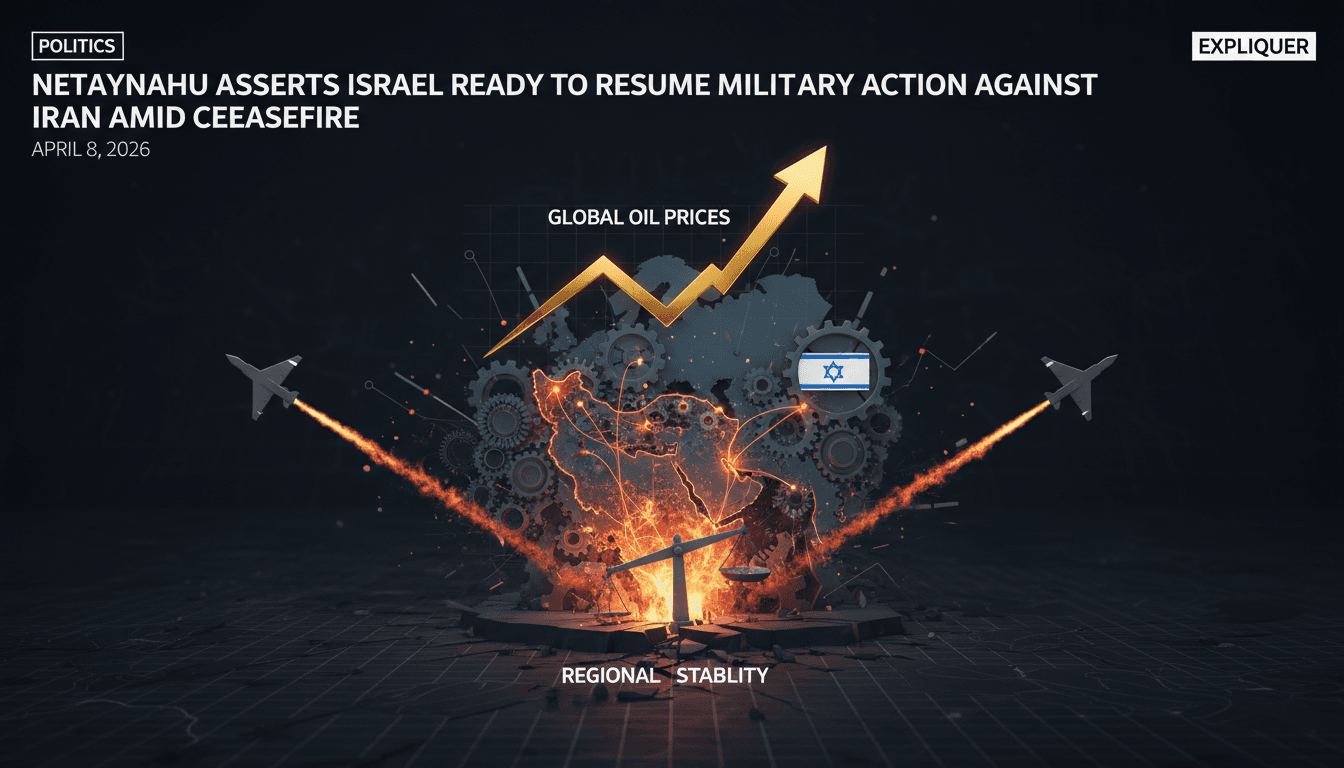
Here's what it means for you.
If you rely on oil or travel in the Middle East, prepare for potential disruptions and rising costs.
Why it matters
The ongoing conflict could destabilize oil markets, impacting global prices and economic conditions.
What happened (in 30 seconds)
- Netanyahu announced Israel's readiness to resume military operations against Iran despite a U.S.-brokered ceasefire.
- The ceasefire, effective from April 7, aims to de-escalate tensions but leaves Israel's military objectives unresolved.
- U.S.-Israeli strikes have reportedly resulted in over 2,000 Iranian casualties, escalating the conflict significantly.
The context you actually need
- The conflict escalated following a U.S.-Israeli military campaign targeting Iranian nuclear facilities and proxy forces, initiated in February 2026.
- Iran responded with missile attacks on Gulf states, further straining regional stability and prompting Israeli military action.
- The ceasefire was brokered partly to reopen the Strait of Hormuz, a critical oil shipping route, amid rising global oil prices.
What's really happening
On April 8, 2026, Israeli Prime Minister Benjamin Netanyahu delivered a stark message regarding Israel's military posture towards Iran. In his televised address, he emphasized that while a two-week ceasefire, mediated by the U.S., is currently in effect, Israel remains poised to resume combat operations at any moment. This declaration is not just rhetoric; it reflects a complex web of military, political, and economic factors that have been intensifying over the past few months.
The ceasefire was established after a series of U.S.-Israeli strikes against Iranian targets, which began in late February 2026. These operations aimed to dismantle Iran's nuclear infrastructure and disrupt its proxy networks in Lebanon and Syria. The strikes have reportedly resulted in 2,076 deaths in Iran, according to Al Jazeera, highlighting the severity of the conflict. The U.S. has played a pivotal role in this escalation, with President Donald Trump imposing a deadline that led to the temporary truce. However, Netanyahu's assertion that Israel is ready to return to combat underscores the fragility of this ceasefire.
Netanyahu's address also included a summary of Israel's military achievements, such as the destruction of missile factories and the elimination of thousands of Iranian Revolutionary Guard Corps (IRGC) operatives. He characterized the ceasefire as coordinated but incomplete, stating, "Our finger remains on the trigger." This statement signals that Israel's military objectives extend beyond merely halting operations; they aim to fundamentally alter Iran's military capabilities and influence in the region.
The implications of this situation are profound. The ongoing conflict not only threatens regional stability but also has significant repercussions for global oil markets. With oil prices already surging toward $110 per barrel due to concerns over the Strait of Hormuz, any resumption of hostilities could exacerbate these increases, affecting economies worldwide. Furthermore, the conflict's impact on travel and logistics in the Middle East, particularly in Dubai, is likely to be felt as airlines may face operational challenges and rising fuel costs.
Who feels it first (and how)
- Travelers in the Middle East: Increased flight cancellations and fare hikes due to jet fuel shortages.
- Oil market stakeholders: Rising prices affecting profitability and operational costs.
- Residents of Dubai: Higher petrol prices and potential disruptions in daily commuting and travel plans.
What to watch next
- Oil price fluctuations: Watch for changes in oil prices, which could signal shifts in market stability and economic conditions.
- Military actions: Monitor any Israeli military operations against Iranian targets, as these could escalate tensions further.
- Diplomatic efforts: Keep an eye on U.S. diplomatic initiatives aimed at de-escalating the conflict, which could influence regional stability.
The ceasefire is in effect, but Israel retains military objectives against Iran.
Oil prices will continue to rise if tensions escalate or military actions resume.
The long-term effectiveness of U.S. diplomatic efforts to stabilize the region remains uncertain.
Frequently Asked Questions
- Why it matters?
- The ongoing conflict could destabilize oil markets, impacting global prices and economic conditions.
- What happened (in 30 seconds)?
- Netanyahu announced Israel's readiness to resume military operations against Iran despite a U.S.-brokered ceasefire. The ceasefire, effective from April 7, aims to de-escalate tensions but leaves Israel's military objectives unresolved. U.S.-Israeli strikes have reportedly resulted in over 2,000 Iranian casualties, escalating the conflict significantly.
- What's really happening?
- On April 8, 2026, Israeli Prime Minister Benjamin Netanyahu delivered a stark message regarding Israel's military posture towards Iran. In his televised address, he emphasized that while a two-week ceasefire, mediated by the U.S., is currently in effect, Israel remains poised to resume combat operations at any moment. This declaration is not just rhetoric; it reflects a complex web of military, political, and economic factors that have been intensifying over the past few months. The ceasefire w
- Who feels it first (and how)?
- Travelers in the Middle East: Increased flight cancellations and fare hikes due to jet fuel shortages. Oil market stakeholders: Rising prices affecting profitability and operational costs. Residents of Dubai: Higher petrol prices and potential disruptions in daily commuting and travel plans.
- What to watch next?
- Oil price fluctuations: Watch for changes in oil prices, which could signal shifts in market stability and economic conditions. Military actions: Monitor any Israeli military operations against Iranian targets, as these could escalate tensions further. Diplomatic efforts: Keep an eye on U.S. diplomatic initiatives aimed at de-escalating the conflict, which could influence regional stability.
Arabic-language UAE newspaper coverage focused on domestic affairs, public institutions, business, society, and regional developments.
"Al Khaleej coverage generally reflects a mainstream UAE editorial lens with strong attention to public affairs, institutions, and regional developments."
— A47 Editor
نتنياهو: إسرائيل مستعدة «للعودة إلى القتال في أي لحظة» ضد إيران
Israeli Prime Minister Benjamin Netanyahu stated on Wednesday that Israel remains prepared to confront Iran if necessary, despite a ceasefire agreement reached between Washington and Tehran. This declaration underscores Israel's ongoing concerns rega...
Pan-Arab news coverage spanning politics, business, sports, and regional affairs.
"Asharq Al-Awsat reflects a broad Arab editorial perspective with strong attention to regional geopolitics."
— A47 Editor
نتنياهو: مستعدون للعودة للقتال في أي وقت... وهذه ليست نهاية المعركة
Israeli Prime Minister Benjamin Netanyahu has indicated the possibility of resuming combat at any time, stating that the current situation is not the end of the battle. This statement reflects ongoing tensions and the readiness of Israel to engage mi...