
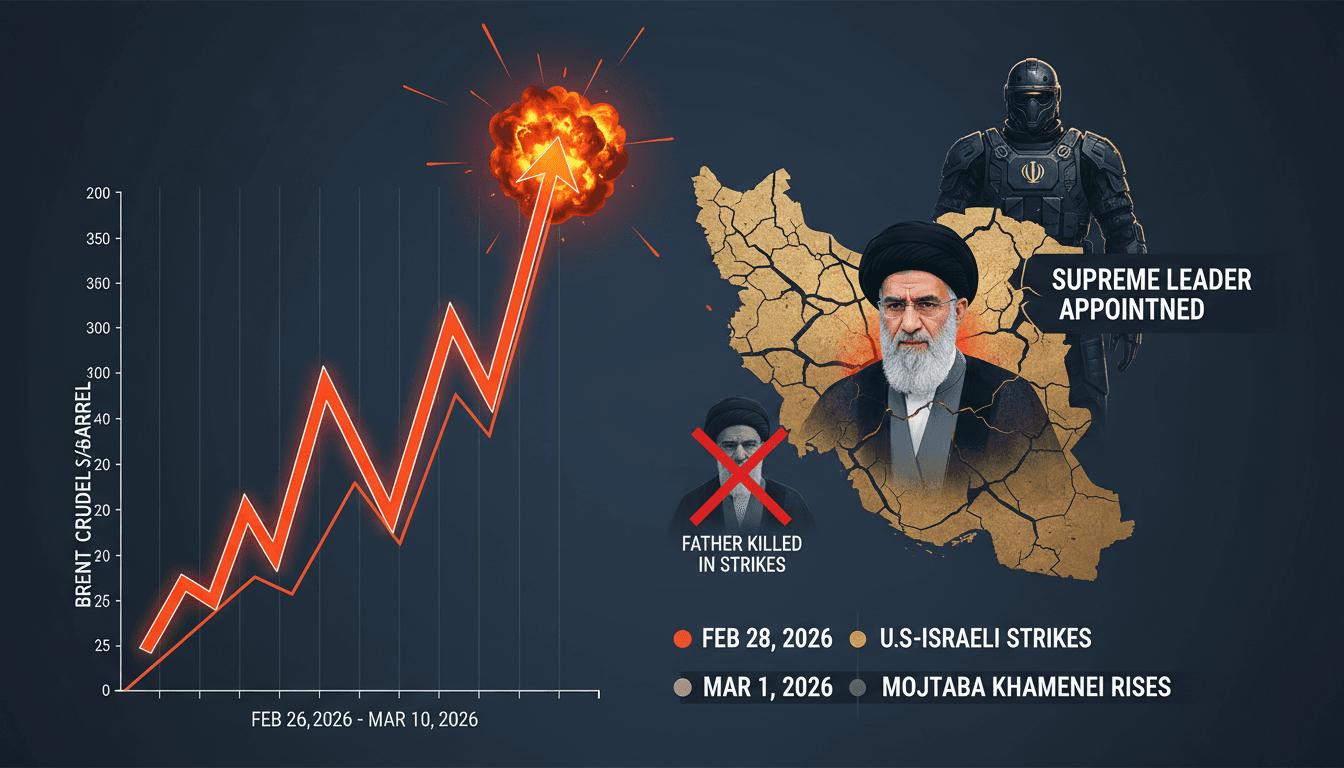
Mojtaba Khamenei appointed Supreme Leader of Iran following U.S.-Israeli strikes that killed his father and top officials
Here's what it means for you.
Rising oil prices and regional instability could significantly impact your cost of living and investment strategies.
Why it matters
The ongoing conflict in Iran threatens global oil supply chains, directly affecting energy prices and economic stability worldwide.
What happened (in 30 seconds)
- U.S. and Israeli airstrikes on February 28, 2026, killed Iran's Supreme Leader Ali Khamenei and several top officials, destabilizing the regime.
- Mojtaba Khamenei, the slain leader's son, was appointed as the new Supreme Leader on March 9, 2026, amid a power struggle dominated by the IRGC.
- The war continues, with ongoing strikes and a consolidated IRGC influence over Iran's strategic decision-making.
The context you actually need
- Iran's Islamic Republic operates under a theocratic system that has historically shown resilience against leadership losses, as seen during the Iran-Iraq War.
- Escalating tensions between the U.S. and Israel over Iran's nuclear ambitions and regional activities led to the preemptive strikes that decimated the leadership.
- The IRGC's growing power signifies a shift in Iran's governance, with hardliners gaining influence and moderates sidelined in the wake of the attacks.
What's really happening
On February 28, 2026, a coordinated U.S.-Israeli airstrike targeted a senior leadership meeting in Tehran, resulting in the deaths of Supreme Leader Ayatollah Ali Khamenei and over 25 top officials, including key military and security figures. The immediate aftermath saw a temporary three-man council assume control, but the IRGC quickly consolidated power, leading to the appointment of Mojtaba Khamenei as the new Supreme Leader on March 9. This transition reflects the IRGC's influence, as they have been pivotal in shaping Iran's military and strategic responses amid the ongoing conflict.
The IRGC's dominance is evident in their swift actions to eliminate potential successors and maintain a hardline stance against perceived threats. For instance, President Masoud Pezeshkian's conciliatory remarks towards Gulf states were retracted under IRGC pressure, illustrating the military's control over political discourse. The situation has forced Parliament Speaker Mohammad Baqer Qalibaf to engage in negotiations with the U.S., indicating a potential shift in Iran's foreign policy approach, albeit under duress.
The ongoing war has led to significant volatility in global oil markets, with prices surging over 50% since the strikes, now exceeding $80 per barrel. This increase is primarily due to fears of supply disruptions through the Strait of Hormuz, a critical chokepoint for global oil transit. As a result, residents in Dubai and other nearby regions are experiencing rising fuel costs, supply hoarding, and increased living expenses. The IRGC's consolidation of power and the ongoing conflict have created an environment of uncertainty, making it difficult to predict the long-term implications for both Iran and the broader Middle East.
Despite the chaos, Iranian state media continues to portray Mojtaba Khamenei as a 'wounded veteran,' emphasizing the regime's resilience. However, the reality is that the IRGC's grip on power is tightening, and the political landscape is shifting towards a more militarized governance structure. This could have lasting effects on Iran's internal stability and its relations with neighboring countries, particularly those in the Gulf region.
Who feels it first (and how)
- Energy sector professionals: Increased oil prices directly impact job security and operational costs.
- Consumers in Dubai: Rising fuel prices lead to higher living costs, affecting daily expenses and purchasing power.
- Investors: Market volatility and geopolitical instability may alter investment strategies, particularly in energy and real estate.
What to watch next
- Oil price fluctuations: Continued volatility could signal further economic strain on consumers and businesses.
- IRGC's strategic decisions: Watch for shifts in military engagement and foreign policy as the IRGC consolidates power.
- International negotiations: Any developments in U.S.-Iran talks could reshape regional dynamics and impact global markets.
The IRGC has consolidated power in Iran following the leadership crisis.
Oil prices will remain volatile due to ongoing conflict and supply chain concerns.
The long-term stability of Mojtaba Khamenei's leadership and its implications for Iran's governance.
Frequently Asked Questions
- Why it matters?
- The ongoing conflict in Iran threatens global oil supply chains, directly affecting energy prices and economic stability worldwide.
- What happened (in 30 seconds)?
- U.S. and Israeli airstrikes on February 28, 2026, killed Iran's Supreme Leader Ali Khamenei and several top officials, destabilizing the regime. Mojtaba Khamenei, the slain leader's son, was appointed as the new Supreme Leader on March 9, 2026, amid a power struggle dominated by the IRGC. The war continues, with ongoing strikes and a consolidated IRGC influence over Iran's strategic decision-making.
- What's really happening?
- On February 28, 2026, a coordinated U.S.-Israeli airstrike targeted a senior leadership meeting in Tehran, resulting in the deaths of Supreme Leader Ayatollah Ali Khamenei and over 25 top officials, including key military and security figures. The immediate aftermath saw a temporary three-man council assume control, but the IRGC quickly consolidated power, leading to the appointment of Mojtaba Khamenei as the new Supreme Leader on March 9. This transition reflects the IRGC's influence, as they h
- Who feels it first (and how)?
- Energy sector professionals: Increased oil prices directly impact job security and operational costs. Consumers in Dubai: Rising fuel prices lead to higher living costs, affecting daily expenses and purchasing power. Investors: Market volatility and geopolitical instability may alter investment strategies, particularly in energy and real estate.
- What to watch next?
- Oil price fluctuations: Continued volatility could signal further economic strain on consumers and businesses. IRGC's strategic decisions: Watch for shifts in military engagement and foreign policy as the IRGC consolidates power. International negotiations: Any developments in U.S.-Iran talks could reshape regional dynamics and impact global markets.
Regional coverage and analysis focused on politics, diplomacy, and business across the Middle East.
"Al-Monitor is known for analytical reporting on Middle East politics and policy developments."
— A47 Editor
Explainer-With top figures dead, who is now running Iran?
A series of U.S.-Israeli strikes has resulted in the deaths of Iran's supreme leader and several high-ranking officials, including Revolutionary Guards commanders, leading to a significant upheaval in the country's leadership. Despite these losses, t...
Oil, metals, and agriculture: supply/demand headlines, OPEC chatter, inventories, and price action.
"Solid tape for energy and metals traders tracking macro and micro catalysts."
— A47 Editor
Explainer-With top figures dead, who is now running Iran?
Following the deaths of key figures in Iran, the political landscape is shifting, raising questions about who will assume leadership roles in the country. The ongoing turmoil has left a power vacuum that could lead to significant changes in governanc...
Global news coverage with extensive reporting on Middle Eastern conflicts and geopolitics.
"Al Jazeera is a Qatar-based broadcaster known for wide regional coverage and alternative perspectives."
— A47 Editor
Who’s left running Iran?
The recent wave of assassinations targeting key Iranian leaders, including Supreme Leader Ayatollah Ali Khamenei and security chief Ali Larijani, has significantly destabilized Iran's political landscape, leaving the country grappling with a leadersh...
Comprehensive coverage of Middle Eastern and global issues.
"Al Jazeera is a prominent voice from the Global South, especially the Middle East, with an emphasis on underreported stories."
— A47 Editor
Who’s left running Iran?
The recent wave of assassinations targeting key Iranian leaders, including Supreme Leader Ayatollah Ali Khamenei and security chief Ali Larijani, has significantly destabilized Iran's political landscape, leaving the country grappling with a leadersh...