
Quantum Oracle Sketching Achieves Major Breakthrough in Machine Learning Efficiency
Here's what it means for you.
If you work with large datasets, quantum oracle sketching could revolutionize how you process data, making machine learning tasks significantly faster and more efficient.
Why it matters
This breakthrough could redefine data processing capabilities across industries, enhancing AI applications and scientific research.
What happened (in 30 seconds)
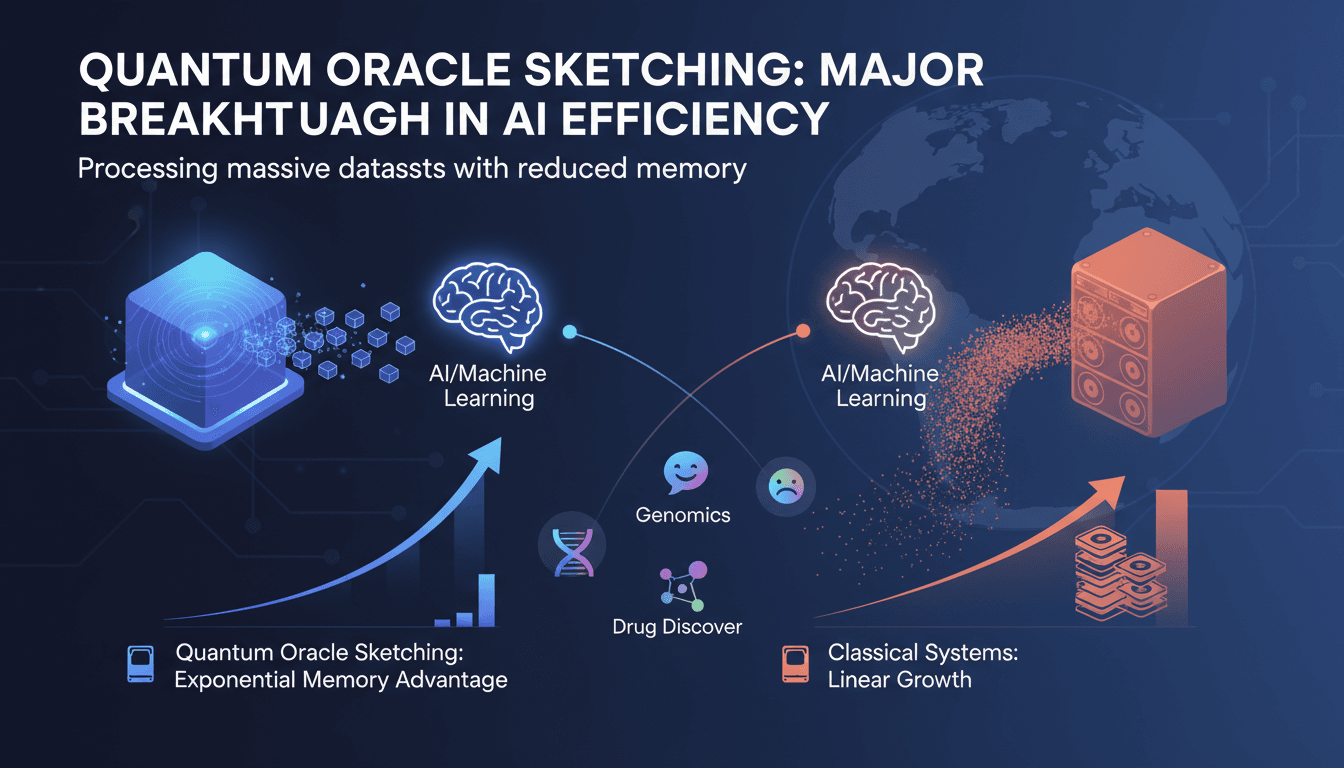
- On April 8, 2026, researchers introduced quantum oracle sketching, a method that allows quantum computers to process massive classical datasets with significantly reduced memory requirements.
- The technique demonstrates a four to six orders of magnitude advantage over classical systems, needing fewer than 60 logical qubits for complex machine learning tasks.
- New Scientist reported on April 20, 2026, highlighting the method's potential applications in fields like single-cell RNA sequencing and sentiment analysis.
The context you actually need
- Quantum computing has long been viewed as a promising technology for simulation and optimization, but skepticism remained regarding its application in machine learning due to data-loading bottlenecks.
- Recent advancements in quantum algorithms, such as classical shadows and superposition-based oracles, have spurred interest in streaming data access models to achieve practical quantum speedups.
- The growing volume of scientific and AI datasets necessitates innovative solutions, making the exploration of quantum methods increasingly relevant.
What's really happening
Quantum oracle sketching represents a significant leap in the ability of quantum computers to handle classical data efficiently. Traditional machine learning methods often struggle with the sheer volume of data generated in fields like genomics and social media analysis. The new approach allows quantum systems to construct superposition states from streaming classical data, eliminating the need for full storage of datasets. This is crucial because classical systems require exponential memory to process large datasets, while quantum oracle sketching can achieve this with polylogarithmic memory, drastically reducing the computational burden.
The research, led by teams from Oratomic, Caltech, ETH Zurich, and Leiden University, has validated its findings on real-world datasets, including single-cell RNA sequencing and IMDb movie reviews. This validation is essential as it addresses previous skepticism regarding the practical applicability of quantum computing in machine learning. The method's reliance on fewer than 60 logical qubits to achieve such a significant memory advantage is particularly noteworthy, as it suggests that even current quantum devices could implement these techniques within the next decade.
The implications of this research extend beyond theoretical interest; they touch on practical applications in various sectors. For instance, in healthcare, the ability to analyze vast amounts of genomic data quickly could lead to breakthroughs in personalized medicine. In finance, enhanced data processing capabilities could improve risk assessment models and fraud detection systems. The method's efficiency in handling large datasets could also benefit industries reliant on sentiment analysis, such as marketing and public relations.
However, the transition to quantum computing is not without challenges. Experts caution about potential risks associated with dequantization, where the advantages of quantum methods may diminish when applied to certain types of data or tasks. Additionally, practical implementation hurdles, such as data streaming overhead, need to be addressed to fully realize the benefits of quantum oracle sketching.
Who feels it first (and how)
- Data scientists in tech and research sectors will experience immediate benefits from enhanced processing capabilities.
- Healthcare professionals working with genomic data will see improved analysis speeds, leading to faster insights.
- Financial analysts will gain access to more efficient risk assessment tools, enhancing decision-making processes.
- Marketing teams leveraging sentiment analysis will be able to process consumer data more effectively, improving campaign strategies.
- Quantum computing researchers will have new avenues for exploration and application of their work in real-world scenarios.
What to watch next
- Implementation timelines: Keep an eye on the development of quantum devices capable of executing these algorithms, as this will determine when industries can adopt the technology.
- Real-world applications: Watch for case studies demonstrating the practical use of quantum oracle sketching in various sectors, which will provide insights into its effectiveness and limitations.
- Regulatory responses: As quantum computing becomes more integrated into industries, monitor how governments and regulatory bodies respond to its implications for data privacy and security.
Quantum oracle sketching offers significant memory advantages over classical systems for machine learning tasks.
Industries reliant on large datasets will begin exploring quantum computing solutions within the next decade.
The extent of practical implementation challenges and the potential risks associated with dequantization remain to be fully understood.
Frequently Asked Questions
- Why it matters?
- This breakthrough could redefine data processing capabilities across industries, enhancing AI applications and scientific research.
- What happened (in 30 seconds)?
- On April 8, 2026, researchers introduced quantum oracle sketching, a method that allows quantum computers to process massive classical datasets with significantly reduced memory requirements. The technique demonstrates a four to six orders of magnitude advantage over classical systems, needing fewer than 60 logical qubits for complex machine learning tasks. New Scientist reported on April 20, 2026, highlighting the method's potential applications in fields like single-cell RNA sequencing and
- What's really happening?
- Quantum oracle sketching represents a significant leap in the ability of quantum computers to handle classical data efficiently. Traditional machine learning methods often struggle with the sheer volume of data generated in fields like genomics and social media analysis. The new approach allows quantum systems to construct superposition states from streaming classical data, eliminating the need for full storage of datasets. This is crucial because classical systems require exponential memory to
- Who feels it first (and how)?
- Data scientists in tech and research sectors will experience immediate benefits from enhanced processing capabilities. Healthcare professionals working with genomic data will see improved analysis speeds, leading to faster insights. Financial analysts will gain access to more efficient risk assessment tools, enhancing decision-making processes. Marketing teams leveraging sentiment analysis will be able to process consumer data more effectively, improving campaign strategies. Quantum comp
- What to watch next?
- Implementation timelines: Keep an eye on the development of quantum devices capable of executing these algorithms, as this will determine when industries can adopt the technology. Real-world applications: Watch for case studies demonstrating the practical use of quantum oracle sketching in various sectors, which will provide insights into its effectiveness and limitations. Regulatory responses: As quantum computing becomes more integrated into industries, monitor how governments and regulato
Tech coverage including AI and robotics.
"Accessible science/tech magazine with AI coverage."
— A47 Editor
We might finally know how to use quantum computers to boost AI
Recent analyses suggest that quantum computers may finally provide significant advantages for artificial intelligence (AI) applications, particularly in enhancing machine learning algorithms. This development marks a shift in the long-held skepticism...
Discoveries, research, environment, and health innovations.
"New Scientist is a well-respected publication offering accessible science news, commentary, and expert analysis."
— A47 Editor
We might finally know how to use quantum computers to boost AI
Recent analyses indicate that quantum computers may soon provide significant advantages in executing machine learning and similar algorithms, challenging previous skepticism about their practical applications in artificial intelligence (AI).
Latest tech news, product reviews, and analysis for consumers and professionals.
"CNET delivers accessible and detailed technology reporting, including trusted product reviews and how-to guides."
— A47 Editor
Researchers Use Quantum Computer to Improve AI Predictions
Researchers have successfully utilized a quantum computer to enhance the predictive capabilities of an artificial intelligence model, enabling calculations that would typically require weeks on conventional computers to be completed in a fraction of ...
Research news on AI and intelligent systems.
"Aggregated research summaries from journals and institutions."
— A47 Editor
Quantum AI just got shockingly good at predicting chaos
Researchers have demonstrated that integrating quantum computing with artificial intelligence (AI) significantly enhances the prediction of complex, chaotic systems. This innovative approach allows quantum computers to uncover hidden patterns in data...