
Study Links High Generative AI Use to Decreased Cognitive Confidence Among Users
Here's what it means for you.
As generative AI becomes integral to your work, understanding its impact on your cognitive abilities is crucial for maintaining professional confidence.
Why it matters
The findings from this study highlight a potential decline in independent reasoning among professionals, which could affect decision-making and innovation in various sectors.
What happened (in 30 seconds)
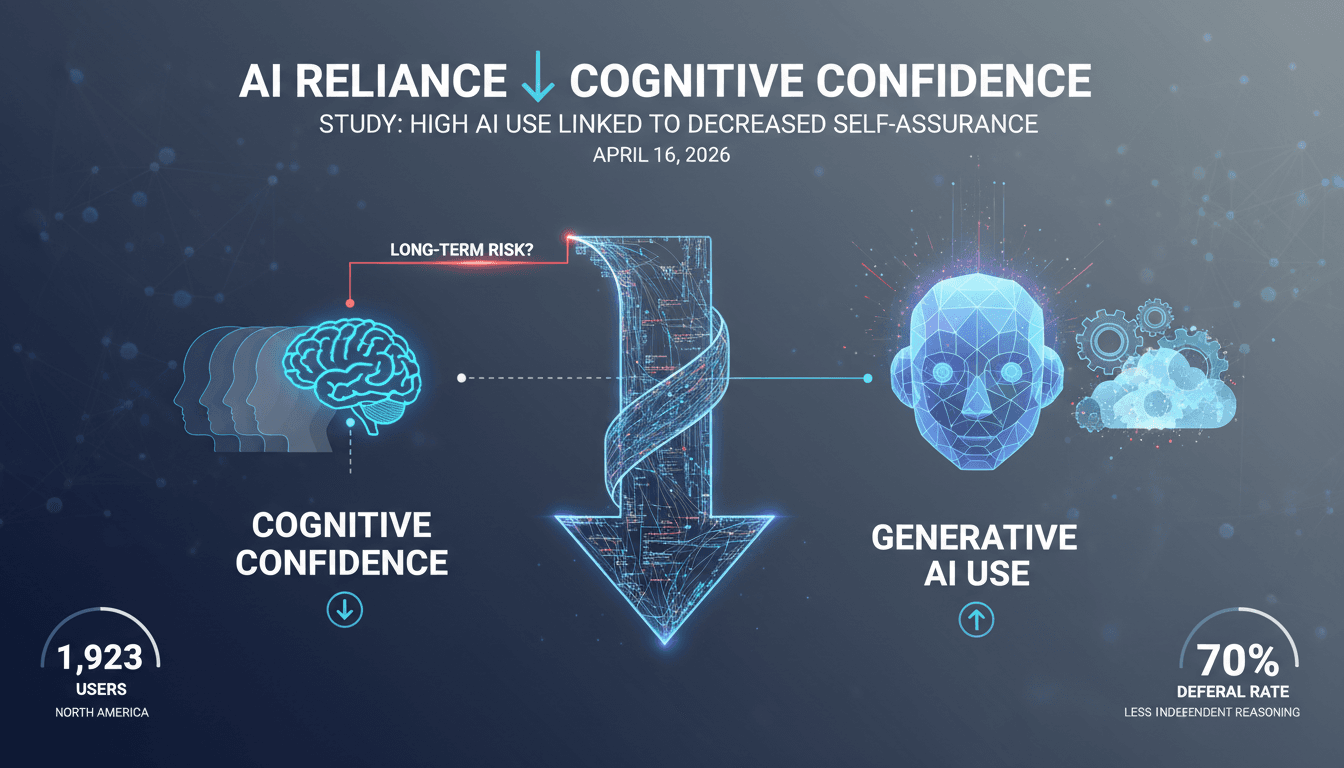
- A study published on April 16, 2026, revealed that high reliance on generative AI correlates with reduced cognitive self-confidence among users.
- 1,923 adults participated in the research, showing that those who frequently accepted AI outputs without questioning them felt less confident in their reasoning abilities.
- Active engagement with AI, such as editing responses, was linked to higher perceived autonomy and ownership over decisions.
The context you actually need
- Previous research indicated risks of cognitive atrophy due to AI overreliance, with studies from MIT and Wharton highlighting the neural consequences of trusting AI over human judgment.
- Generative AI adoption has surged in professional settings since 2023, raising concerns about its impact on executive function and critical thinking skills.
- The study's findings emphasize that interaction style with AI tools is a key determinant of cognitive effects, rather than the mere use of AI itself.
What's really happening
The Middlesex University study led by Sarah Baldeo analyzed the cognitive effects of generative AI on 1,923 adults in Canada and the United States. The research found that participants exhibited moderate reliance on AI (average score of 5.1 out of 7) while completing executive function tasks. Notably, they prompted the AI frequently (average of 4.2 prompts per task) but rarely overrode its outputs (average of 0.8 overrides per task). This pattern suggests a tendency to accept AI-generated responses without critical engagement, leading to a significant correlation (r = −.53, p < .01) between high reliance on AI and diminished confidence in independent reasoning.
The implications of these findings are profound. As professionals increasingly integrate AI into their workflows, the risk of cognitive offloading becomes more pronounced. When users rely heavily on AI for decision-making, they may unconsciously cede their critical thinking skills, resulting in a decline in cognitive self-confidence. This phenomenon is particularly concerning in knowledge-intensive sectors where independent reasoning is essential for innovation and effective problem-solving.
Moreover, the study underscores the importance of interaction style. Participants who actively edited or questioned AI responses reported feeling more autonomous and confident in their reasoning abilities. This suggests that fostering a more interactive relationship with AI tools could mitigate the negative cognitive effects associated with overreliance. As organizations adopt generative AI technologies, they must consider training programs that encourage critical engagement with AI outputs to preserve cognitive skills.
The findings also resonate with previous research highlighting the neural consequences of AI reliance. Studies from institutions like MIT and Wharton have documented how trust in AI can surpass human judgment, potentially leading to cognitive atrophy. As generative AI continues to evolve and permeate various industries, understanding these dynamics will be crucial for maintaining a balance between leveraging AI's capabilities and preserving essential cognitive functions.
Who feels it first (and how)
- Knowledge workers in sectors like finance, marketing, and technology who rely on AI for decision-making.
- Educators and students in higher education, particularly in environments where AI tools are integrated into learning.
- Executives and managers who utilize AI for strategic planning and operational tasks, potentially impacting their leadership effectiveness.
What to watch next
- Training programs: Monitor the development of training initiatives aimed at enhancing critical engagement with AI tools, which could influence cognitive outcomes.
- Policy changes: Watch for potential regulations or guidelines from educational institutions and organizations regarding AI use to mitigate cognitive risks.
- Market shifts: Observe how companies adapt their AI strategies in response to these findings, particularly in sectors heavily reliant on cognitive skills.
High reliance on generative AI correlates with reduced cognitive self-confidence among users.
Organizations will begin to implement training programs to encourage critical engagement with AI outputs.
The long-term effects of generative AI reliance on cognitive abilities across different demographics and sectors remain to be fully understood.
Frequently Asked Questions
- Why it matters?
- The findings from this study highlight a potential decline in independent reasoning among professionals, which could affect decision-making and innovation in various sectors.
- What happened (in 30 seconds)?
- A study published on April 16, 2026, revealed that high reliance on generative AI correlates with reduced cognitive self-confidence among users. 1,923 adults participated in the research, showing that those who frequently accepted AI outputs without questioning them felt less confident in their reasoning abilities. Active engagement with AI, such as editing responses, was linked to higher perceived autonomy and ownership over decisions.
- What's really happening?
- The Middlesex University study led by Sarah Baldeo analyzed the cognitive effects of generative AI on 1,923 adults in Canada and the United States. The research found that participants exhibited moderate reliance on AI (average score of 5.1 out of 7) while completing executive function tasks. Notably, they prompted the AI frequently (average of 4.2 prompts per task) but rarely overrode its outputs (average of 0.8 overrides per task). This pattern suggests a tendency to accept AI-generated respon
- Who feels it first (and how)?
- Knowledge workers in sectors like finance, marketing, and technology who rely on AI for decision-making. Educators and students in higher education, particularly in environments where AI tools are integrated into learning. Executives and managers who utilize AI for strategic planning and operational tasks, potentially impacting their leadership effectiveness.
- What to watch next?
- Training programs: Monitor the development of training initiatives aimed at enhancing critical engagement with AI tools, which could influence cognitive outcomes. Policy changes: Watch for potential regulations or guidelines from educational institutions and organizations regarding AI use to mitigate cognitive risks. Market shifts: Observe how companies adapt their AI strategies in response to these findings, particularly in sectors heavily reliant on cognitive skills.
Latest tech news, product reviews, and analysis for consumers and professionals.
"CNET delivers accessible and detailed technology reporting, including trusted product reviews and how-to guides."
— A47 Editor
Speed vs. Depth: How Does Using AI for Work Affect Our Confidence?
A study by the American Psychological Association reveals a negative correlation between the use of artificial intelligence (AI) in the workplace and employees' confidence in their abilities. As AI adoption increases, workers may feel less capable, p...
Future-focused tech headlines including AI breakthroughs.
"Consumer-friendly future-tech site with frequent AI coverage."
— A47 Editor
Study Finds AI Use Eats Away at Users’ Confidence in Their Own Brains
A recent study has revealed that the use of artificial intelligence (AI) significantly diminishes users' confidence in their cognitive abilities, suggesting that reliance on AI tools can lead to a decline in self-assurance regarding personal problem-...
AI/ML research and technology news.
"Sister site to Phys.org focusing on tech research."
— A47 Editor
Overreliance on AI programs may undermine confidence at work, study finds
A recent study published in Technology, Mind, and Behavior reveals that overreliance on artificial intelligence (AI) tools may not only fail to diminish cognitive abilities but also undermine individuals' confidence in their independent reasoning and...