
World Bank Cuts MENA 2026 Growth Forecast to 1.8 Percent Amid Regional Conflicts
Here's what it means for you.
If you operate in or trade with the MENA region, expect significant economic turbulence affecting energy prices and market stability.
Why it matters
The World Bank's drastic revision signals a potential economic downturn that could ripple through global markets, particularly in energy sectors.
What happened (in 30 seconds)
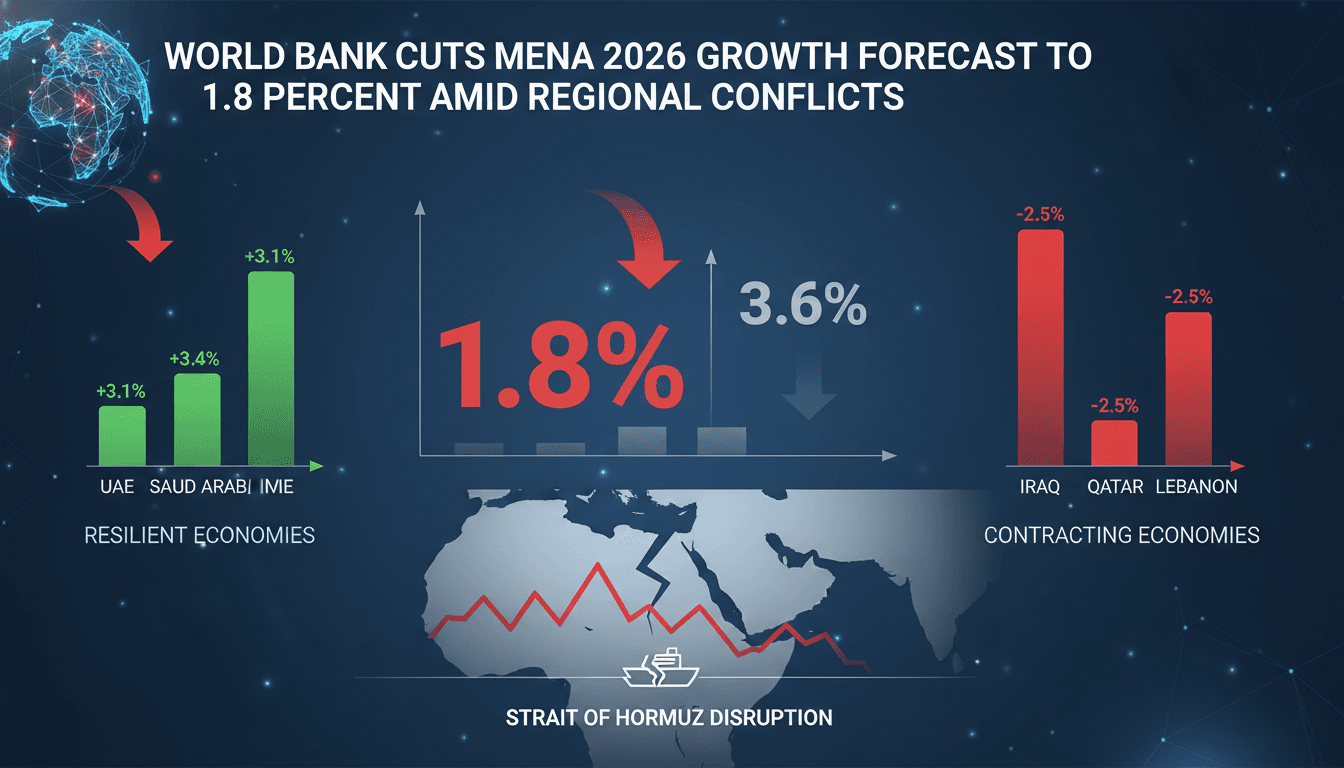
- The World Bank revised its MENA growth forecast for 2026 from 3.6% to 1.8%, primarily due to regional conflicts and the closure of the Strait of Hormuz.
- Saudi Arabia remains relatively resilient, with a growth forecast adjustment from 4.3% to 3.1%, while other GCC nations face sharp declines.
- Qatar and Kuwait are projected to contract by -5.7% and -6.4%, respectively, due to halted energy exports amid ongoing geopolitical tensions.
The context you actually need
- Structural challenges in the MENA region, including low productivity and labor market rigidities, were already hindering growth before the recent conflicts.
- Geopolitical tensions have escalated with attacks on energy infrastructure, disrupting about 20% of global oil flows and significantly impacting LNG exports from Qatar.
- The recent US-Iran ceasefire has not alleviated the economic fallout, as the closure of the Strait of Hormuz continues to threaten regional stability.
What's really happening
The World Bank's revision of the MENA growth forecast reflects a stark response to the ongoing geopolitical crises that have intensified in recent months. The closure of the Strait of Hormuz, a critical chokepoint for global oil shipments, has led to significant disruptions in energy exports, affecting not just the MENA region but also global markets reliant on stable oil supplies. The report indicates that the region's growth is now projected at a mere 1.8% for 2026, a dramatic decline from earlier estimates of 3.6%.
This downturn is particularly pronounced in the Gulf Cooperation Council (GCC) countries, where growth is expected to plummet from 4.4% in 2025 to just 1.3% in 2026. Saudi Arabia, while still facing a reduction in its growth forecast from 4.3% to 3.1%, is managing to weather the storm better than its neighbors due to ongoing economic diversification efforts. In contrast, countries like Qatar and Kuwait are facing severe contractions, with forecasts of -5.7% and -6.4%, respectively, as their economies heavily depend on energy exports that have been severely impacted by the conflict.
The broader implications of these economic forecasts are concerning. The International Monetary Fund (IMF) has warned of potential global inflation and growth slowdowns, as the volatility in oil prices continues to create uncertainty in international markets. The UAE has responded with a $270 million economic relief package aimed at supporting businesses and households affected by the war's economic fallout. However, the long-term effects of these geopolitical tensions remain uncertain, particularly as energy prices fluctuate and supply chains are disrupted.
The World Bank's report underscores the fragility of the MENA region's economic landscape, which is already grappling with structural challenges. The combination of geopolitical instability and economic vulnerability raises questions about the future trajectory of growth in the region, as well as its potential ripple effects on global markets.
Who feels it first (and how)
- Energy Sector Workers: Job security is threatened as companies face reduced output and layoffs due to export halts.
- Small Businesses in Dubai: Increased operational costs from elevated energy prices and reduced consumer spending impact profitability.
- Investors: Heightened market volatility leads to cautious investment strategies, particularly in energy-dependent sectors.
- Households: Rising food and energy prices strain budgets, prompting government intervention and support measures.
What to watch next
- Energy Prices: Watch for fluctuations in global oil prices as the situation evolves; these will directly impact economic stability.
- Government Responses: Monitor how regional governments, particularly in the UAE and Saudi Arabia, adapt their economic policies in response to the downturn.
- Geopolitical Developments: Keep an eye on any shifts in US-Iran relations and their potential impact on regional stability and economic forecasts.
The MENA region's growth forecast has been revised down to 1.8% for 2026.
Continued volatility in energy markets will affect global economic conditions.
The long-term impacts of the current geopolitical tensions on MENA's economic recovery remain uncertain.
Frequently Asked Questions
- Why it matters?
- The World Bank's drastic revision signals a potential economic downturn that could ripple through global markets, particularly in energy sectors.
- What happened (in 30 seconds)?
- The World Bank revised its MENA growth forecast for 2026 from 3.6% to 1.8%, primarily due to regional conflicts and the closure of the Strait of Hormuz. Saudi Arabia remains relatively resilient, with a growth forecast adjustment from 4.3% to 3.1%, while other GCC nations face sharp declines. Qatar and Kuwait are projected to contract by -5.7% and -6.4%, respectively, due to halted energy exports amid ongoing geopolitical tensions.
- What's really happening?
- The World Bank's revision of the MENA growth forecast reflects a stark response to the ongoing geopolitical crises that have intensified in recent months. The closure of the Strait of Hormuz, a critical chokepoint for global oil shipments, has led to significant disruptions in energy exports, affecting not just the MENA region but also global markets reliant on stable oil supplies. The report indicates that the region's growth is now projected at a mere 1.8% for 2026, a dramatic decline from ear
- Who feels it first (and how)?
- Energy Sector Workers: Job security is threatened as companies face reduced output and layoffs due to export halts. Small Businesses in Dubai: Increased operational costs from elevated energy prices and reduced consumer spending impact profitability. Investors: Heightened market volatility leads to cautious investment strategies, particularly in energy-dependent sectors. Households: Rising food and energy prices strain budgets, prompting government intervention and support measures.
- What to watch next?
- Energy Prices: Watch for fluctuations in global oil prices as the situation evolves; these will directly impact economic stability. Government Responses: Monitor how regional governments, particularly in the UAE and Saudi Arabia, adapt their economic policies in response to the downturn. Geopolitical Developments: Keep an eye on any shifts in US-Iran relations and their potential impact on regional stability and economic forecasts.
Pan-Arab news coverage spanning politics, business, sports, and regional affairs.
"Asharq Al-Awsat reflects a broad Arab editorial perspective with strong attention to regional geopolitics."
— A47 Editor
البنك الدولي: الحرب تقلّص نمو المنطقة إلى النصف... والسعودية تمتص الصدمة
The World Bank has halved its growth forecast for the Middle East and North Africa region for 2026 to just 1.8 percent, citing the impact of ongoing conflicts as a significant factor. This adjustment reflects the challenging economic landscape faced ...
UAE-based English-language newspaper covering regional politics, economics, and global affairs.
"The National reflects Emirati policy perspectives while maintaining international editorial standards."
— A47 Editor
World Bank expects Middle East economic growth to slow to 1.8% and warns of scarring from Iran war
The World Bank has projected a significant slowdown in economic growth for the Middle East, forecasting a decline to 1.8% by 2026, primarily due to the ongoing war in Iran and its associated economic impacts.