
China Narrows AI Performance Gap with US to 2.7 Percent Amid Disparity in Investment
Here's what it means for you.
As AI continues to evolve, understanding the shifting dynamics between the US and China can inform your strategic decisions in technology and investment.
Why it matters
The narrowing performance gap in AI models signals a critical shift in global technological leadership that could reshape industries and economies.
What happened (in 30 seconds)
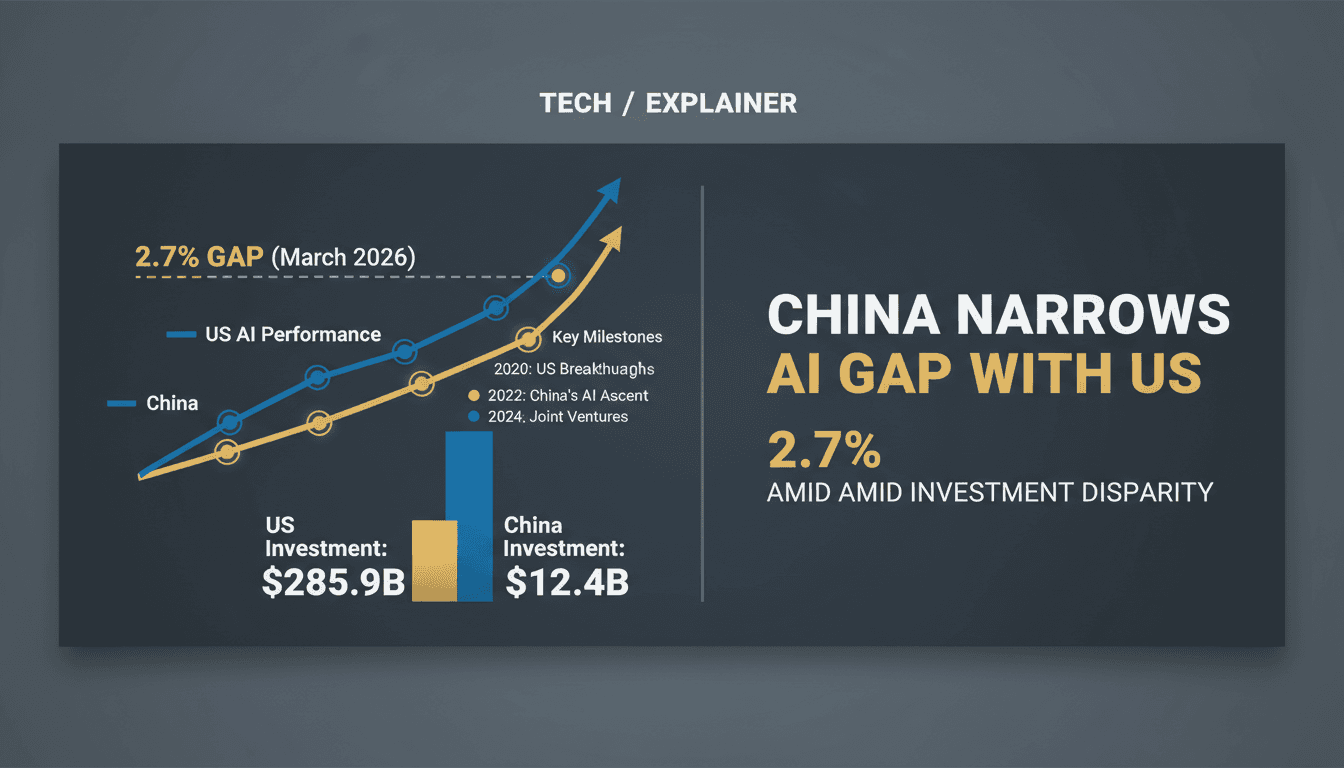
- In April 2026, Stanford's AI Index Report revealed that the performance gap between US and Chinese AI models has decreased to 2.7 percent.
- Despite a 23-fold disparity in private investment—$285.9 billion in the US versus $12.4 billion in China—Chinese models have rapidly advanced.
- The report highlights intensified competition, with China leading in research publications and patents while the US maintains dominance in model production.
The context you actually need
- The US and China have been competing in AI since the mid-2010s, with the US focusing on private sector investment and China on state-directed research.
- Previous reports indicated a widening US lead in AI performance, but recent advancements by Chinese models have significantly narrowed this gap.
- Geopolitical tensions and export controls on AI hardware have influenced talent flows and investment strategies in both countries.
What's really happening
The AI landscape is undergoing a significant transformation, driven by a combination of strategic investments, research advancements, and geopolitical factors. The Stanford AI Index Report 2026 highlights a pivotal moment where the performance gap between US and Chinese AI models has shrunk to just 2.7 percent, a stark contrast to the 17.5-31.6 percent gap observed in May 2023. This shift is not merely a statistical anomaly; it reflects a broader trend of increasing competition and capability in the global AI ecosystem.
China's rapid advancements can be attributed to its state-directed approach to research and development, which allows for a concentrated allocation of resources towards AI initiatives. The Chinese government has prioritized AI as a strategic industry, leading to significant investments in research publications, patents, and industrial applications. In contrast, while the US has leveraged its private sector's financial clout—investing $285.9 billion in AI in 2025—this has not translated into a proportional advantage in model performance.
The competition has intensified since early 2025, with leading models from both countries frequently exchanging positions on performance benchmarks like the Arena leaderboard. For instance, China's DeepSeek-R1 matched the leading US model in February 2025, and by March 2026, Anthropic's Claude Opus outperformed ByteDance's Dola-Seed-2.0-Preview, albeit by a narrow margin. This back-and-forth highlights the dynamic nature of AI development, where advancements can quickly shift the balance of power.
Moreover, the report underscores the implications of these developments for global talent flows. The US has experienced an 89 percent decline in talent inflow since 2017, raising concerns about its ability to maintain its competitive edge. Meanwhile, China's efficiency in utilizing state funding and infrastructure advantages has spurred a wave of AI IPOs, valued at $110 billion in Hong Kong, further solidifying its position in the global market.
As the competition heats up, the implications extend beyond just performance metrics. The AI arms race is reshaping industries, influencing economic policies, and redefining global technological leadership. The convergence of US and Chinese capabilities in AI not only affects the tech sector but also has far-reaching consequences for sectors like healthcare, energy, and finance, where AI applications are becoming increasingly integral.
Who feels it first (and how)
- Tech companies: Both US and Chinese firms must adapt to a rapidly changing competitive landscape.
- Investors: Shifts in AI performance can influence investment strategies and valuations in tech sectors.
- Policymakers: Governments will need to respond to the evolving dynamics of AI leadership and its implications for national security and economic competitiveness.
- Talent: AI professionals may find new opportunities in regions with growing AI capabilities, particularly in China and the UAE.
What to watch next
- Investment trends: Monitor shifts in private and public sector investments in AI, particularly in China and the US, to gauge future performance trajectories.
- Talent migration: Watch for changes in talent flows between the US and China, as this will impact innovation and competitive advantage.
- Regulatory responses: Keep an eye on how governments respond to the evolving AI landscape, particularly regarding export controls and funding for AI initiatives.
The performance gap between US and Chinese AI models has narrowed to 2.7 percent.
Continued competition will drive further advancements in AI capabilities from both countries.
The long-term implications of this competition on global economic stability and technological leadership remain to be seen.
Frequently Asked Questions
- Why it matters?
- The narrowing performance gap in AI models signals a critical shift in global technological leadership that could reshape industries and economies.
- What happened (in 30 seconds)?
- In April 2026, Stanford's AI Index Report revealed that the performance gap between US and Chinese AI models has decreased to 2.7 percent. Despite a 23-fold disparity in private investment—$285.9 billion in the US versus $12.4 billion in China—Chinese models have rapidly advanced. The report highlights intensified competition, with China leading in research publications and patents while the US maintains dominance in model production.
- What's really happening?
- The AI landscape is undergoing a significant transformation, driven by a combination of strategic investments, research advancements, and geopolitical factors. The Stanford AI Index Report 2026 highlights a pivotal moment where the performance gap between US and Chinese AI models has shrunk to just 2.7 percent, a stark contrast to the 17.5-31.6 percent gap observed in May 2023. This shift is not merely a statistical anomaly; it reflects a broader trend of increasing competition and capability in
- Who feels it first (and how)?
- Tech companies: Both US and Chinese firms must adapt to a rapidly changing competitive landscape. Investors: Shifts in AI performance can influence investment strategies and valuations in tech sectors. Policymakers: Governments will need to respond to the evolving dynamics of AI leadership and its implications for national security and economic competitiveness. Talent: AI professionals may find new opportunities in regions with growing AI capabilities, particularly in China and the UAE.
- What to watch next?
- Investment trends: Monitor shifts in private and public sector investments in AI, particularly in China and the US, to gauge future performance trajectories. Talent migration: Watch for changes in talent flows between the US and China, as this will impact innovation and competitive advantage. Regulatory responses: Keep an eye on how governments respond to the evolving AI landscape, particularly regarding export controls and funding for AI initiatives.
Opinionated AI coverage for general audiences.
"TNW’s AI vertical covering tools, ethics, and trends."
— A47 Editor
Stanford’s AI Index finds China has nearly closed the performance gap with the US despite spending 23 times less
The 2026 AI Index Report from Stanford University reveals that China has nearly closed the performance gap with the United States in artificial intelligence, now at just 2.7%, a significant reduction from 17.5-31.6 percentage points in May 2023, desp...
Future-focused tech headlines including AI breakthroughs.
"Consumer-friendly future-tech site with frequent AI coverage."
— A47 Editor
China Is Starting to Pull Ahead of US in AI Race
Recent reports indicate that China has effectively closed the gap with the United States in artificial intelligence (AI) capabilities, with the Stanford HAI's 2026 AI Index revealing significant advancements in China's AI technologies. This developme...