
Lebanese President Aoun Demands Israeli Withdrawal for Ceasefire Negotiations
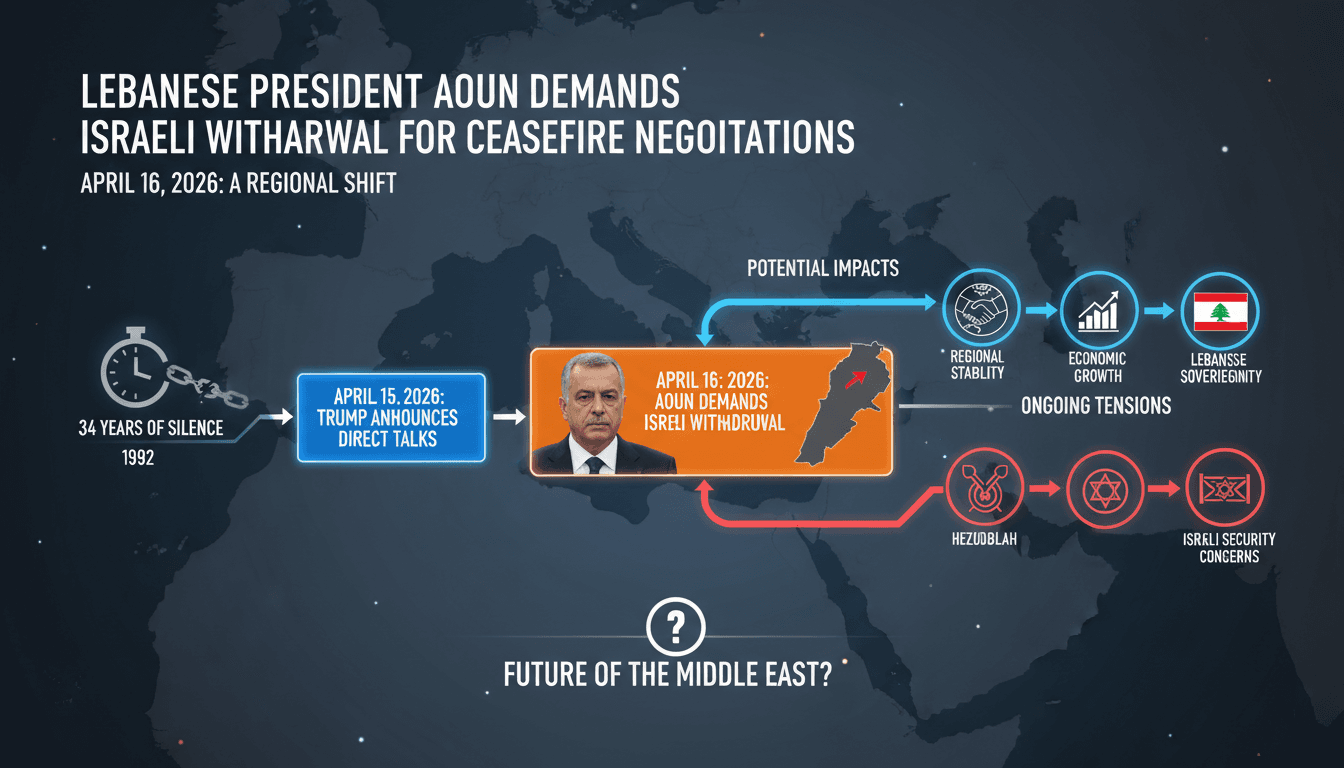
Here's what it means for you.
If you’re in the Middle East or have business interests there, the evolving ceasefire could reshape regional dynamics and economic opportunities.
Why it matters
This ceasefire marks a pivotal moment in Middle Eastern diplomacy, potentially stabilizing a historically volatile region.
What happened (in 30 seconds)
- On April 16, 2026, Lebanese President Joseph Aoun declared that Israeli withdrawal from Lebanese territory is essential for a ceasefire.
- U.S. President Donald Trump announced direct talks between Israel and Lebanon, the first in 34 years, aimed at de-escalating tensions.
- A 10-day ceasefire was initiated, with skepticism from local populations about its longevity and effectiveness.
The context you actually need
- Tensions escalated in March 2026 after violations of the 2024 ceasefire agreement, leading to open conflict between Israel and Hezbollah.
- Aoun's presidential initiative emphasizes Lebanese sovereignty and aims to establish state authority over armed groups, a critical step for national stability.
- U.S. mediation efforts are crucial, as they signal a shift in international engagement in the region, particularly amid broader U.S.-Iran confrontations.
What's really happening
The recent diplomatic developments between Israel and Lebanon are rooted in a complex interplay of historical grievances, regional power dynamics, and international mediation. The announcement of direct talks by U.S. President Donald Trump represents a significant shift in U.S. foreign policy, as it seeks to address longstanding conflicts that have plagued the region for decades.
Lebanese President Joseph Aoun's insistence on Israeli withdrawal as a precondition for a ceasefire underscores the deep-seated issues surrounding territorial sovereignty and national security. Aoun's administration, which advocates for a state monopoly on arms, is attempting to reassert control over armed groups like Hezbollah, which have historically operated independently of the Lebanese state. This move is not just about immediate security; it is also about establishing a framework for long-term governance and stability in Lebanon.
The backdrop of U.S.-Iran tensions, particularly regarding the Strait of Hormuz, adds another layer of complexity. The U.S. has been keen to stabilize the region to prevent further escalation that could disrupt global oil supplies and impact international markets. The recent pledge of £20.5 million in humanitarian aid from the UK to Lebanon for displaced persons highlights the international community's recognition of the humanitarian crisis resulting from the conflict.
However, skepticism remains among local populations regarding the ceasefire's durability. Hezbollah's condemnation of the Lebanese government's engagement in talks with Israel reflects the internal divisions within Lebanon and the potential for backlash against Aoun's administration. The ceasefire's success hinges not only on the withdrawal of Israeli forces but also on the ability of the Lebanese government to unify various factions under a common national agenda.
As the ceasefire takes effect, regional markets are already reacting, with oil prices pulling back from recent highs and stocks showing signs of recovery. This volatility indicates that investors are closely monitoring the situation, aware that any breakdown in negotiations could lead to renewed conflict and economic instability.
Who feels it first (and how)
- Lebanese citizens: They face immediate impacts from the ceasefire, including potential security improvements or further instability depending on the outcome of negotiations.
- International businesses: Companies with interests in the region may see shifts in market conditions, particularly in sectors like oil and aviation.
- Regional governments: Neighboring countries, especially those involved in mediation, will be affected by the geopolitical shifts resulting from any agreements reached.
What to watch next
- The outcome of direct talks: Success or failure in negotiations will significantly influence regional stability and economic conditions.
- Reactions from Hezbollah: Their response to the ceasefire and negotiations will be critical in determining the internal political landscape in Lebanon.
- International aid and support: Continued international engagement and support for Lebanon will be essential for rebuilding and stabilizing the country post-conflict.
A 10-day ceasefire has been initiated, and direct talks between Israel and Lebanon are scheduled.
Regional markets will continue to react to developments in the ceasefire and negotiations, impacting oil prices and investor confidence.
The long-term effectiveness of the ceasefire and the potential for renewed conflict if negotiations falter.
Frequently Asked Questions
- Why it matters?
- This ceasefire marks a pivotal moment in Middle Eastern diplomacy, potentially stabilizing a historically volatile region.
- What happened (in 30 seconds)?
- On April 16, 2026, Lebanese President Joseph Aoun declared that Israeli withdrawal from Lebanese territory is essential for a ceasefire. U.S. President Donald Trump announced direct talks between Israel and Lebanon, the first in 34 years, aimed at de-escalating tensions. A 10-day ceasefire was initiated, with skepticism from local populations about its longevity and effectiveness.
- What's really happening?
- The recent diplomatic developments between Israel and Lebanon are rooted in a complex interplay of historical grievances, regional power dynamics, and international mediation. The announcement of direct talks by U.S. President Donald Trump represents a significant shift in U.S. foreign policy, as it seeks to address longstanding conflicts that have plagued the region for decades. Lebanese President Joseph Aoun's insistence on Israeli withdrawal as a precondition for a ceasefire underscores the
- Who feels it first (and how)?
- Lebanese citizens: They face immediate impacts from the ceasefire, including potential security improvements or further instability depending on the outcome of negotiations. International businesses: Companies with interests in the region may see shifts in market conditions, particularly in sectors like oil and aviation. Regional governments: Neighboring countries, especially those involved in mediation, will be affected by the geopolitical shifts resulting from any agreements reached.
- What to watch next?
- The outcome of direct talks: Success or failure in negotiations will significantly influence regional stability and economic conditions. Reactions from Hezbollah: Their response to the ceasefire and negotiations will be critical in determining the internal political landscape in Lebanon. International aid and support: Continued international engagement and support for Lebanon will be essential for rebuilding and stabilizing the country post-conflict.
Arabic-language coverage of political affairs and current events.
"Okaz political coverage typically follows mainstream Saudi framing on national and regional affairs."
— A47 Editor
الرئيس اللبناني: الانسحاب الإسرائيلي أساس لوقف «النار».. والمفاوضات سيادية
Lebanese President Joseph Aoun stated that the Israeli withdrawal is essential for establishing a ceasefire with Israel, which he believes should lead to direct negotiations between the two nations. Aoun emphasized the need for Lebanon to maintain so...
Arabic-language coverage of international news and geopolitics.
"RT Arabic is a Russian state-funded outlet often criticized for promoting Kremlin-aligned narratives."
— A47 Editor
عون: انسحاب القوات الإسرائيلية من الأراضي اللبنانية خطوة أساسية لتثبيت وقف إطلاق النار
Lebanese President Joseph Aoun stated that the withdrawal of Israeli forces from Lebanese territory is a crucial step towards solidifying the ceasefire that Lebanon seeks with Israel. He emphasized that this ceasefire would serve as a natural entry p...
Arabic-language UAE newspaper coverage focused on domestic affairs, public institutions, business, society, and regional developments.
"Al Khaleej coverage generally reflects a mainstream UAE editorial lens with strong attention to public affairs, institutions, and regional developments."
— A47 Editor
الرئيس اللبناني: آمل أن تشكل المحادثات مع إسرائيل بداية لإنهاء معاناة اللبنانيين
Lebanese President Joseph Aoun expressed hope that the talks with Israel, which commenced in Washington, could mark the beginning of alleviating the suffering of the Lebanese people following weeks of intense conflict between Hezbollah and Israel.
Pan-Arab news coverage spanning politics, business, sports, and regional affairs.
"Asharq Al-Awsat reflects a broad Arab editorial perspective with strong attention to regional geopolitics."
— A47 Editor
عون يحذّر من كارثة إنسانية في لبنان ودعم أوروبي لمسار التفاوض مع إسرائيل
President Joseph Aoun has warned of a looming humanitarian disaster in Lebanon, where over one million people have been displaced due to the ongoing conflict. The situation highlights the severe impact of the war on the Lebanese population, raising c...