
Lebanon and Israel Begin Historic Negotiations in Washington Amid U.S.-Brokered Ceasefire
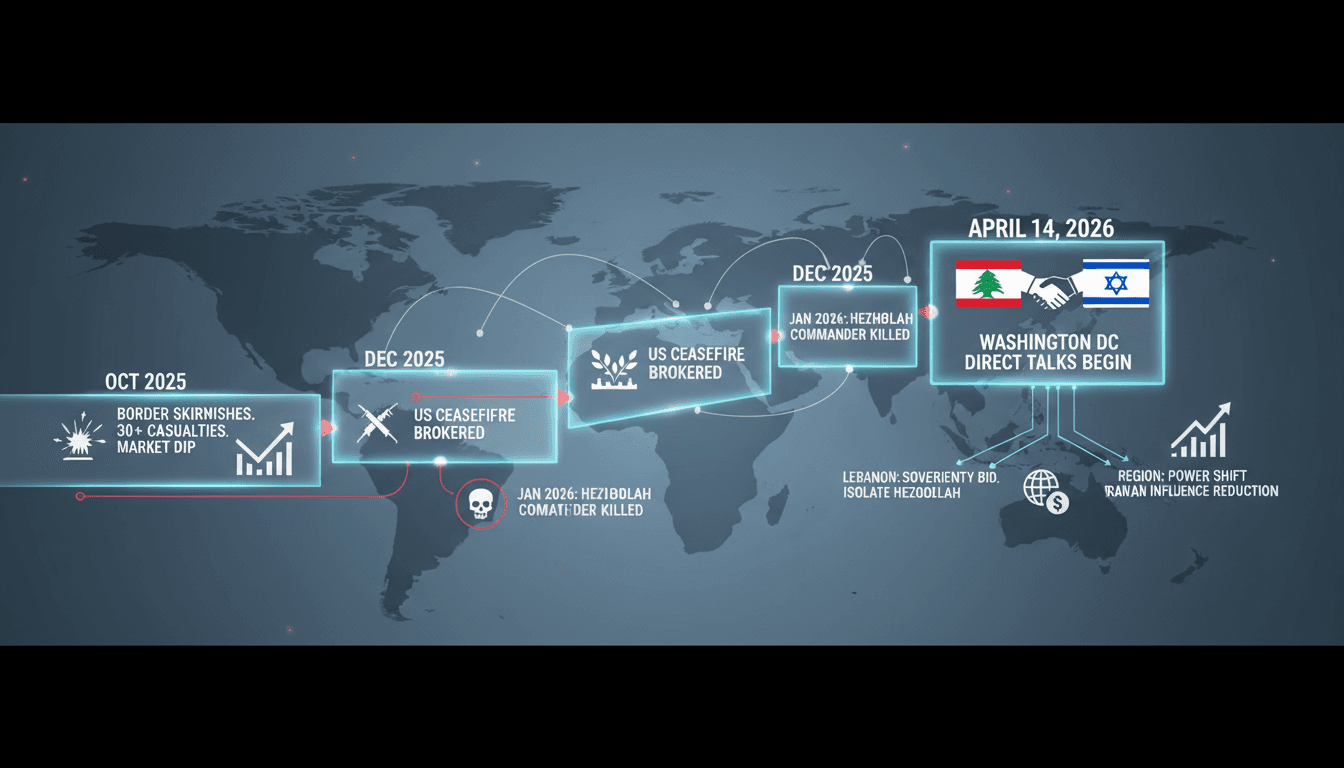
Here's what it means for you.
The outcome of these negotiations could reshape regional stability, impacting energy prices and travel costs for global citizens.
Why it matters
This diplomatic breakthrough could redefine Middle Eastern geopolitics, influencing global energy markets and security dynamics.
What happened (in 30 seconds)
- Direct negotiations between Lebanon and Israel began on April 14, 2026, in Washington, D.C., marking the first high-level talks since 1993.
- A 10-day ceasefire was announced by President Trump, effective April 17, 2026, amid escalating hostilities and significant casualties.
- Hezbollah's position is increasingly isolated as it opposes state-led talks, complicating Lebanon's pursuit of national sovereignty.
The context you actually need
- Escalating violence resumed on March 2, 2026, with over 2,000 Lebanese casualties and significant displacement due to Hezbollah's attacks and Israeli responses.
- U.S. mediation aims to affirm Lebanon's state monopoly on force and disarm Hezbollah, leveraging previous disarmament commitments made in 2024.
- Regional dynamics are shifting as Lebanon seeks to assert its sovereignty while the U.S. attempts to diminish Iranian influence in the area.
What's really happening
The initiation of direct negotiations between Lebanon and Israel represents a significant shift in Middle Eastern diplomacy, driven by a complex interplay of military, political, and economic factors. Following a series of violent escalations that began in early March 2026, the U.S. stepped in to mediate discussions aimed at establishing a lasting peace. The backdrop of these negotiations is critical: hostilities had resumed after Hezbollah's attacks in support of Iran during the ongoing U.S.-Iran conflict, leading to a humanitarian crisis in Lebanon with over 2,000 casualties, including children and medical personnel.
The U.S. Secretary of State, Marco Rubio, facilitated the talks, which included Lebanese Ambassador Nida Hammadeh Maouad and Israeli Ambassador Yehiel Leiter. Their discussions focused on ceasefire implementation, Hezbollah disarmament, and border demarcation, all under the framework of a 10-day truce announced by President Trump. This truce is not merely a pause in hostilities; it is a strategic maneuver to isolate Hezbollah, which has historically opposed state-led negotiations and has now found itself at odds with the Lebanese government's push for sovereignty.
Hezbollah's leadership, particularly Deputy Secretary-General Naim Qassem, has publicly denounced the negotiations, labeling them as a form of surrender. This internal dissent highlights the growing rift between Hezbollah and the Lebanese state, which is attempting to assert its authority and independence from Iranian influence. The U.S. aims to leverage this moment to reinforce Lebanon's sovereignty and diminish Hezbollah's power, which has been a significant player in the region's conflicts.
The implications of these negotiations extend beyond Lebanon and Israel. The announcement of the ceasefire has already influenced global markets, with oil prices declining as tensions ease. For Dubai residents, this could mean lower jet fuel costs and airfares, enhancing regional travel stability. The broader economic ramifications could affect various sectors, particularly those reliant on energy prices and regional stability.
Who feels it first (and how)
- Energy sector professionals: Fluctuations in oil prices could impact profitability and operational costs.
- Travel and tourism industries: Lower airfares and stable regional conditions may boost travel to and from Dubai.
- Lebanese citizens: The outcome of negotiations will directly affect national security and economic stability.
- Investors in Middle Eastern markets: Changes in geopolitical stability will influence investment strategies and market confidence.
What to watch next
- Hezbollah's response: Monitor how Hezbollah reacts to the negotiations and whether it will adhere to the ceasefire or escalate tensions.
- U.S. involvement: Watch for further U.S. diplomatic efforts to stabilize the region and their impact on Iranian influence.
- Market reactions: Keep an eye on oil prices and stock market trends as the situation evolves, as these will reflect broader economic sentiments.
Direct negotiations have commenced, and a ceasefire is in effect.
Hezbollah will continue to oppose the negotiations, potentially leading to further internal conflict within Lebanon.
The long-term effectiveness of the ceasefire and whether it will lead to a lasting peace agreement.
Frequently Asked Questions
- Why it matters?
- This diplomatic breakthrough could redefine Middle Eastern geopolitics, influencing global energy markets and security dynamics.
- What happened (in 30 seconds)?
- Direct negotiations between Lebanon and Israel began on April 14, 2026, in Washington, D.C., marking the first high-level talks since 1993. A 10-day ceasefire was announced by President Trump, effective April 17, 2026, amid escalating hostilities and significant casualties. Hezbollah's position is increasingly isolated as it opposes state-led talks, complicating Lebanon's pursuit of national sovereignty.
- What's really happening?
- The initiation of direct negotiations between Lebanon and Israel represents a significant shift in Middle Eastern diplomacy, driven by a complex interplay of military, political, and economic factors. Following a series of violent escalations that began in early March 2026, the U.S. stepped in to mediate discussions aimed at establishing a lasting peace. The backdrop of these negotiations is critical: hostilities had resumed after Hezbollah's attacks in support of Iran during the ongoing U.S.-Ir
- Who feels it first (and how)?
- Energy sector professionals: Fluctuations in oil prices could impact profitability and operational costs. Travel and tourism industries: Lower airfares and stable regional conditions may boost travel to and from Dubai. Lebanese citizens: The outcome of negotiations will directly affect national security and economic stability. Investors in Middle Eastern markets: Changes in geopolitical stability will influence investment strategies and market confidence.
- What to watch next?
- Hezbollah's response: Monitor how Hezbollah reacts to the negotiations and whether it will adhere to the ceasefire or escalate tensions. U.S. involvement: Watch for further U.S. diplomatic efforts to stabilize the region and their impact on Iranian influence. Market reactions: Keep an eye on oil prices and stock market trends as the situation evolves, as these will reflect broader economic sentiments.
Pan-Arab news coverage spanning politics, business, sports, and regional affairs.
"Asharq Al-Awsat reflects a broad Arab editorial perspective with strong attention to regional geopolitics."
— A47 Editor
بدء المفاوضات اللبنانية - الإسرائيلية يحاصر «حزب الله» فكيف سيتصرف؟
The commencement of Lebanese-Israeli negotiations has intensified the political landscape, particularly as the outcome of the ceasefire hinges on the ongoing military confrontations between Hezbollah and the Israeli army.
Arabic-language UAE newspaper coverage focused on domestic affairs, public institutions, business, society, and regional developments.
"Al Khaleej coverage generally reflects a mainstream UAE editorial lens with strong attention to public affairs, institutions, and regional developments."
— A47 Editor
إسرائيل: محادثات لبنان تمثل فرصة للحد من هيمنة حزب الله
Israel praised the initiation of direct talks with Lebanon on Wednesday, describing it as a 'historic opportunity' that could potentially limit Hezbollah's dominance in Lebanon.
Arabic-language coverage of international news and geopolitics.
"RT Arabic is a Russian state-funded outlet often criticized for promoting Kremlin-aligned narratives."
— A47 Editor
على وقع أول لقاء بين لبنان وإسرائيل.. "حزب الله" ينفذ عشرات العمليات العسكرية ويقصف مستوطنات الشمال
Hezbollah has reported executing dozens of military operations against Israel on Tuesday, coinciding with the first official meeting between Lebanon and Israel in Washington, D.C. This escalation highlights ongoing tensions in the region despite dipl...
Jordanian news and regional updates.
"Roya News is a Jordanian outlet focused on breaking news and local affairs."
— A47 Editor
الريفي لـنبض البلد:الحكومة اللبنانية والاحتلال استثنوا حزب الله من المفاوضات وهي الأساس
In a recent statement, the Lebanese politician criticized the Lebanese government and the occupying forces for excluding Hezbollah from negotiations, labeling these actions as merely a 'preparatory session' rather than genuine negotiations. This excl...
Arabic-language coverage of international news and geopolitics.
"RT Arabic is a Russian state-funded outlet often criticized for promoting Kremlin-aligned narratives."
— A47 Editor
تصعيد مزدوج على الجليل وجنوب لبنان.. قصف متبادل واسع يتزامن مع مفاوضات واشنطن
A significant military escalation is occurring in northern Israel, with numerous towns being targeted by rocket and drone attacks launched by Hezbollah. This escalation coincides with direct negotiations taking place between Lebanon and Israel in Was...
Arabic-language reporting on global and regional news.
"BBC Arabic is part of the BBC, generally regarded for editorial standards and broad international coverage."
— A47 Editor
لبنان يدخل محادثات مع إسرائيل من دون أي أوراق قوة
Lebanon has entered negotiations with Israel despite lacking any significant leverage, raising questions about the government's influence over Hezbollah and the potential for achieving lasting peace.