
NVIDIA and Cadence Expand Partnership to Enhance AI Robotics Capabilities
Here's what it means for you.
If you're in tech or engineering, this partnership could redefine how quickly and efficiently AI-driven robotics are developed, impacting your workflow and project timelines.
Why it matters
This collaboration signals a significant shift in engineering practices, potentially accelerating the adoption of AI in robotics and semiconductor design.
What happened (in 30 seconds)
- NVIDIA and Cadence announced an expanded partnership on April 15, 2026, integrating their technologies to enhance robotics training.
- The collaboration aims to bridge the sim-to-real gap in robotics, reducing reliance on expensive real-world trials for AI training.
- Cadence shares rose over 4% following the announcement, indicating positive market reception and investor confidence.
The context you actually need
- NVIDIA and Cadence have a longstanding collaboration in semiconductor design, with previous integrations of NVIDIA's tools into Cadence workflows.
- The expansion addresses challenges from Moore's Law limitations, such as heat dissipation and data scarcity, by leveraging advanced simulations and AI.
- Agentic AI is positioned to reshape engineering workflows, enabling faster and more efficient development processes in robotics and chip design.
What's really happening
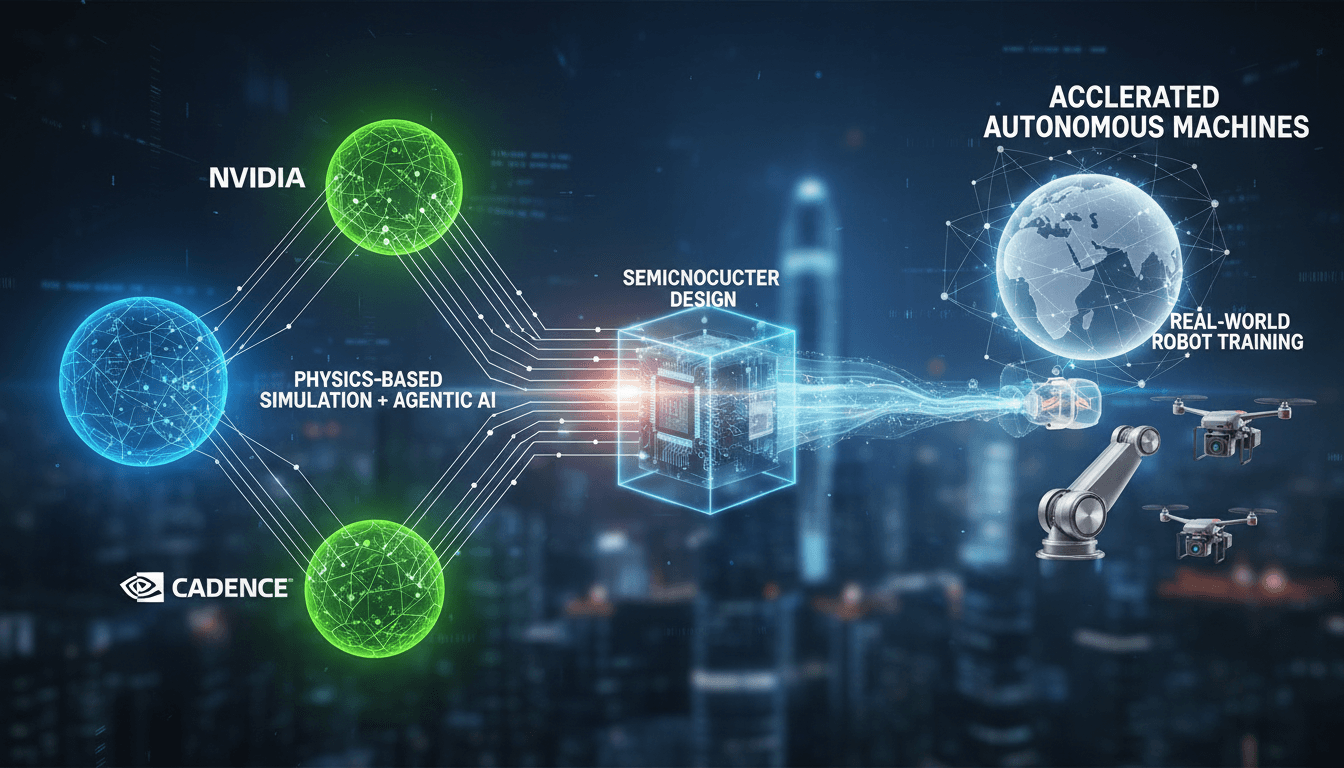
On April 15, 2026, at the CadenceLIVE Silicon Valley 2026 conference, the expanded partnership between NVIDIA and Cadence was officially announced. This collaboration integrates Cadence's high-fidelity physics-based simulation engines with NVIDIA's Isaac simulation libraries, Omniverse platform, and AI models. The goal is to bridge the sim-to-real gap in robotics training, which has been a significant bottleneck in the development of AI-powered robots and autonomous machines.
The partnership is particularly timely as the industry grapples with the limitations imposed by Moore's Law, which has slowed down the pace of semiconductor advancements. By combining Cadence's multiphysics simulation tools with NVIDIA's AI capabilities, the two companies aim to create a feedback loop that optimizes both hardware and software. This integration allows for the generation of accurate training data for robots, significantly reducing the need for costly real-world trials that can delay development timelines.
CEOs Anirudh Devgan and Jensen Huang emphasized the transformative potential of this partnership. Devgan highlighted how agentic AI is reshaping engineering workflows, while Huang pointed out that CUDA-accelerated computing is reinventing processes across the board. The partnership extends to Cadence's AgentStack, powered by NVIDIA's Nemotron models, which is designed to optimize chip designs and AI factories. Demonstrations showcased up to a 100X speedup in engineering workflows, a substantial improvement that could redefine industry standards.
The implications of this partnership are profound. By enabling faster development cycles and reducing costs associated with physical trials, companies can bring AI-driven robotics to market more quickly. This could lead to a surge in innovation within the robotics sector, as firms leverage these advanced tools to create more capable and efficient machines. The integration of AI into engineering workflows not only enhances productivity but also opens up new avenues for research and development, potentially leading to breakthroughs in various applications, from manufacturing to healthcare.
Who feels it first (and how)
- Tech companies: They will benefit from faster development cycles and reduced costs in robotics and AI integration.
- Engineers and designers: Professionals in these roles will experience enhanced tools that streamline their workflows and improve productivity.
- Investors: Those with stakes in Cadence and NVIDIA will see potential growth in stock value as the partnership yields results.
- Robotics startups: New entrants in the robotics field may find it easier to develop competitive products using these advanced tools.
What to watch next
- Adoption rates of AI-driven robotics: Monitoring how quickly companies implement these technologies will indicate the partnership's impact on the market.
- Stock performance of Cadence and NVIDIA: Continued growth in share prices could signal investor confidence in the partnership's success.
- Emergence of new robotics applications: Watch for innovative uses of AI in robotics that could arise from this collaboration, potentially disrupting existing markets.
The partnership aims to reduce reliance on real-world trials for AI training in robotics.
The integration of these technologies will lead to faster engineering workflows and reduced costs in development.
The long-term market impact and how quickly competitors will respond to this partnership remain uncertain.
Frequently Asked Questions
- Why it matters?
- This collaboration signals a significant shift in engineering practices, potentially accelerating the adoption of AI in robotics and semiconductor design.
- What happened (in 30 seconds)?
- NVIDIA and Cadence announced an expanded partnership on April 15, 2026, integrating their technologies to enhance robotics training. The collaboration aims to bridge the sim-to-real gap in robotics, reducing reliance on expensive real-world trials for AI training. Cadence shares rose over 4% following the announcement, indicating positive market reception and investor confidence.
- What's really happening?
- On April 15, 2026, at the CadenceLIVE Silicon Valley 2026 conference, the expanded partnership between NVIDIA and Cadence was officially announced. This collaboration integrates Cadence's high-fidelity physics-based simulation engines with NVIDIA's Isaac simulation libraries, Omniverse platform, and AI models. The goal is to bridge the sim-to-real gap in robotics training, which has been a significant bottleneck in the development of AI-powered robots and autonomous machines. The partnership is
- Who feels it first (and how)?
- Tech companies: They will benefit from faster development cycles and reduced costs in robotics and AI integration. Engineers and designers: Professionals in these roles will experience enhanced tools that streamline their workflows and improve productivity. Investors: Those with stakes in Cadence and NVIDIA will see potential growth in stock value as the partnership yields results. Robotics startups: New entrants in the robotics field may find it easier to develop competitive products usin
- What to watch next?
- Adoption rates of AI-driven robotics: Monitoring how quickly companies implement these technologies will indicate the partnership's impact on the market. Stock performance of Cadence and NVIDIA: Continued growth in share prices could signal investor confidence in the partnership's success. Emergence of new robotics applications: Watch for innovative uses of AI in robotics that could arise from this collaboration, potentially disrupting existing markets.
Curated insights and thought leadership in enterprise technology.
"Ciente.io delivers curated insights, thought leadership, and trends in B2B tech and innovation."
— A47 Editor
AI for Robots in Agenda for NVIDIA as It Partners Up with Cadence
NVIDIA has announced a partnership with Cadence Design Systems aimed at integrating artificial intelligence into hardware design, raising questions about whether AI can effectively guide the development of future technologies. This collaboration refl...
Industry news and analysis for the global AI community.
"A business-first look at AI adoption, policy, and ecosystem trends."
— A47 Editor
Nvidia Partners with Chip Software Maker to Close Sim-to-Real Gap
Nvidia has expanded its partnership with Cadence to enhance the accuracy of robot training data and improve AI offerings for engineers. This collaboration aims to close the gap between simulation and real-world applications, which is crucial for adva...
Policy and strategy for digital leaders, including AI.
"Analyzes AI in the context of enterprise strategy."
— A47 Editor
Cadence, Nvidia expand partnership for accelerated engineering AI
Cadence has expanded its technology partnership with Nvidia to accelerate the development of agentic AI and physics-based simulation, a move announced during a conference in Santa Clara. This collaboration aims to enhance the accuracy of robot traini...
Opinionated AI coverage for general audiences.
"TNW’s AI vertical covering tools, ethics, and trends."
— A47 Editor
Cadence and Nvidia are bridging the simulation gap that’s slowing down robotics
Cadence Design Systems and Nvidia have announced an expanded partnership during a conference in Santa Clara, aiming to enhance the accuracy of robot training data to expedite the deployment of physical AI systems in real-world applications. This coll...
U.S. company headlines: M&A, product launches, legal/regulatory actions, and leadership moves.
"U.S.-centric corporate tape; good for tracking single-name catalysts."
— A47 Editor
Cadence expands NVIDIA partnership for AI-driven chip design
Cadence has expanded its partnership with NVIDIA to enhance AI-driven chip design capabilities. This collaboration aims to leverage NVIDIA's advanced technologies in conjunction with Cadence's design tools to improve the efficiency and performance of...