
Netanyahu Asserts US-Iran Ceasefire Does Not Resolve Conflict or Address Hezbollah
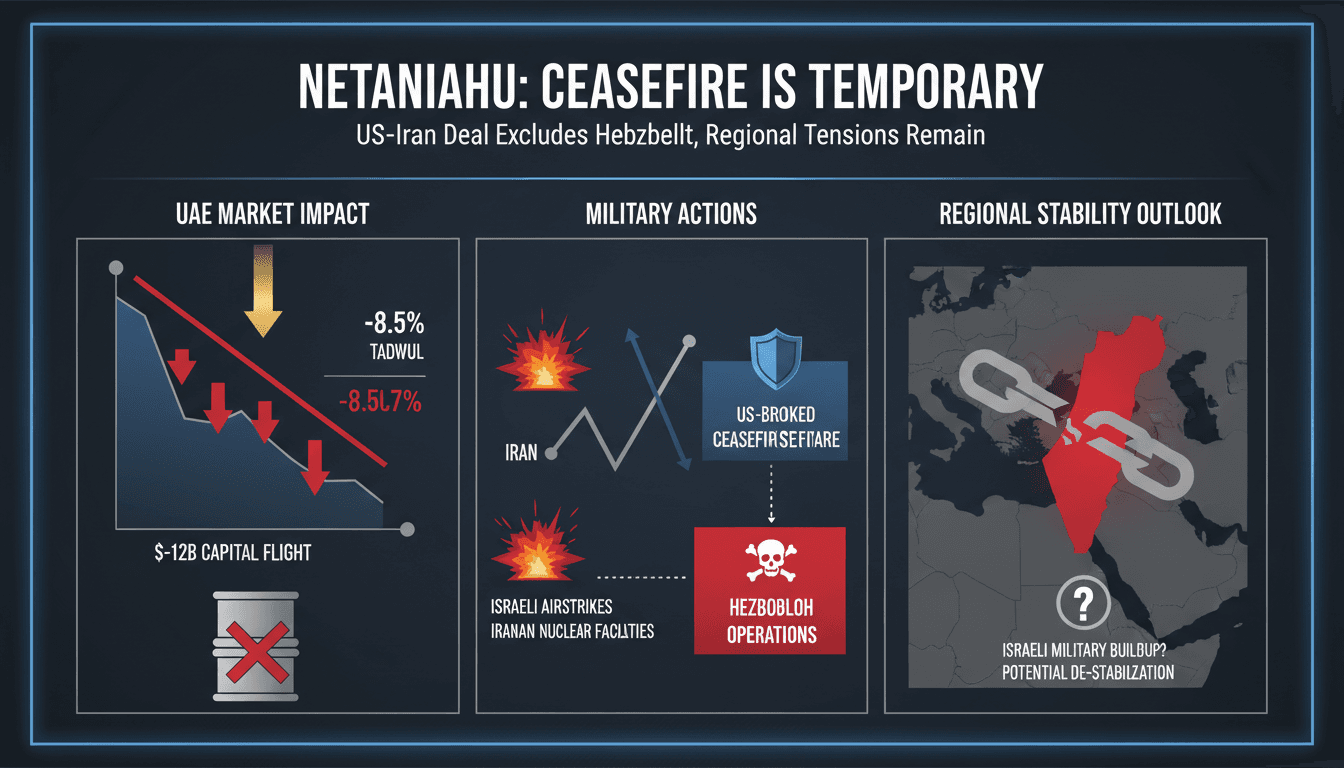
Here's what it means for you.
If you’re in the UAE or involved in regional markets, the ongoing conflict and its implications could directly impact your investments and travel plans.
Why it matters
The fragile ceasefire between the US, Israel, and Iran underscores ongoing regional instability that could disrupt markets and security in the Middle East.
What happened (in 30 seconds)
- Netanyahu clarified that the US-brokered ceasefire with Iran is a temporary pause, not a resolution to the conflict.
- Hezbollah operations in Lebanon remain unaffected by the ceasefire, indicating continued military engagements.
- Israeli military actions against Iranian targets have resulted in significant achievements, including the destruction of nuclear facilities.
The context you actually need
- Tensions escalated in early 2026 due to Israeli airstrikes on Iranian nuclear sites and scientists, leading to a broader conflict involving the US.
- A two-week ceasefire was announced on April 7-8, 2026, to facilitate negotiations, but it does not include Hezbollah, which complicates the situation further.
- Stock markets in Dubai and Abu Dhabi have lost over $120 billion since the onset of the conflict, reflecting the economic fallout from regional instability.
What's really happening
The recent declaration by Israeli Prime Minister Benjamin Netanyahu highlights a critical juncture in the ongoing conflict between Israel and Iran. While the US-brokered ceasefire aims to provide a temporary respite, Netanyahu's emphasis on the exclusion of Hezbollah operations indicates that military tensions are far from resolved. This situation is rooted in a complex web of geopolitical interests, where Israel seeks to neutralize Iranian influence in the region while maintaining a strong partnership with the US.
The backdrop of this announcement includes a series of Israeli airstrikes in March 2026 that targeted Iranian nuclear facilities and scientists, significantly escalating hostilities. The US, under President Donald Trump, intervened by issuing an ultimatum to Iran, which led to the acceptance of a 10-point ceasefire proposal. However, the ceasefire is seen as a tactical maneuver rather than a strategic resolution, with Netanyahu asserting Israel’s readiness to resume military operations if necessary.
The exclusion of Hezbollah from the ceasefire discussions is particularly significant. Hezbollah, a powerful militant group based in Lebanon, has been a key player in the regional conflict, often acting as a proxy for Iranian interests. By continuing operations against Hezbollah, Israel signals its intent to confront Iranian influence directly, which could lead to further escalations in Lebanon and beyond.
This situation has immediate implications for regional stability. The ongoing conflict has already resulted in over 37,000 flight cancellations and soaring airfares due to increased fuel costs, affecting travelers and businesses alike. Additionally, the economic ramifications are stark, with Dubai and Abu Dhabi stock markets experiencing a staggering $120 billion loss since the conflict began. This financial strain is felt across various sectors, particularly in tourism and trade, which are vital to the UAE's economy.
As the ceasefire remains fragile, the potential for renewed hostilities looms large, creating a precarious environment for both local and international stakeholders. The interplay between military actions and diplomatic efforts will be crucial in determining the future trajectory of this conflict.
Who feels it first (and how)
- Investors in UAE markets: Facing volatility and significant losses in stock values.
- Travelers and airlines: Experiencing disruptions and increased costs due to flight cancellations.
- Businesses reliant on stability: Particularly those in tourism and trade sectors, feeling the economic pinch from regional tensions.
What to watch next
- US diplomatic efforts: Continued negotiations between the US and Iran will be crucial in determining the longevity of the ceasefire and its potential expansion.
- Israeli military actions: Any escalation in operations against Hezbollah could signal a breakdown of the ceasefire and further destabilize the region.
- Market reactions: Watch for fluctuations in oil prices and stock markets in the UAE as they respond to developments in the conflict.
The ceasefire is a temporary measure and does not include Hezbollah operations.
Continued military engagements between Israel and Hezbollah, as well as potential escalations in the broader conflict.
The long-term effectiveness of diplomatic negotiations in achieving a lasting peace.
Frequently Asked Questions
- Why it matters?
- The fragile ceasefire between the US, Israel, and Iran underscores ongoing regional instability that could disrupt markets and security in the Middle East.
- What happened (in 30 seconds)?
- Netanyahu clarified that the US-brokered ceasefire with Iran is a temporary pause, not a resolution to the conflict. Hezbollah operations in Lebanon remain unaffected by the ceasefire, indicating continued military engagements. Israeli military actions against Iranian targets have resulted in significant achievements, including the destruction of nuclear facilities.
- What's really happening?
- The recent declaration by Israeli Prime Minister Benjamin Netanyahu highlights a critical juncture in the ongoing conflict between Israel and Iran. While the US-brokered ceasefire aims to provide a temporary respite, Netanyahu's emphasis on the exclusion of Hezbollah operations indicates that military tensions are far from resolved. This situation is rooted in a complex web of geopolitical interests, where Israel seeks to neutralize Iranian influence in the region while maintaining a strong part
- Who feels it first (and how)?
- Investors in UAE markets: Facing volatility and significant losses in stock values. Travelers and airlines: Experiencing disruptions and increased costs due to flight cancellations. Businesses reliant on stability: Particularly those in tourism and trade sectors, feeling the economic pinch from regional tensions.
- What to watch next?
- US diplomatic efforts: Continued negotiations between the US and Iran will be crucial in determining the longevity of the ceasefire and its potential expansion. Israeli military actions: Any escalation in operations against Hezbollah could signal a breakdown of the ceasefire and further destabilize the region. Market reactions: Watch for fluctuations in oil prices and stock markets in the UAE as they respond to developments in the conflict.
U.S. national news with a West Coast perspective.
"The Los Angeles Times is a major West Coast newspaper offering in-depth reporting with a liberal editorial tone and strong regional focus."
— A47 Editor
Netanyahu says ceasefire doesn't include Lebanon. Then 50 Israeli jets drop 160 bombs
Israeli Prime Minister Benjamin Netanyahu stated that the recent U.S.-brokered ceasefire does not apply to Lebanon, leading to a significant escalation in military operations as Israeli jets dropped 160 bombs on Hezbollah positions. This marks one of...
International news with cultural insight.
"The Los Angeles Times is a major West Coast newspaper offering in-depth reporting with a liberal editorial tone and strong regional focus."
— A47 Editor
Netanyahu says ceasefire doesn't include Lebanon. Then 50 Israeli jets drop 160 bombs
Israeli Prime Minister Benjamin Netanyahu stated that the recent U.S.-brokered ceasefire does not apply to Lebanon, leading to a significant escalation in military operations as Israeli jets dropped 160 bombs on Hezbollah positions. This marks one of...
Arabic-language coverage of political affairs and current events.
"Okaz political coverage typically follows mainstream Saudi framing on national and regional affairs."
— A47 Editor
نتنياهو: الاتفاق مع إيران ليس نهاية المعركة ولا يشمل لبنان
Israeli Prime Minister Benjamin Netanyahu stated that the agreement with Iran is not the end of the battle but a preparation phase for future actions. He emphasized that Iran has conceded all its conditions to halt the war and that Israel is ready to...
Global business headlines with AI angles.
"General business outlet that frequently covers AI."
— A47 Editor
Netanyahu Says Ceasefire Doesn't Mean 'The End Of The Campaign': 'We Will Achieve These Goals'
Israeli Prime Minister Benjamin Netanyahu stated that the recently announced ceasefire by the U.S. and Iran does not signify the conclusion of military operations, asserting that Israel will persist in pursuing its objectives.