
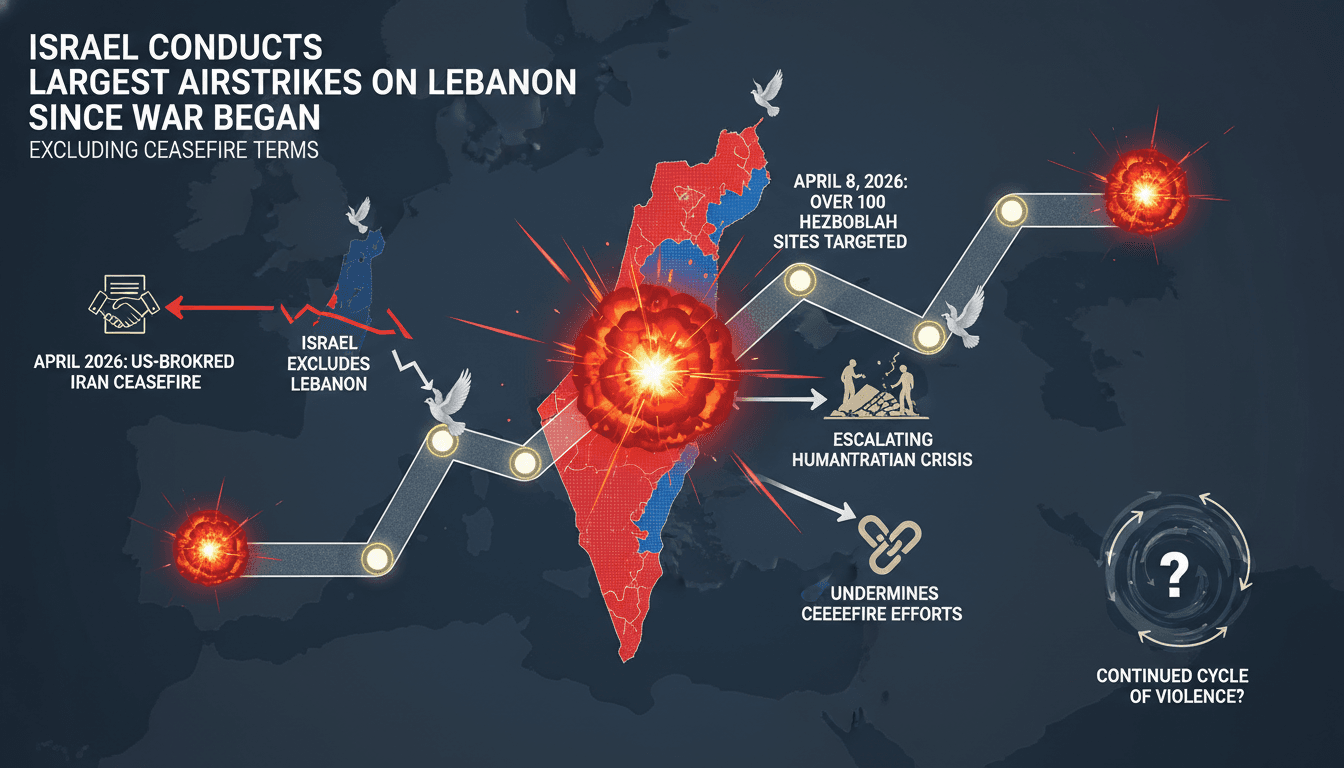
Israel Conducts Largest Airstrikes on Lebanon Since War Began Excluding Ceasefire Terms
Here's what it means for you.
The escalation of military actions in Lebanon could disrupt global markets and travel, impacting your economic stability.
Why it matters
The conflict's intensification poses risks to regional security and economic conditions, particularly affecting global oil prices and trade routes.
What happened (in 30 seconds)
- On April 8, 2026, Israel launched its largest airstrike campaign against Hezbollah in Lebanon since the onset of the current conflict.
- The strikes targeted over 100 sites, including command centers in Beirut and southern regions, following a US-brokered ceasefire that excluded Lebanon.
- Casualties are significant, with reports indicating over 1,530 Lebanese deaths since the war began, alongside mass displacement.
The context you actually need
- The 2026 Lebanon war began on March 2, 2026, when Hezbollah initiated rocket attacks on Israel, prompting a robust Israeli military response.
- A US-Iran ceasefire was announced on April 7-8, mediated by Pakistan, but Israel explicitly excluded operations against Hezbollah from this agreement.
- Civilian areas have been heavily impacted, with the Lebanese Red Cross reporting substantial casualties and hospitals overwhelmed by the influx of wounded.
What's really happening
The latest Israeli airstrikes represent a significant escalation in the ongoing conflict, which has already resulted in over 1,530 Lebanese casualties and displaced more than 1.1 million people. The strikes were executed just hours after a US-brokered ceasefire was announced, which aimed to halt hostilities between the US and Iran but did not extend to the Lebanon front. This exclusion reflects Israel's strategic decision to treat its operations against Hezbollah as separate from broader regional negotiations.
The Israeli government, led by Prime Minister Benjamin Netanyahu, has made it clear that its military operations will continue until Hezbollah's capabilities are significantly degraded. This stance indicates a commitment to a prolonged military engagement, which could further destabilize the region and complicate international diplomatic efforts. The Israeli Defense Forces (IDF) have been actively targeting Hezbollah infrastructure, including command centers and logistical hubs, to disrupt their operational capacity.
The airstrikes have not only resulted in immediate military objectives but have also led to severe humanitarian consequences. The Lebanese Red Cross has reported a dramatic increase in casualties, with hospitals calling for blood donations to cope with the influx of injured civilians. This humanitarian crisis is likely to provoke international outrage and could lead to calls for intervention or increased diplomatic pressure on Israel.
Moreover, the geopolitical implications of this conflict extend beyond Lebanon. The ongoing hostilities are affecting regional markets, with volatility observed in stock exchanges, particularly in the UAE, which has already suffered over $120 billion in losses due to the broader conflict. The situation is further complicated by the potential for Iranian retaliation, as Hezbollah has indicated that any military actions will be met with a coordinated response from Iran.
The airstrikes also underscore the fragility of the ceasefire negotiations. While Pakistani Prime Minister Shehbaz Sharif has insisted that the ceasefire includes Lebanon, Israel's actions suggest otherwise. The divergence in interpretations of the ceasefire could lead to further escalations, as both sides remain entrenched in their positions.
Who feels it first (and how)
- Civilians in Lebanon: Facing immediate danger, casualties, and displacement due to airstrikes.
- Regional markets: Investors and businesses in the UAE and surrounding areas are experiencing volatility and economic uncertainty.
- International travelers: Individuals planning to travel to or from the region may face disruptions due to airspace closures and increased military activity.
What to watch next
- Continuation of military operations: Monitor Israel's military actions against Hezbollah and any potential escalations that could further destabilize the region.
- International diplomatic responses: Watch for reactions from the US and other global powers regarding the ceasefire's applicability and potential interventions.
- Humanitarian developments: Keep an eye on the humanitarian situation in Lebanon, including international aid responses and the impact on civilian populations.
The conflict has resulted in significant casualties and displacement in Lebanon.
Continued military operations by Israel against Hezbollah, with potential for Iranian involvement.
The long-term implications for regional stability and international diplomatic efforts.
Frequently Asked Questions
- Why it matters?
- The conflict's intensification poses risks to regional security and economic conditions, particularly affecting global oil prices and trade routes.
- What happened (in 30 seconds)?
- On April 8, 2026, Israel launched its largest airstrike campaign against Hezbollah in Lebanon since the onset of the current conflict. The strikes targeted over 100 sites, including command centers in Beirut and southern regions, following a US-brokered ceasefire that excluded Lebanon. Casualties are significant, with reports indicating over 1,530 Lebanese deaths since the war began, alongside mass displacement.
- What's really happening?
- The latest Israeli airstrikes represent a significant escalation in the ongoing conflict, which has already resulted in over 1,530 Lebanese casualties and displaced more than 1.1 million people. The strikes were executed just hours after a US-brokered ceasefire was announced, which aimed to halt hostilities between the US and Iran but did not extend to the Lebanon front. This exclusion reflects Israel's strategic decision to treat its operations against Hezbollah as separate from broader regiona
- Who feels it first (and how)?
- Civilians in Lebanon: Facing immediate danger, casualties, and displacement due to airstrikes. Regional markets: Investors and businesses in the UAE and surrounding areas are experiencing volatility and economic uncertainty. International travelers: Individuals planning to travel to or from the region may face disruptions due to airspace closures and increased military activity.
- What to watch next?
- Continuation of military operations: Monitor Israel's military actions against Hezbollah and any potential escalations that could further destabilize the region. International diplomatic responses: Watch for reactions from the US and other global powers regarding the ceasefire's applicability and potential interventions. Humanitarian developments: Keep an eye on the humanitarian situation in Lebanon, including international aid responses and the impact on civilian populations.
International coverage from The Guardian's global desks.
"The Guardian is known for its progressive editorial stance and in-depth analysis."
— A47 Editor
At least 254 killed after Israel hits Lebanon with massive wave of airstrikes
Israel has conducted its largest airstrike on Lebanon since the onset of its conflict with Hezbollah, resulting in at least 254 fatalities and 837 injuries. This unprecedented assault targeted multiple buildings in Beirut, marking a significant escal...
International coverage of politics, culture, and current affairs.
"BBC News is widely regarded as a reputable international news organization, known for its impartial tone and public service mandate."
— A47 Editor
At least 182 killed across Lebanon in large wave of Israeli strikes
A large wave of Israeli airstrikes across Lebanon has resulted in at least 182 fatalities, primarily affecting the southern suburbs of Beirut, southern Lebanon, and the eastern Bekaa Valley. This escalation occurred shortly after a ceasefire agreemen...
Arabic-language coverage of political affairs and current events.
"Okaz political coverage typically follows mainstream Saudi framing on national and regional affairs."
— A47 Editor
حزام ناري شامل.. إسرائيل تشن أوسع هجوم على لبنان منذ عملية «زئير الأسد»
In a dramatic escalation, Israel launched a series of airstrikes targeting vital neighborhoods in the heart of Beirut, including areas known for their high population density and commercial activity, causing widespread panic among civilians. The atta...