
MIT Researchers Develop Total Uncertainty Metric to Enhance Reliability of Large Language Models
Here's what it means for you.
As AI continues to permeate critical sectors, understanding the reliability of its predictions is essential for informed decision-making.
Why it matters
This advancement in AI reliability could significantly impact industries relying on large language models, such as healthcare and finance.
What happened (in 30 seconds)
- On March 19, 2026, MIT researchers unveiled a new method called Total Uncertainty (TU) for detecting overconfidence in large language models (LLMs).
- TU combines aleatoric uncertainty from self-consistency with epistemic uncertainty from cross-model semantic disagreement, enhancing prediction reliability.
- The method is set to be presented at the International Conference on Learning Representations (ICLR 2026) in Rio de Janeiro, Brazil.
The context you actually need
- Large language models often produce incorrect outputs with high certainty, known as hallucinations, which can be particularly risky in high-stakes environments.
- Prior methods for uncertainty quantification have been limited, primarily relying on self-consistency, which fails when models consistently err.
- The new TU metric addresses these limitations by incorporating cross-model disagreement, offering a more robust framework for evaluating AI predictions.
What's really happening
The introduction of the Total Uncertainty (TU) metric marks a significant evolution in the field of artificial intelligence, particularly in the realm of large language models (LLMs). Developed by a team at MIT, including researchers from the MIT-IBM Watson AI Lab, TU enhances the reliability of AI predictions by addressing a critical flaw in existing uncertainty quantification methods. Traditionally, approaches have focused primarily on aleatoric uncertainty, which is the inherent randomness in data. This method involves sampling multiple responses from the same model to gauge its consistency. However, this approach falls short when a model consistently produces incorrect outputs, leading to overconfidence in its predictions—a phenomenon known as hallucination.
The TU metric innovatively combines aleatoric uncertainty with epistemic uncertainty, which arises from gaps in the model's knowledge. By leveraging cross-model semantic disagreement among similar LLMs from different vendors, TU provides a more comprehensive understanding of uncertainty in AI predictions. This dual approach allows for the identification of overconfident predictions that might otherwise go undetected, thus enhancing the reliability of AI systems in critical applications such as healthcare and finance.
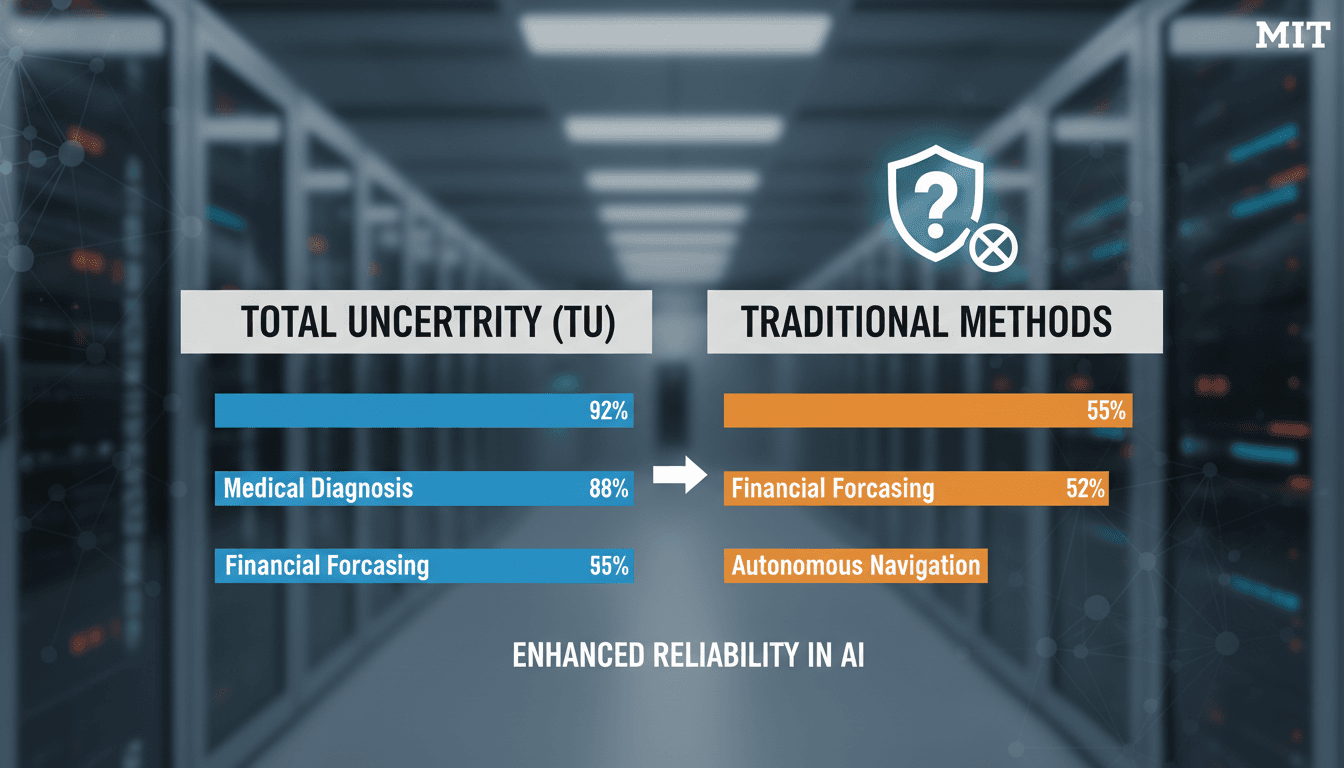
The research team evaluated TU across five instruction-tuned LLMs and ten diverse tasks, demonstrating its superiority in detecting unreliable predictions. The aggregated Area Under the Receiver Operating Characteristic curve (AUROC) for TU was reported at 0.746, outperforming traditional aleatoric uncertainty measures, which averaged 0.707. This empirical evidence underscores the potential of TU to improve decision-making processes in sectors where accuracy is paramount.
As AI technologies become increasingly integrated into various industries, the implications of this research extend beyond academic interest. Organizations deploying LLMs will need to consider the reliability of their outputs, particularly in high-stakes environments. The introduction of TU could lead to enhanced AI deployment pipelines, where the reliability of predictions is systematically evaluated, thereby reducing the risks associated with overconfident outputs.
Moreover, the research's relevance is amplified by its potential application in regions like Dubai, where AI initiatives are rapidly advancing. Although no direct impacts on Dubai residents have been identified, the involvement of Mikhail Yurochkin from the Institute for Foundational Models at Mohamed bin Zayed University of Artificial Intelligence (MBZUAI) suggests that this research could contribute to regional AI safety efforts.
Who feels it first (and how)
- Healthcare professionals: Increased reliability in AI-driven diagnostics and treatment recommendations.
- Financial analysts: Enhanced accuracy in predictive models for market trends and risk assessments.
- AI developers: Improved methodologies for integrating uncertainty quantification in model training and deployment.
- Regulatory bodies: Greater assurance in the safety and efficacy of AI applications in critical sectors.
What to watch next
- Adoption of TU in AI systems: Monitor how quickly organizations implement this metric in their LLM deployment pipelines, as it could reshape industry standards.
- Regulatory responses: Watch for potential regulations emerging around AI reliability and safety, particularly in sectors like healthcare and finance.
- Research collaborations: Look for partnerships between academic institutions and industry players that aim to further develop and refine uncertainty quantification methods.
The TU metric improves the detection of overconfident predictions in large language models.
Organizations will begin integrating TU into their AI systems, particularly in high-stakes industries.
The long-term impact of TU on AI regulatory frameworks and industry standards remains to be seen.
Frequently Asked Questions
- Why it matters?
- This advancement in AI reliability could significantly impact industries relying on large language models, such as healthcare and finance.
- What happened (in 30 seconds)?
- On March 19, 2026, MIT researchers unveiled a new method called Total Uncertainty (TU) for detecting overconfidence in large language models (LLMs). TU combines aleatoric uncertainty from self-consistency with epistemic uncertainty from cross-model semantic disagreement, enhancing prediction reliability. The method is set to be presented at the International Conference on Learning Representations (ICLR 2026) in Rio de Janeiro, Brazil.
- What's really happening?
- The introduction of the Total Uncertainty (TU) metric marks a significant evolution in the field of artificial intelligence, particularly in the realm of large language models (LLMs). Developed by a team at MIT, including researchers from the MIT-IBM Watson AI Lab, TU enhances the reliability of AI predictions by addressing a critical flaw in existing uncertainty quantification methods. Traditionally, approaches have focused primarily on aleatoric uncertainty, which is the inherent randomness in
- Who feels it first (and how)?
- Healthcare professionals: Increased reliability in AI-driven diagnostics and treatment recommendations. Financial analysts: Enhanced accuracy in predictive models for market trends and risk assessments. AI developers: Improved methodologies for integrating uncertainty quantification in model training and deployment. Regulatory bodies: Greater assurance in the safety and efficacy of AI applications in critical sectors.
- What to watch next?
- Adoption of TU in AI systems: Monitor how quickly organizations implement this metric in their LLM deployment pipelines, as it could reshape industry standards. Regulatory responses: Watch for potential regulations emerging around AI reliability and safety, particularly in sectors like healthcare and finance. Research collaborations: Look for partnerships between academic institutions and industry players that aim to further develop and refine uncertainty quantification methods.
Latest AI/ML research news and breakthroughs.
"Aggregated research highlights across institutions."
— A47 Editor
A better method for identifying overconfident large language models
Researchers have developed improved methods for identifying overconfident large language models (LLMs), which can produce seemingly credible but inaccurate responses. Traditional methods that assess self-confidence may not accurately reflect the reli...
MIT news on machine learning research and impact.
"Institutional news highlighting ML breakthroughs at MIT."
— A47 Editor
A better method for identifying overconfident large language models
A new metric for measuring uncertainty in large language models has been developed, which aims to identify overconfident AI systems and flag potential hallucinations. This advancement is reported by MIT News and is expected to enhance user trust in A...
Computation and Language (NLP) preprints.
"Daily stream of NLP research papers and preprints."
— A47 Editor
Can LLMs Detect Their Confabulations? Estimating Reliability in Uncertainty-Aware Language Models
A recent study investigates the reliability of Large Language Models (LLMs) in detecting their own confabulations, which are fluent but incorrect outputs. The research focuses on how in-context information affects model behavior and proposes a method...