
Iran Conducts Missile and Drone Strikes on Gulf States Following US-Iran Ceasefire Announcement
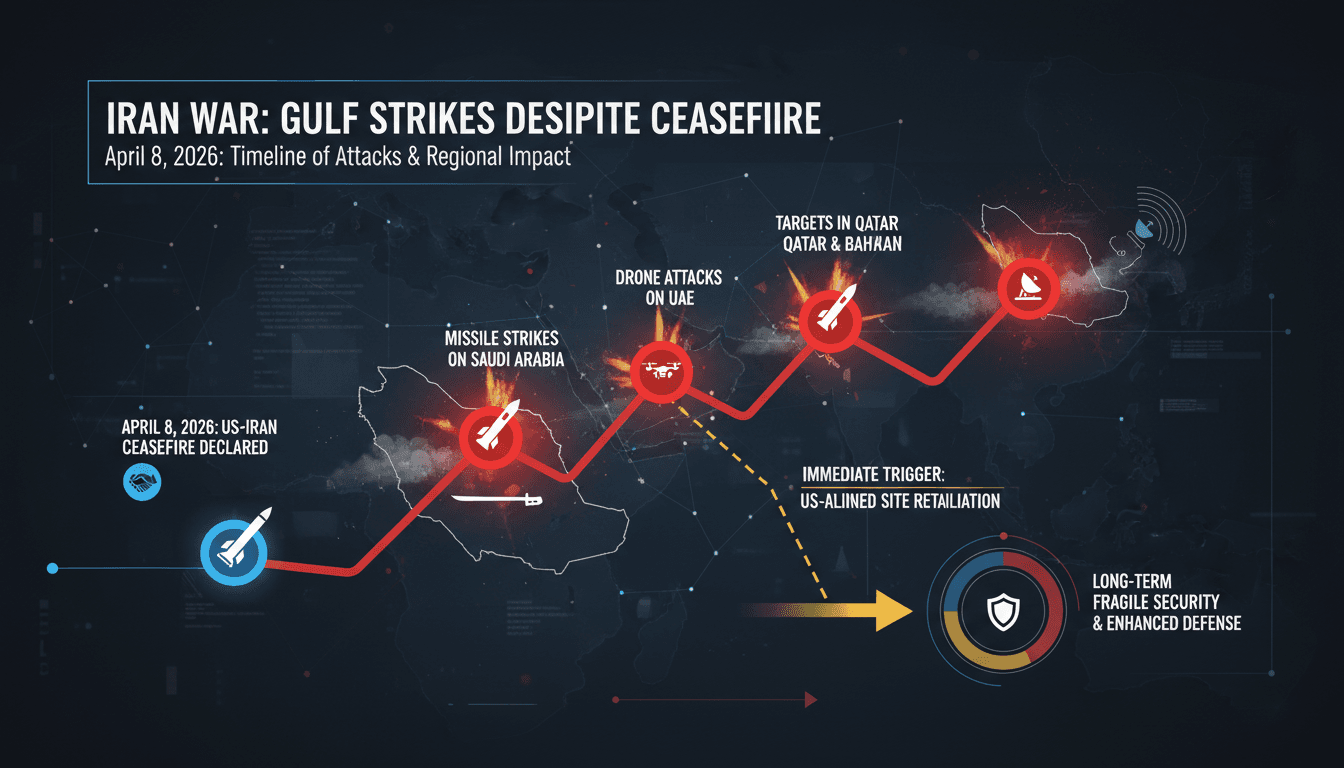
Here's what it means for you.
If you have business interests or travel plans in the Gulf region, the escalating conflict could impact safety and economic stability.
Why it matters
The recent missile and drone attacks by Iran highlight the fragility of regional security and the potential for broader economic repercussions.
What happened (in 30 seconds)
- Iran launched missile and drone strikes on Gulf Arab states hours after a US-brokered ceasefire announcement.
- Regional air defenses intercepted most attacks, resulting in limited damage and minor injuries.
- The ongoing conflict stems from the 2026 Iran war, ignited by US and Israeli strikes on Iranian facilities.
The context you actually need
- The 2026 Iran war began on February 28, following US and Israeli airstrikes on Iranian military and nuclear sites, escalating tensions in the region.
- Iran has conducted over 5,471 attacks on US-aligned sites in Gulf states since the war began, demonstrating its capability and willingness to retaliate.
- The fragile ceasefire announced on April 8, 2026, is contingent on halting hostilities and reopening the Strait of Hormuz, a crucial global oil trade route.
What's really happening
The recent missile and drone attacks by Iran on Gulf states serve as a stark reminder of the ongoing volatility in the region. Following the US and Israeli airstrikes on Iranian facilities, Iran has responded with a sustained campaign of retaliatory strikes against US-aligned targets in the Gulf. This has included over 5,471 missile and drone attacks on critical infrastructure in countries like the UAE, Kuwait, Bahrain, Qatar, and Saudi Arabia since the conflict's inception.
The timing of these attacks, just hours after a US-brokered ceasefire was announced, underscores Iran's defiance and the tenuous nature of diplomatic resolutions in the region. The ceasefire, brokered in Islamabad, aimed to halt hostilities for two weeks, but the lack of consensus on Iran's nuclear and missile programs remains a significant barrier to lasting peace.
The Gulf states' air defenses managed to intercept most of the incoming threats, mitigating potential damage and casualties. However, the attacks still caused minor injuries and disruptions, particularly in energy infrastructure, which is vital for the region's economy. For instance, a fire at the Habshan gas complex in the UAE led to temporary operational suspensions, illustrating how quickly tensions can escalate into tangible economic impacts.
The ongoing conflict has broader implications for global oil markets, as the Strait of Hormuz is a critical chokepoint for oil shipments, accounting for approximately 20% of the world's oil trade. Any disruption in this area can lead to significant fluctuations in oil prices, affecting economies worldwide. The recent attacks caused a brief dip in oil prices, but the underlying instability suggests that markets will remain sensitive to developments in the region.
Furthermore, the attacks reflect Iran's strategic calculus, where demonstrating military capability serves both as a deterrent against perceived aggressors and as a means of rallying domestic support amid external pressures. The regional states, while welcoming the ceasefire, are likely to remain on high alert, recognizing that Iran's missile and nuclear capabilities persist even in a temporary truce.
Who feels it first (and how)
- Business travelers: Increased safety concerns may affect travel plans and business operations in the Gulf.
- Energy sector professionals: Fluctuations in oil prices and potential disruptions in supply chains could impact jobs and investments.
- Local residents: Citizens in Gulf states may experience heightened security measures and disruptions to daily life due to ongoing military tensions.
What to watch next
- Ceasefire compliance: Monitor whether Iran adheres to the ceasefire terms and if hostilities escalate again, which could signal a shift in regional stability.
- Oil price fluctuations: Keep an eye on oil market reactions to any further attacks or military engagements, as these can have immediate economic impacts globally.
- Diplomatic negotiations: Watch for developments in talks regarding Iran's nuclear and missile programs, as progress or setbacks will influence regional security dynamics.
Iran's missile and drone capabilities pose a significant threat to Gulf states.
Continued military tensions and potential for further attacks despite ceasefire efforts.
The long-term effectiveness of diplomatic negotiations on Iran's nuclear and missile programs.
Frequently Asked Questions
- Why it matters?
- The recent missile and drone attacks by Iran highlight the fragility of regional security and the potential for broader economic repercussions.
- What happened (in 30 seconds)?
- Iran launched missile and drone strikes on Gulf Arab states hours after a US-brokered ceasefire announcement. Regional air defenses intercepted most attacks, resulting in limited damage and minor injuries. The ongoing conflict stems from the 2026 Iran war, ignited by US and Israeli strikes on Iranian facilities.
- What's really happening?
- The recent missile and drone attacks by Iran on Gulf states serve as a stark reminder of the ongoing volatility in the region. Following the US and Israeli airstrikes on Iranian facilities, Iran has responded with a sustained campaign of retaliatory strikes against US-aligned targets in the Gulf. This has included over 5,471 missile and drone attacks on critical infrastructure in countries like the UAE, Kuwait, Bahrain, Qatar, and Saudi Arabia since the conflict's inception. The timing of these
- Who feels it first (and how)?
- Business travelers: Increased safety concerns may affect travel plans and business operations in the Gulf. Energy sector professionals: Fluctuations in oil prices and potential disruptions in supply chains could impact jobs and investments. Local residents: Citizens in Gulf states may experience heightened security measures and disruptions to daily life due to ongoing military tensions.
- What to watch next?
- Ceasefire compliance: Monitor whether Iran adheres to the ceasefire terms and if hostilities escalate again, which could signal a shift in regional stability. Oil price fluctuations: Keep an eye on oil market reactions to any further attacks or military engagements, as these can have immediate economic impacts globally. Diplomatic negotiations: Watch for developments in talks regarding Iran's nuclear and missile programs, as progress or setbacks will influence regional security dynamics.
European coverage of Middle East politics and security issues.
"France 24 offers international reporting with a European editorial perspective."
— A47 Editor
Iran continues to target Gulf countries despite ceasefire announcement
Despite a recent two-week ceasefire agreement between the United States and Iran, which includes Iran's commitment to reopen the strategically vital Strait of Hormuz, Iran continues to target Gulf countries, raising concerns about regional stability....
Coverage of current events and conflicts in the Middle East.
"France 24 is viewed as a globally focused outlet with balanced coverage and a European perspective."
— A47 Editor
Iran continues to target Gulf countries despite ceasefire announcement
Despite a recent two-week ceasefire agreement between the United States and Iran, which includes Iran's commitment to reopen the strategically vital Strait of Hormuz, Iran continues to target Gulf countries, raising concerns about regional stability....
Regional and international reporting focused on Middle Eastern politics, diplomacy, and economics.
"Asharq Al-Awsat is a Saudi-owned international newspaper reflecting mainstream Gulf political perspectives."
— A47 Editor
Iran Attacks on Gulf States Continue Despite Ceasefire Announcement
Despite a recent ceasefire announcement, Iran has continued its military aggression against Gulf States, raising concerns about regional stability. Reports indicate ongoing attacks, including missile and drone strikes, which have intensified tensions...