
Samsung Electronics Reports Record Q1 2026 Semiconductor Profit Amid AI Chip Demand Surge
Here's what it means for you.
If you're in tech or consumer electronics, expect rising prices and potential supply constraints.
Why it matters
Samsung's semiconductor profits signal a critical shift in the global tech supply chain, particularly for AI applications.
What happened (in 30 seconds)
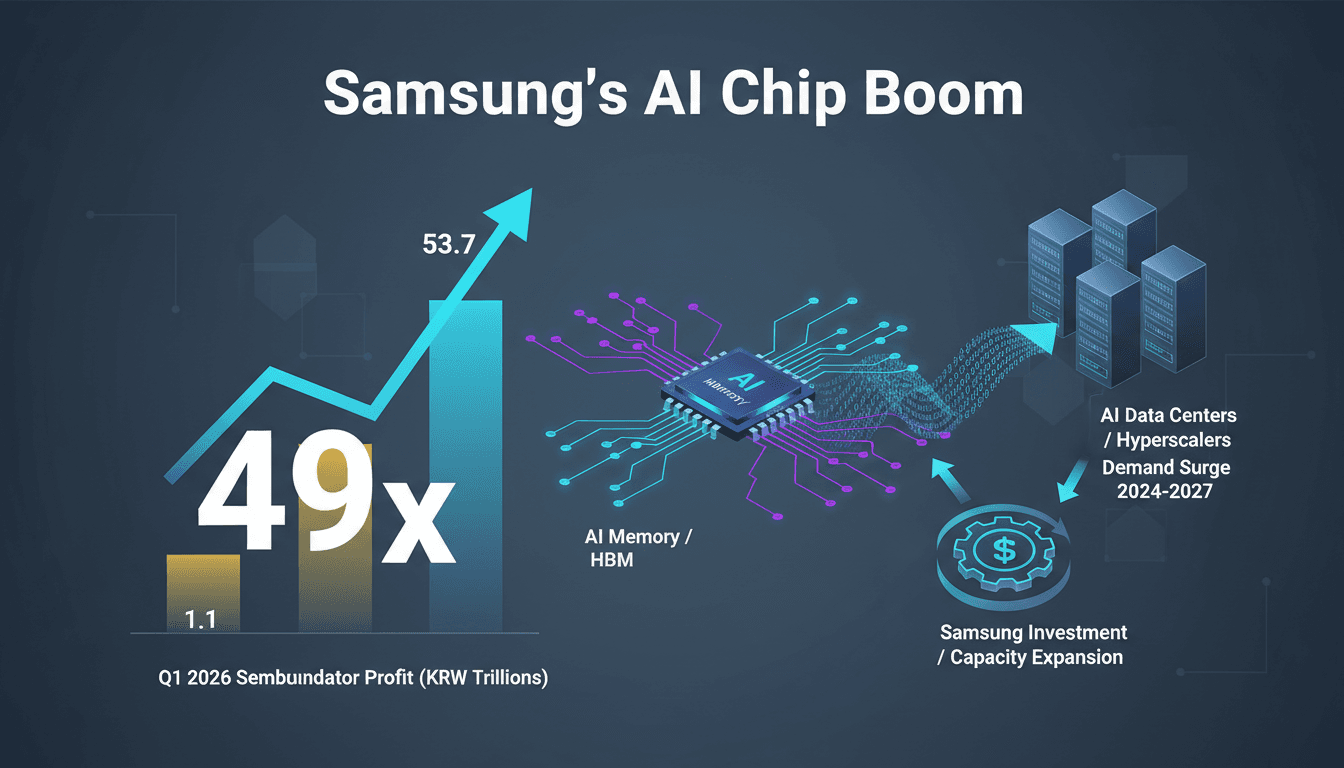
- Samsung Electronics reported a staggering 49-fold increase in semiconductor operating profit to 53.7 trillion won for Q1 2026.
- High-bandwidth memory (HBM) demand surged due to AI applications, driving revenue to 81.7 trillion won.
- Executives forecast that supply shortages will worsen through 2027, impacting pricing and availability.
The context you actually need
- 2025 was challenging for Samsung's memory chip sector, marked by oversupply and weak pricing, leading to modest profits.
- The landscape shifted in early 2026 as hyperscalers expanded AI data centers, increasing demand for HBM crucial for AI accelerators like Nvidia GPUs.
- Geopolitical tensions in the Middle East have prompted Samsung to diversify its gas supplies, affecting fabrication processes.
What's really happening
The semiconductor market is undergoing a seismic shift driven by the explosive growth of artificial intelligence. In Q1 2026, Samsung Electronics reported an operating profit of 53.7 trillion won, a staggering increase from just 1.1 trillion won in the same quarter the previous year. This surge is primarily attributed to the skyrocketing demand for high-bandwidth memory (HBM), which is essential for powering AI applications and data centers.
As major tech companies, known as hyperscalers, ramp up their AI infrastructure, the need for advanced memory solutions has intensified. Samsung's decision to initiate mass production of HBM4 chips for Nvidia's Vera Rubin platform in February 2026 exemplifies this trend. The company’s semiconductor division generated 81.7 trillion won in revenue, accounting for 94% of its overall operating profit of 57.2 trillion won. This marks a significant turnaround from the subdued market conditions of 2025, where oversupply and weak pricing plagued the memory sector.
However, the rapid growth in demand has created a supply-demand imbalance that is expected to widen through 2027. Memory executive Kim Jaejune highlighted during the earnings call that current supply levels are insufficient to meet demand, with booked orders indicating that the gap will only increase. This situation is compounded by Samsung's strategic reallocation of production capacity toward advanced HBM nodes, which has constrained the supply of conventional DRAM and elevated prices.
Additionally, geopolitical factors are influencing Samsung's operations. Tensions in the Middle East have prompted the company to diversify its gas supplies, which are critical for its fabrication processes. This move is part of a broader strategy to mitigate risks associated with supply chain disruptions.
As a result, analysts anticipate that memory prices will remain elevated into the second half of 2026, impacting not only Samsung but also the broader tech ecosystem. The implications of these developments extend beyond just Samsung's bottom line; they signal a potential increase in consumer electronics prices and could constrain the expansion of AI data centers in regions like the UAE.
Who feels it first (and how)
- Tech companies: Increased costs for memory chips may lead to higher prices for consumer electronics.
- AI startups: Potential supply shortages could hinder growth and scalability.
- Data center operators: Rising costs and limited availability of HBM may impact infrastructure investments.
- Consumers: Higher prices for gadgets and devices reliant on advanced memory technology.
What to watch next
- Supply chain adjustments: Monitor how Samsung and competitors adapt their production strategies to meet rising demand.
- Pricing trends: Keep an eye on memory chip prices and their impact on consumer electronics.
- Geopolitical developments: Watch for changes in the Middle East that could affect Samsung's supply chain and production capabilities.
Samsung's semiconductor profits surged due to AI-driven demand.
Supply shortages will continue to escalate through 2027.
The long-term impact on consumer electronics pricing remains uncertain.
Frequently Asked Questions
- Why it matters?
- Samsung's semiconductor profits signal a critical shift in the global tech supply chain, particularly for AI applications.
- What happened (in 30 seconds)?
- Samsung Electronics reported a staggering 49-fold increase in semiconductor operating profit to 53.7 trillion won for Q1 2026. High-bandwidth memory (HBM) demand surged due to AI applications, driving revenue to 81.7 trillion won. Executives forecast that supply shortages will worsen through 2027, impacting pricing and availability.
- What's really happening?
- The semiconductor market is undergoing a seismic shift driven by the explosive growth of artificial intelligence. In Q1 2026, Samsung Electronics reported an operating profit of 53.7 trillion won, a staggering increase from just 1.1 trillion won in the same quarter the previous year. This surge is primarily attributed to the skyrocketing demand for high-bandwidth memory (HBM), which is essential for powering AI applications and data centers. As major tech companies, known as hyperscalers, ramp
- Who feels it first (and how)?
- Tech companies: Increased costs for memory chips may lead to higher prices for consumer electronics. AI startups: Potential supply shortages could hinder growth and scalability. Data center operators: Rising costs and limited availability of HBM may impact infrastructure investments. Consumers: Higher prices for gadgets and devices reliant on advanced memory technology.
- What to watch next?
- Supply chain adjustments: Monitor how Samsung and competitors adapt their production strategies to meet rising demand. Pricing trends: Keep an eye on memory chip prices and their impact on consumer electronics. Geopolitical developments: Watch for changes in the Middle East that could affect Samsung's supply chain and production capabilities.
Tech news, hardware, and AI tools coverage.
"PC/tech site increasingly covering AI hardware and apps."
— A47 Editor
Samsung's chip profit jumped nearly 50-fold in a single year, execs warn the shortage will get worse
Samsung's semiconductor operating profit surged to 53.7 trillion won ($36.15 billion) in Q1 2026, a nearly 50-fold increase from 1.1 trillion won a year prior, driven by a 69% rise in revenue to 133.9 trillion won. This remarkable growth highlights t...
Latest tech news, product reviews, and analysis for consumers and professionals.
"CNET delivers accessible and detailed technology reporting, including trusted product reviews and how-to guides."
— A47 Editor
Samsung Chip Profits Soar Amid the Tech World's RAM Shortages
Samsung Electronics Co. has reported a staggering 48-fold increase in profits within its semiconductor division, driven by the surging demand for memory chips fueled by artificial intelligence (AI) applications. This remarkable growth comes amid ongo...
Top international stories selected by The Guardian editors.
"The Guardian is known for its progressive editorial stance and in-depth analysis."
— A47 Editor
Samsung reports record quarterly profit as chip income jumps almost 50-fold
Samsung Electronics reported a record quarterly profit, driven by a staggering 49-fold increase in chip income, as the demand for memory chips surges due to the AI boom. The company anticipates that the global memory chip shortage will persist, exace...
News and features on AI from The Guardian.
"Progressive-leaning international outlet with critical AI coverage."
— A47 Editor
Samsung reports record quarterly profit as chip income jumps almost 50-fold
Samsung Electronics reported a record quarterly profit, driven by a staggering 49-fold increase in chip income, as the demand for memory chips surges due to the AI boom. The company anticipates that the global memory chip shortage will persist, exace...
Tech business coverage, major deals, product launches, and Silicon Valley trends.
"WSJ’s tech section offers authoritative reporting on the intersection of technology and business, including exclusive industry analysis."
— A47 Editor
AI Has Made Memory Chips One of the World’s Most Profitable Products
Samsung is projected to surpass Apple, Microsoft, and Alphabet in earnings this year, driven by the booming demand for memory chips, which have become one of the most profitable products globally. This surge is attributed to the increasing reliance o...
Technology and innovation coverage, including consumer tech and digital transformation stories.
"Emirates 24|7 technology coverage often highlights practical tech developments with relevance to Gulf readers and businesses."
— A47 Editor
Samsung Electronics Q1 chip profit jumps almost 50-fold, sees robust AI demand Samsung Electronics Q1 chip profit jumps almost 50-fold, sees robust AI demand
Samsung Electronics reported a record quarterly profit, with a staggering 49-fold increase in chip income, driven by robust demand for AI infrastructure and memory chips. The company anticipates this momentum to continue as clients invest heavily in ...
Market-moving headlines impacting equities, bonds, and related risk assets.
"Real-time catalysts and volatility drivers across indices and sectors."
— A47 Editor
Samsung chip profit jumps almost 50-fold; supply shortage to worsen in 2027
Samsung has reported a staggering nearly 50-fold increase in its chip profits, driven by a surge in demand for AI chips, which has significantly impacted the semiconductor market. This remarkable growth highlights the company's strong positioning in ...
Technology business and AI-related headlines.
"Data-driven tech newsroom with global scope."
— A47 Editor
Samsung Beats Estimates After Chip Sales Defy War Fears
Samsung Electronics Co. reported an impressive eight-fold increase in quarterly profit, driven by robust demand for AI memory chips, despite ongoing geopolitical tensions in the Middle East. This surge highlights the company's strong market position ...
Technology business news, market impacts, and innovation trends.
"Bloomberg is a premier financial and tech news provider, respected for its in-depth reporting and analytical rigor."
— A47 Editor
Samsung Beats Estimates After Chip Sales Defy War Fears
Samsung Electronics Co. reported an impressive eight-fold increase in quarterly profit, driven by robust demand for AI memory chips, despite ongoing geopolitical tensions in the Middle East. This surge highlights the company's strong market position ...
U.S. business news, corporate developments, and economy.
"The Wall Street Journal is respected for deep financial and economic reporting with a center-right editorial perspective."
— A47 Editor
Samsung’s Net Profit Soars as AI Demand Fuels Record Chip Earnings
Samsung has reported a remarkable nearly sixfold increase in its first-quarter net profit, driven by record earnings in its semiconductor business, which is significantly bolstered by the rising demand for artificial intelligence (AI) technologies.
Curated tech headlines including AI stories.
"Influential aggregator surfacing the day’s top tech/AI links."
— A47 Editor
Samsung reports Q1 revenue up 69% YoY to ~$90.2B, vs. ~$89.4B est., and operating profit up 756% to ~$38.5B, vs. ~$37.2B est., driven by AI-linked memory demand (Dylan Butts/CNBC)
Samsung Electronics reported a significant increase in its Q1 revenue, rising 69% year-over-year to approximately $90.2 billion, and an operating profit surge of 756% to around $38.5 billion, driven primarily by robust demand for AI-linked memory pro...
Technology business and AI-related headlines.
"Data-driven tech newsroom with global scope."
— A47 Editor
Samsung’s Chip Profit Soars 48-Fold Due to AI Spending Frenzy
Samsung Electronics Co. reported a remarkable 48-fold increase in profit within its semiconductor division, driven by the escalating demand for memory chips fueled by artificial intelligence (AI) applications. This surge in profitability highlights t...
Technology business news, market impacts, and innovation trends.
"Bloomberg is a premier financial and tech news provider, respected for its in-depth reporting and analytical rigor."
— A47 Editor
Samsung’s Chip Profit Soars 48-Fold on AI-Fueled Memory Shortage
Samsung Electronics Co. reported a remarkable 48-fold increase in profit within its semiconductor division, driven by the escalating demand for memory chips fueled by artificial intelligence (AI) applications. This surge in profitability highlights t...