
Trump Orders U.S. Military to Stay Near Iran Until Ceasefire Compliance
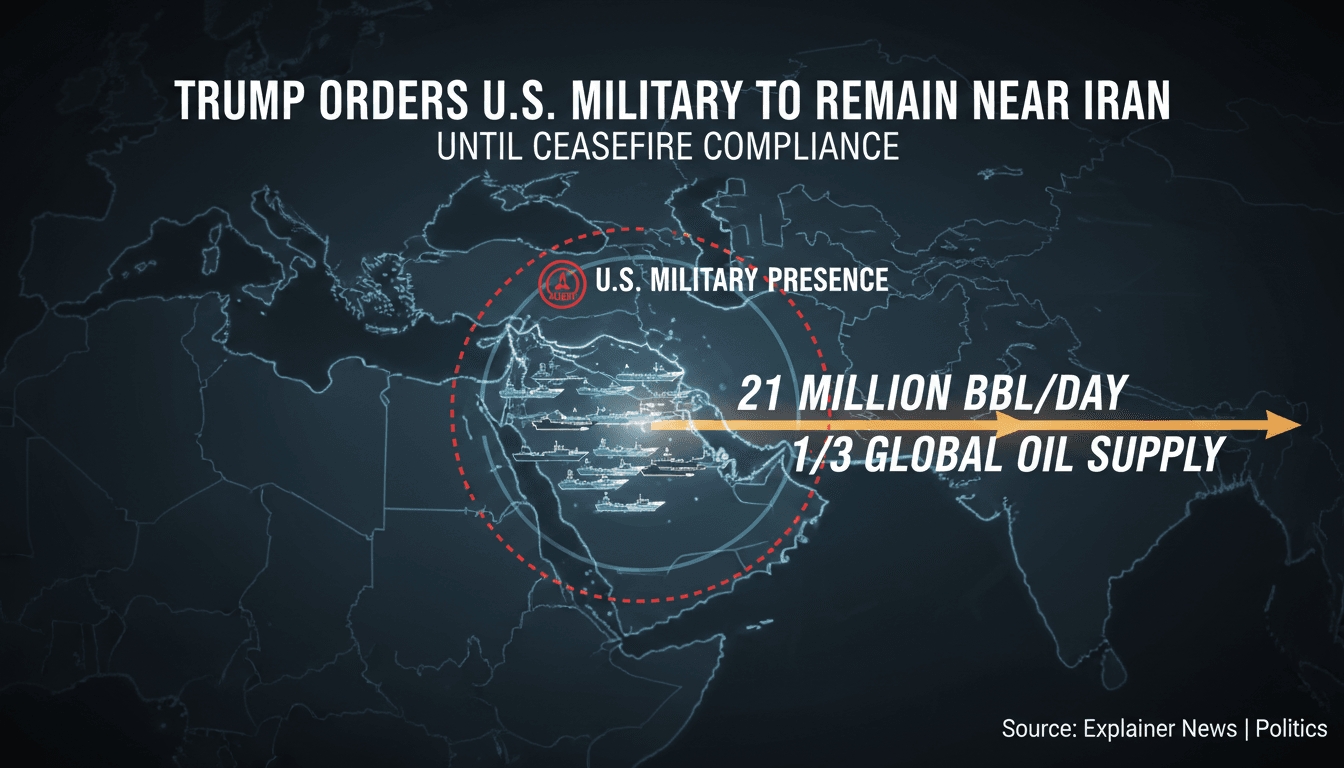
Here's what it means for you.
If you rely on stable energy prices or are involved in international trade, this military stance could impact your costs and logistics.
Why it matters
The U.S. military's presence in the Persian Gulf directly affects global oil prices and regional stability, influencing markets worldwide.
What happened (in 30 seconds)
- On April 9, 2026, President Trump announced U.S. military assets will remain in and around Iran until compliance with a ceasefire agreement.
- This follows a two-week ceasefire brokered by Pakistan after six weeks of hostilities initiated by U.S.-Israeli strikes on Iranian targets.
- Trump's statement emphasizes the importance of an open Strait of Hormuz and threatens military escalation if Iran fails to comply.
The context you actually need
- The Iran war began on February 28, 2026, with U.S.-Israeli airstrikes targeting Iranian military infrastructure, escalating tensions in the region.
- The Strait of Hormuz is a critical chokepoint for global oil transportation, with 20% of petroleum liquids consumption passing through it annually.
- Negotiations are ongoing in Islamabad, focusing on nuclear restrictions and maritime security amid compliance monitoring.
What's really happening
The announcement from President Trump reflects a strategic decision to maintain military pressure on Iran, which has been a focal point of U.S. foreign policy for decades. The U.S. military's presence in the region serves multiple purposes: it acts as a deterrent against Iranian aggression, reassures allies in the Gulf, and secures vital shipping routes that are crucial for global energy markets.
The backdrop of this situation is the ongoing conflict that erupted following U.S.-Israeli airstrikes on February 28, 2026. These strikes were a response to Iran's disruptive actions in the Strait of Hormuz, which included threats to block this vital maritime route. The U.S. aimed to curb Iran's nuclear ambitions and military capabilities, leading to a significant military buildup in the Gulf region.
The ceasefire brokered by Pakistan was a temporary measure to ease hostilities and allow for negotiations. However, Trump's declaration of a sustained military presence indicates that the U.S. is not willing to back down until it achieves a "real agreement" with Iran. This stance could lead to further military escalation if Iran does not comply with the terms set forth in the negotiations.
The implications of this military posture extend beyond the immediate conflict. Global oil prices are already reacting to the uncertainty, with Brent crude rising 2.46% to $97.08 per barrel. For countries like the UAE and regions dependent on stable energy prices, this could translate into higher fuel costs and inflationary pressures.
Moreover, the U.S. military's presence is likely to influence geopolitical dynamics in the region, affecting relationships with other nations and potentially drawing in additional players. As negotiations unfold, the outcomes will not only determine the future of U.S.-Iran relations but also impact global energy security and economic stability.
Who feels it first (and how)
- Energy consumers: Increased fuel prices directly affect households and businesses relying on oil.
- Aviation sector: Higher oil prices lead to increased operational costs for airlines, impacting ticket prices and travel demand.
- Logistics and trade companies: Disruptions in shipping routes can lead to delays and increased costs in international trade.
- Residents of Dubai: Proximity to the Strait of Hormuz means local economies are sensitive to fluctuations in oil prices and regional stability.
What to watch next
- Negotiation outcomes: The success or failure of talks in Islamabad will significantly influence military actions and regional stability.
- Oil price trends: Monitor Brent crude prices as they reflect market reactions to geopolitical developments.
- Military movements: Watch for changes in U.S. military deployments in the region, which could signal shifts in policy or escalation.
The U.S. military will maintain its presence in the region until Iran complies with the ceasefire agreement.
Oil prices will continue to fluctuate based on developments in U.S.-Iran relations and military actions.
The long-term implications of sustained military presence on regional stability and international relations remain uncertain.
Frequently Asked Questions
- Why it matters?
- The U.S. military's presence in the Persian Gulf directly affects global oil prices and regional stability, influencing markets worldwide.
- What happened (in 30 seconds)?
- On April 9, 2026, President Trump announced U.S. military assets will remain in and around Iran until compliance with a ceasefire agreement. This follows a two-week ceasefire brokered by Pakistan after six weeks of hostilities initiated by U.S.-Israeli strikes on Iranian targets. Trump's statement emphasizes the importance of an open Strait of Hormuz and threatens military escalation if Iran fails to comply.
- What's really happening?
- The announcement from President Trump reflects a strategic decision to maintain military pressure on Iran, which has been a focal point of U.S. foreign policy for decades. The U.S. military's presence in the region serves multiple purposes: it acts as a deterrent against Iranian aggression, reassures allies in the Gulf, and secures vital shipping routes that are crucial for global energy markets. The backdrop of this situation is the ongoing conflict that erupted following U.S.-Israeli airstri
- Who feels it first (and how)?
- Energy consumers: Increased fuel prices directly affect households and businesses relying on oil. Aviation sector: Higher oil prices lead to increased operational costs for airlines, impacting ticket prices and travel demand. Logistics and trade companies: Disruptions in shipping routes can lead to delays and increased costs in international trade. Residents of Dubai: Proximity to the Strait of Hormuz means local economies are sensitive to fluctuations in oil prices and regional stability.
- What to watch next?
- Negotiation outcomes: The success or failure of talks in Islamabad will significantly influence military actions and regional stability. Oil price trends: Monitor Brent crude prices as they reflect market reactions to geopolitical developments. Military movements: Watch for changes in U.S. military deployments in the region, which could signal shifts in policy or escalation.
Arabic-language UAE newspaper coverage focused on domestic affairs, public institutions, business, society, and regional developments.
"Al Khaleej coverage generally reflects a mainstream UAE editorial lens with strong attention to public affairs, institutions, and regional developments."
— A47 Editor
ترامب: قواتنا باقية في إيران وحولها حتى تلتزم بالاتفاق
U.S. President Donald Trump stated on Thursday that American military forces will remain in Iran and its vicinity until the country complies with the agreement. This announcement underscores the ongoing tensions between the United States and Iran reg...
Pan-Arab news coverage spanning politics, business, sports, and regional affairs.
"Asharq Al-Awsat reflects a broad Arab editorial perspective with strong attention to regional geopolitics."
— A47 Editor
ترمب: الجيش الأميركي سيبقى منتشراً قرب إيران حتى يتم التوصل إلى «اتفاق حقيقي»
On Wednesday evening, U.S. President Donald Trump announced that American forces stationed near Iran will remain in the region until a 'real agreement' is reached. This statement underscores the ongoing military presence of the U.S. in the Middle Eas...
Pan-Arab political news and analysis.
"Al-Quds Al-Arabi is a London-based Arabic newspaper known for political coverage."
— A47 Editor
ترامب: القوات الأمريكية ستبقى حول إيران حتى تلتزم بالاتفاق ويهددها بردّ “أقوى وأكبر”
On Wednesday evening, U.S. President Donald Trump announced that American forces stationed near Iran will remain in the region until a 'real agreement' is reached, following the initiation of a fragile two-week ceasefire with Tehran. Trump emphasized...
Arabic-language coverage of international news and geopolitics.
"RT Arabic is a Russian state-funded outlet often criticized for promoting Kremlin-aligned narratives."
— A47 Editor
ترامب: قواتنا باقية داخل إيران وحولها حتى الالتزام الكامل بالاتفاق
U.S. President Donald Trump announced that all American forces will remain in their positions inside and around Iran until there is full compliance with the genuine agreement reached. This statement underscores the U.S. commitment to its strategic in...