
Tunisian Court Sentences Ennahda Leader Rached Ghannouchi to 20 Years for State Conspiracy
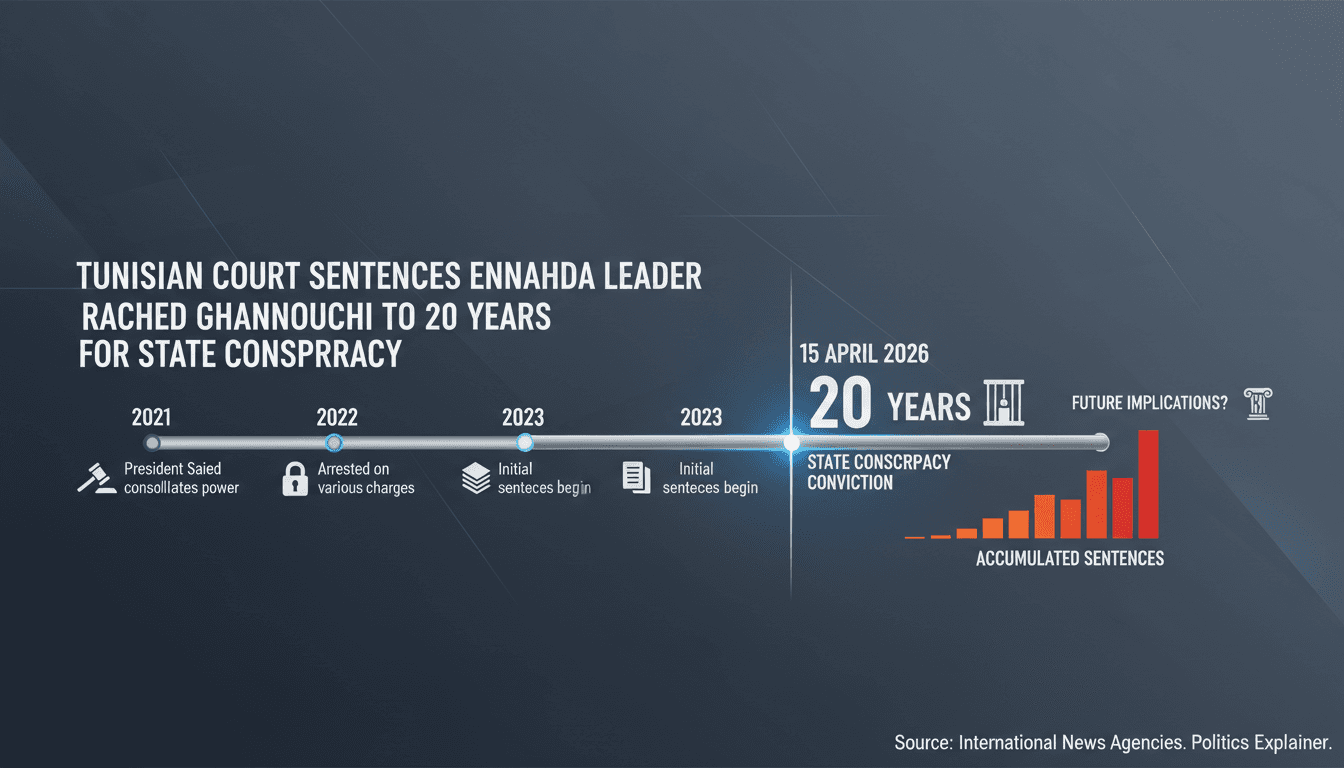
Here's what it means for you.
The political landscape in Tunisia is shifting, impacting regional stability and economic ties.
Why it matters
This ruling underscores the ongoing suppression of dissent in Tunisia, which could influence foreign investment and regional migration patterns.
What happened (in 30 seconds)
- On April 15, 2026, Rached Ghannouchi was sentenced to 20 years in prison for conspiring against state security.
- This ruling is part of a broader crackdown on opposition figures since President Kais Saied's consolidation of power in 2021.
- Ghannouchi has accumulated over 60 years in prison sentences across multiple cases, reflecting a significant shift in Tunisia's political climate.
The context you actually need
- Rached Ghannouchi, leader of the Ennahda movement, has been a central figure in Tunisian politics since the 2011 Jasmine Revolution.
- President Kais Saied suspended parliament and seized executive powers in July 2021, leading to accusations of authoritarianism and a rollback of democratic gains.
- The 'Ramadan Gathering' case stems from speeches made during a 2023 opposition conference, highlighting the government's increasing intolerance for dissent.
What's really happening
The sentencing of Rached Ghannouchi is emblematic of a broader trend in Tunisia where the government, under President Kais Saied, is actively suppressing opposition voices. Since Saied's power consolidation in 2021, there has been a systematic crackdown on dissent, with numerous opposition leaders facing severe legal repercussions. Ghannouchi's case is particularly notable as it reflects the government's strategy to delegitimize political opponents by framing them as threats to state security.
The 'Ramadan Gathering' case, which led to Ghannouchi's latest conviction, is rooted in speeches that warned against the government's exclusionary practices. This suggests that the regime is not only targeting individuals but is also attempting to stifle any public discourse that could challenge its authority. The accumulation of over 60 years of prison sentences against Ghannouchi alone indicates a calculated effort to eliminate dissenting voices from the political arena.
The implications of this ruling extend beyond Tunisia's borders. The UAE, which maintains supportive ties with Saied's government, may see this as a stabilizing factor in the region, potentially affecting migrant labor flows from Tunisia. However, there are no immediate market disruptions or policy changes reported in Dubai or elsewhere as a direct result of this ruling.
The international community's response has been mixed, with human rights organizations condemning the verdict as politically motivated. The Ennahda movement has rejected the ruling, framing it as an attempt to silence opposition and distract from economic failures. This narrative is crucial as it highlights the ongoing struggle for democratic governance in Tunisia, a country that has been viewed as a beacon of hope in the Arab Spring.
As the situation evolves, the potential for increased unrest or further crackdowns remains a concern. The government's actions may lead to a cycle of repression that could destabilize the region, affecting not only Tunisia but also its neighbors and international partners.
Who feels it first (and how)
- Political activists: Increased risk of arrest and legal repercussions for dissenting voices.
- Foreign investors: Heightened uncertainty regarding Tunisia's political stability may deter investment.
- Migrant workers: Potential shifts in labor flows from Tunisia to other countries, including the UAE.
What to watch next
- Appeals process: The outcome of Ghannouchi's appeal could signal the government's willingness to engage with opposition or further entrench its position.
- International reactions: Watch for responses from human rights organizations and foreign governments, which could influence Tunisia's diplomatic relations.
- Economic indicators: Monitor Tunisia's economic performance and foreign investment levels, as political stability is closely tied to economic health.
Ghannouchi has been sentenced to 20 years in prison, reflecting a broader crackdown on dissent.
The political climate in Tunisia will remain tense, with potential for further repression of opposition figures.
The long-term impact on Tunisia's economy and regional stability remains uncertain.
Frequently Asked Questions
- Why it matters?
- This ruling underscores the ongoing suppression of dissent in Tunisia, which could influence foreign investment and regional migration patterns.
- What happened (in 30 seconds)?
- On April 15, 2026, Rached Ghannouchi was sentenced to 20 years in prison for conspiring against state security. This ruling is part of a broader crackdown on opposition figures since President Kais Saied's consolidation of power in 2021. Ghannouchi has accumulated over 60 years in prison sentences across multiple cases, reflecting a significant shift in Tunisia's political climate.
- What's really happening?
- The sentencing of Rached Ghannouchi is emblematic of a broader trend in Tunisia where the government, under President Kais Saied, is actively suppressing opposition voices. Since Saied's power consolidation in 2021, there has been a systematic crackdown on dissent, with numerous opposition leaders facing severe legal repercussions. Ghannouchi's case is particularly notable as it reflects the government's strategy to delegitimize political opponents by framing them as threats to state security.
- Who feels it first (and how)?
- Political activists: Increased risk of arrest and legal repercussions for dissenting voices. Foreign investors: Heightened uncertainty regarding Tunisia's political stability may deter investment. Migrant workers: Potential shifts in labor flows from Tunisia to other countries, including the UAE.
- What to watch next?
- Appeals process: The outcome of Ghannouchi's appeal could signal the government's willingness to engage with opposition or further entrench its position. International reactions: Watch for responses from human rights organizations and foreign governments, which could influence Tunisia's diplomatic relations. Economic indicators: Monitor Tunisia's economic performance and foreign investment levels, as political stability is closely tied to economic health.
Arabic-language reporting on global and regional news.
"BBC Arabic is part of the BBC, generally regarded for editorial standards and broad international coverage."
— A47 Editor
أحكام السجن لمدد تُقدر بعقود بحق زعيم حركة النهضة في تونس راشد الغنوشي
Raed Ghannouchi, the leader of the Ennahda Movement in Tunisia, has been sentenced to prison terms amounting to decades, stemming from a case linked to a conference organized by the Tunisian opposition during Ramadan three years ago, where he warned ...
Pan-Arab news coverage spanning politics, business, sports, and regional affairs.
"Asharq Al-Awsat reflects a broad Arab editorial perspective with strong attention to regional geopolitics."
— A47 Editor
تونس: 20 سنة سجناً للغنوشي وقيادات في حركة النهضة
A Tunisian court has sentenced the leader of the Ennahda Islamic Movement, Rached Ghannouchi, to 20 years in prison on charges of conspiracy against state security. This ruling was announced on Tuesday evening and marks a significant development in t...
Arabic-language coverage of international news and geopolitics.
"RT Arabic is a Russian state-funded outlet often criticized for promoting Kremlin-aligned narratives."
— A47 Editor
تونس.. السجن 20 عاما للغنوشي في قضية "المسامرة" ليتجاوز مجموع أحكامه 70 عاما
A Tunisian court has sentenced Rached Ghannouchi, the leader of the Ennahda Movement, to 20 years in prison for conspiracy against state security in connection with the 'Ramadan Gathering' case, bringing his total prison sentences to over 70 years.
Pan-Arab political news and analysis.
"Al-Quds Al-Arabi is a London-based Arabic newspaper known for political coverage."
— A47 Editor
محكمة تونسية تصدر حكما بسجن الغنوشي 20 عاما
A Tunisian court has sentenced Rached Ghannouchi, the leader of the Ennahda Islamic Movement, to 20 years in prison for conspiracy against state security in connection with the 'Ramadan gatherings' case. The same sentence was also imposed on movement...
Arabic-language digital news outlet covering UAE, regional, and international developments with broad general-news coverage.
"Al Ain News coverage typically blends UAE-focused reporting with wider Arab regional and international news."
— A47 Editor
لتهديده بالحرب الأهلية.. السجن 20 عاما لزعيم إخوان تونس
A Tunisian court sentenced Rached Ghannouchi, the leader of the Ennahda movement, to 20 years in prison in a case known as the 'Ramadan Gathering,' where he was accused of threatening civil war. This ruling marks a significant development in Tunisia'...