
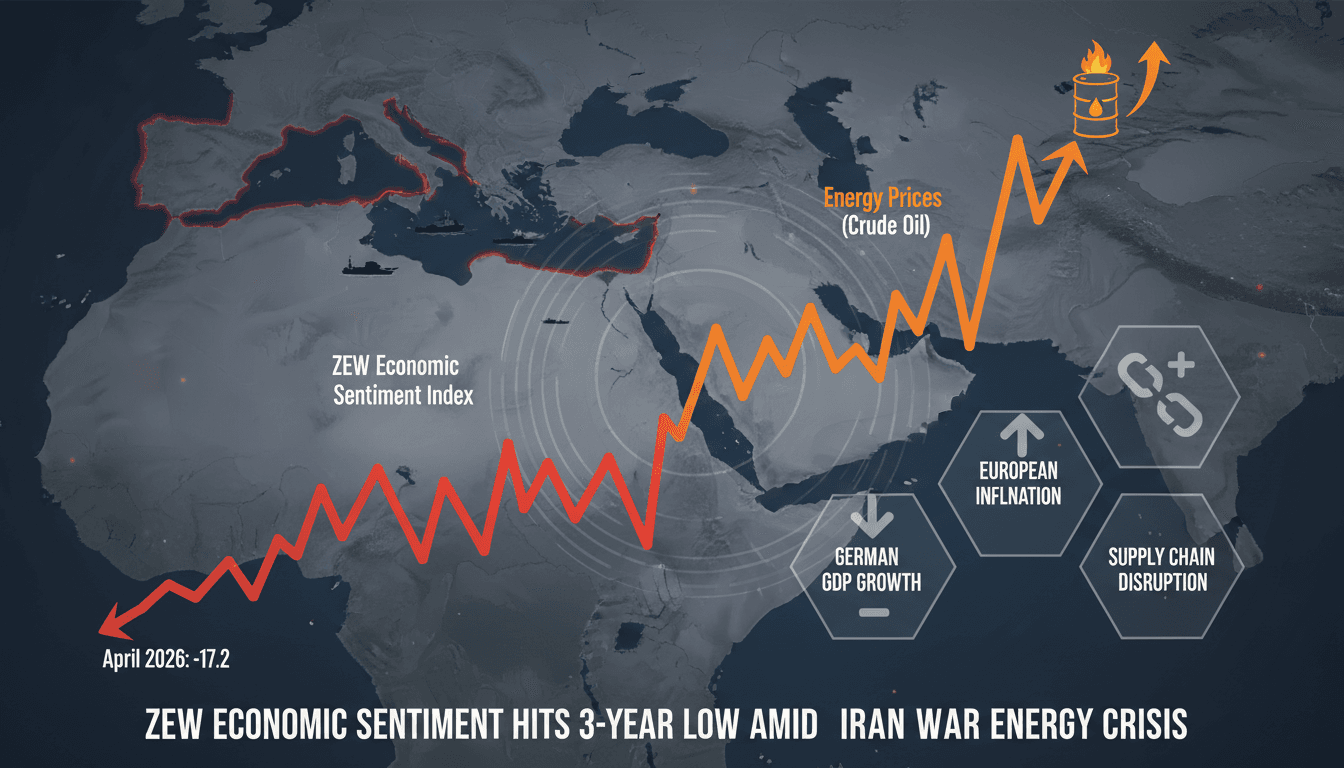
ZEW Economic Sentiment Index Hits Three-Year Low Amid Iran War Energy Crisis
Here's what it means for you.
Rising energy prices and economic uncertainty from the Iran war could impact your cost of living and job stability.
Why it matters
Germany's economic outlook is deteriorating, which could ripple through global markets and affect your financial landscape.
What happened (in 30 seconds)
- The ZEW Economic Sentiment Index plunged to -17.2 points in April 2026, marking a three-year low due to investor fears over energy supply disruptions.
- The ongoing Iran war has led to a blockade of the Strait of Hormuz, causing significant spikes in oil and gas prices.
- Germany's government is revising its GDP growth forecast down to 0.5% for 2026, reflecting the economic strain from the energy crisis.
The context you actually need
- Germany relies heavily on energy imports, making it particularly vulnerable to geopolitical tensions that disrupt supply chains.
- The Iran war escalated on February 28, 2026, when U.S.-Israeli strikes prompted Iran to block a critical shipping route, affecting one-fifth of global oil shipments.
- Investor sentiment had already been declining prior to April, with the ZEW index falling from -0.5 points in March, indicating a growing lack of confidence in economic recovery.
What's really happening
The ZEW Economic Sentiment Index serves as a barometer for investor confidence in Germany's economic future. The recent plunge to -17.2 points reflects a significant shift in sentiment, primarily driven by fears surrounding energy supply disruptions due to the ongoing Iran war. This conflict escalated dramatically on February 28, 2026, when U.S.-Israeli military strikes on Iran led to a blockade of the Strait of Hormuz, a vital artery for global oil shipments. The blockade has resulted in a surge in oil and gas prices, exacerbating existing inflationary pressures in Germany.
Germany's economy, already grappling with post-COVID recovery challenges, is particularly sensitive to energy price fluctuations. The ZEW survey, conducted among approximately 350 institutional investors and analysts, revealed that concerns over prolonged energy shortages have led to a sharp decline in confidence. The index's drop from -0.5 points in March to -17.2 points in April indicates a rapid deterioration in outlook, with current conditions also worsening to -73.7 points.
The implications of this sentiment shift are profound. As energy prices rise, sectors heavily reliant on energy inputs—such as chemicals, pharmaceuticals, steel, and metals—face increased operational costs, which could lead to reduced profitability and potential layoffs. The German government has already responded by halving its GDP growth forecast for 2026 to 0.5% and raising inflation projections, signaling a broader economic slowdown.
Moreover, the volatility in the DAX index, Germany's stock market benchmark, reflects investor caution amid war uncertainties. This volatility can lead to a tightening of credit conditions, making it more difficult for businesses to secure financing for expansion or operational needs. As a result, the economic landscape is shifting, with potential long-term consequences for both businesses and consumers.
In the broader context, the energy crisis stemming from the Iran war is not just a localized issue; it has global ramifications. Countries dependent on oil imports will likely experience similar pressures, leading to increased costs for consumers and businesses alike. The interconnectedness of global supply chains means that disruptions in one region can have cascading effects worldwide, impacting everything from fuel prices to the cost of goods and services.
Who feels it first (and how)
- Consumers: Higher energy prices will increase living costs, affecting household budgets.
- Businesses in energy-intensive sectors: Companies in chemicals, pharmaceuticals, and manufacturing may face rising operational costs and reduced margins.
- Investors: Volatility in the stock market could lead to losses and reduced investment opportunities.
- Tourism and logistics sectors in Dubai: Rising fuel prices and supply chain disruptions may impact travel and trade, affecting local economies.
What to watch next
- Energy prices: Monitor fluctuations in oil and gas prices, as they will directly impact inflation and consumer spending.
- Economic forecasts: Keep an eye on updates from the German government and economic institutes regarding GDP growth and inflation projections.
- Market volatility: Watch for changes in the DAX index and other European markets, as they may signal broader economic trends.
The ZEW Economic Sentiment Index has reached its lowest level in three years.
Continued volatility in energy prices will affect inflation and economic growth forecasts.
The long-term impact of the Iran war on global supply chains and energy markets remains uncertain.
Frequently Asked Questions
- Why it matters?
- Germany's economic outlook is deteriorating, which could ripple through global markets and affect your financial landscape.
- What happened (in 30 seconds)?
- The ZEW Economic Sentiment Index plunged to -17.2 points in April 2026, marking a three-year low due to investor fears over energy supply disruptions. The ongoing Iran war has led to a blockade of the Strait of Hormuz, causing significant spikes in oil and gas prices. Germany's government is revising its GDP growth forecast down to 0.5% for 2026, reflecting the economic strain from the energy crisis.
- What's really happening?
- The ZEW Economic Sentiment Index serves as a barometer for investor confidence in Germany's economic future. The recent plunge to -17.2 points reflects a significant shift in sentiment, primarily driven by fears surrounding energy supply disruptions due to the ongoing Iran war. This conflict escalated dramatically on February 28, 2026, when U.S.-Israeli military strikes on Iran led to a blockade of the Strait of Hormuz, a vital artery for global oil shipments. The blockade has resulted in a surg
- Who feels it first (and how)?
- Consumers: Higher energy prices will increase living costs, affecting household budgets. Businesses in energy-intensive sectors: Companies in chemicals, pharmaceuticals, and manufacturing may face rising operational costs and reduced margins. Investors: Volatility in the stock market could lead to losses and reduced investment opportunities. Tourism and logistics sectors in Dubai: Rising fuel prices and supply chain disruptions may impact travel and trade, affecting local economies.
- What to watch next?
- Energy prices: Monitor fluctuations in oil and gas prices, as they will directly impact inflation and consumer spending. Economic forecasts: Keep an eye on updates from the German government and economic institutes regarding GDP growth and inflation projections. Market volatility: Watch for changes in the DAX index and other European markets, as they may signal broader economic trends.
Key macro releases (CPI, jobs, PMIs), surprise indexes, and market implications.
"Great for data-print awareness and instant read-through to rates and risk assets."
— A47 Editor
German investor morale sinks to three-year low on Iran war fears, ZEW finds
German investor morale has plummeted to its lowest level in three years, driven by fears surrounding the ongoing conflict in Iran, as reported by the ZEW. This decline reflects growing concerns about economic stability and the potential impact of geo...
Social/economic commentary and analysis relevant to business and markets.
"WSJ blends data-driven economic insight with commentary on policy and society."
— A47 Editor
German Financial Sentiment Hits Lowest Since 2022 on Energy Shock
German financial sentiment has reached its lowest point since 2022, primarily due to the economic repercussions of the ongoing conflict in Iran, as highlighted by ZEW President Achim Wambach. The energy shock resulting from this situation has led to ...
Global political, business, and cultural coverage from WSJ international desks.
"The Wall Street Journal offers extensive international reporting with a reputation for financial insight and a center-right editorial stance."
— A47 Editor
German Financial Sentiment Hits Lowest Since 2022 on Energy Shock
German financial sentiment has reached its lowest point since 2022, primarily due to the economic repercussions of the ongoing conflict in Iran, as highlighted by ZEW President Achim Wambach. The energy shock resulting from this situation has led to ...