
United States Conducts Airstrikes on Iranian Military Targets in Kharg Island
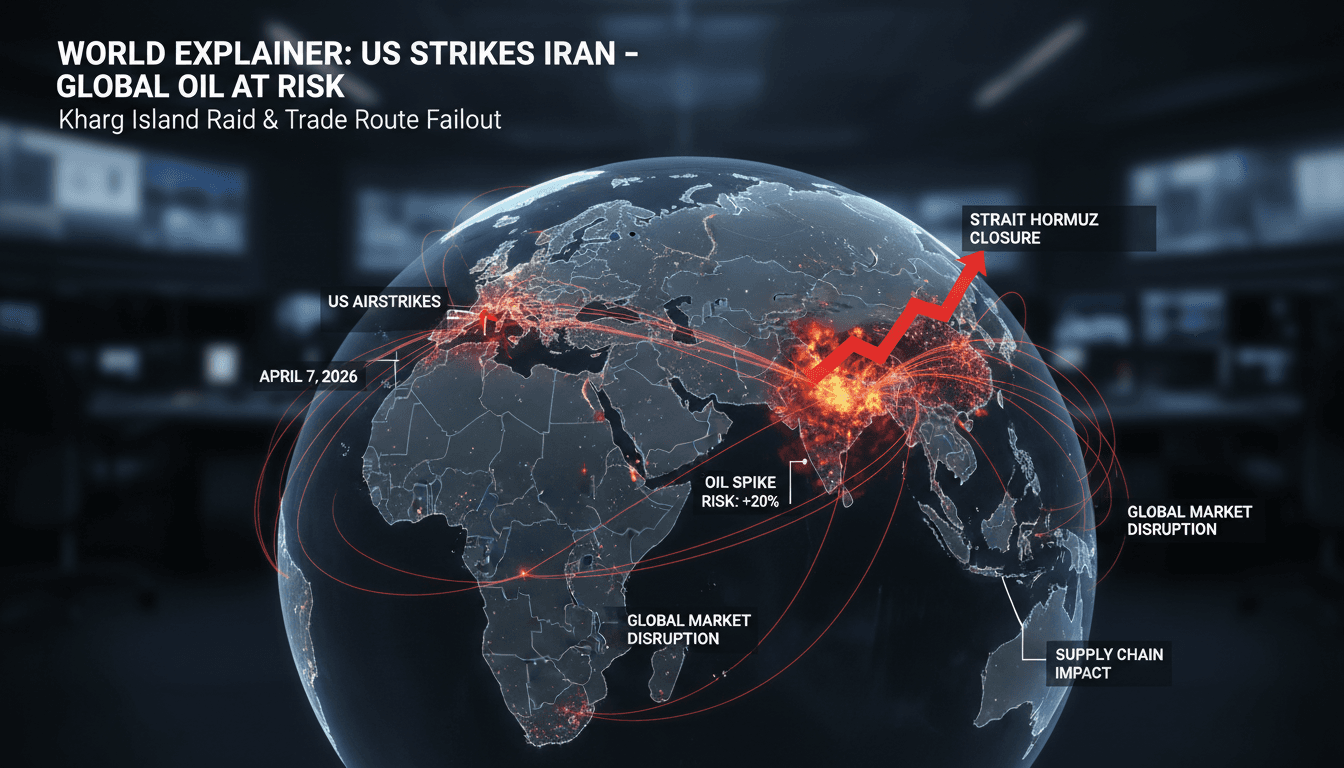
Here's what it means for you.
The recent U.S. airstrikes could lead to significant disruptions in global oil markets, impacting energy prices and trade routes that affect your daily costs.
Why it matters
The airstrikes on Kharg Island, a critical oil export hub, threaten to escalate tensions in the Persian Gulf, potentially disrupting global energy supply chains.
What happened (in 30 seconds)
- On April 7, 2026, the U.S. launched airstrikes on over 50 military targets on Iran's Kharg Island.
- President Trump issued a deadline for Iran to reopen the Strait of Hormuz, which Tehran had closed, threatening severe consequences.
- Iran's Revolutionary Guard vowed to retaliate against U.S. allies, raising concerns about regional security and oil supply disruptions.
The context you actually need
- Kharg Island is vital for Iran, facilitating approximately 90% of its oil exports, making it a strategic target in U.S.-Iran hostilities.
- Previous strikes by the U.S. and Israel have already targeted Iranian infrastructure, escalating military tensions in the region.
- Global energy markets are on alert, with speculation that oil prices could soar to $200 per barrel due to potential supply shocks.
What's really happening
The U.S. airstrikes on Kharg Island are part of a broader strategy to curb Iran's nuclear ambitions and regional influence. The operation, which targeted military installations rather than oil infrastructure, reflects a calculated approach to minimize immediate impacts on global oil supply while still delivering a strong message to Tehran. The strikes were executed just before a deadline set by President Trump, emphasizing the urgency of the situation and the administration's commitment to maintaining pressure on Iran.
Iran's response has been aggressive, with threats to target U.S. allies' civilian and energy infrastructure if red lines are crossed. This rhetoric indicates a willingness to escalate the conflict, which could lead to retaliatory attacks on Gulf shipping lanes and energy assets, further destabilizing the region. The Iranian military's threats against UAE ports specifically highlight the interconnectedness of regional security and global energy markets, as disruptions in these areas could have far-reaching consequences.
Vice President J.D. Vance's comments about achieving military objectives suggest that the U.S. is prepared for further actions if negotiations fail. The ongoing mediation efforts, including those from Pakistan, aim to de-escalate tensions but face significant challenges given the entrenched positions of both sides. As negotiations unfold, the potential for miscalculation or miscommunication remains high, which could trigger a broader conflict.
The situation is compounded by the fact that Kharg Island is a linchpin in the global oil supply chain. Any sustained disruption could lead to significant price increases, impacting consumers and businesses worldwide. With oil prices already volatile, the prospect of reaching $200 per barrel is not just a theoretical concern; it could become a reality if hostilities escalate further. This scenario underscores the importance of closely monitoring developments in the region, as they have direct implications for energy costs and economic stability globally.
Who feels it first (and how)
- Energy consumers: Higher oil prices will lead to increased costs for gasoline and heating.
- Businesses reliant on oil: Companies in transportation, manufacturing, and logistics may face rising operational costs.
- Investors in energy markets: Volatility in oil prices could affect stock valuations and investment strategies.
- Residents of Dubai: Heightened security concerns and potential disruptions to trade routes could impact daily life and economic stability.
What to watch next
- Iran's military response: Monitoring any retaliatory actions against U.S. allies will be crucial for understanding escalation risks.
- Negotiation outcomes: The effectiveness of mediation efforts could either stabilize or further destabilize the region.
- Oil price fluctuations: Keeping an eye on oil market trends will provide insight into the economic impact of the conflict.
The U.S. conducted airstrikes on Kharg Island targeting military installations.
Iran will respond with threats or actions against U.S. allies, increasing regional tensions.
The long-term impact on global oil prices and trade routes remains uncertain.
Frequently Asked Questions
- Why it matters?
- The airstrikes on Kharg Island, a critical oil export hub, threaten to escalate tensions in the Persian Gulf, potentially disrupting global energy supply chains.
- What happened (in 30 seconds)?
- On April 7, 2026, the U.S. launched airstrikes on over 50 military targets on Iran's Kharg Island. President Trump issued a deadline for Iran to reopen the Strait of Hormuz, which Tehran had closed, threatening severe consequences. Iran's Revolutionary Guard vowed to retaliate against U.S. allies, raising concerns about regional security and oil supply disruptions.
- What's really happening?
- The U.S. airstrikes on Kharg Island are part of a broader strategy to curb Iran's nuclear ambitions and regional influence. The operation, which targeted military installations rather than oil infrastructure, reflects a calculated approach to minimize immediate impacts on global oil supply while still delivering a strong message to Tehran. The strikes were executed just before a deadline set by President Trump, emphasizing the urgency of the situation and the administration's commitment to maint
- Who feels it first (and how)?
- Energy consumers: Higher oil prices will lead to increased costs for gasoline and heating. Businesses reliant on oil: Companies in transportation, manufacturing, and logistics may face rising operational costs. Investors in energy markets: Volatility in oil prices could affect stock valuations and investment strategies. Residents of Dubai: Heightened security concerns and potential disruptions to trade routes could impact daily life and economic stability.
- What to watch next?
- Iran's military response: Monitoring any retaliatory actions against U.S. allies will be crucial for understanding escalation risks. Negotiation outcomes: The effectiveness of mediation efforts could either stabilize or further destabilize the region. Oil price fluctuations: Keeping an eye on oil market trends will provide insight into the economic impact of the conflict.
Capitol Hill news, legislation, and policy insight.
"The Hill specializes in U.S. politics and policy, with a focus on Capitol Hill developments and a reputation for insider reporting."
— A47 Editor
US strikes Kharg Island as Trump's deadline looms
The United States conducted airstrikes on military targets on Iran's Kharg Island, a critical hub for the nation's oil exports, as tensions escalated ahead of a deadline set by President Trump for Iran to reopen the Strait of Hormuz. This military ac...
Pan-Arab news coverage spanning politics, business, sports, and regional affairs.
"Asharq Al-Awsat reflects a broad Arab editorial perspective with strong attention to regional geopolitics."
— A47 Editor
أميركا تشن غارات على أكثر من 50 هدفاً عسكرياً في جزيرة «خرج»
The United States conducted airstrikes on over 50 military targets in the island of Kharg early today, according to American officials, ahead of the deadline set by President Trump for Iran to reopen the Strait of Hormuz.
Arabic-language UAE newspaper coverage focused on domestic affairs, public institutions, business, society, and regional developments.
"Al Khaleej coverage generally reflects a mainstream UAE editorial lens with strong attention to public affairs, institutions, and regional developments."
— A47 Editor
«خرج تهتز».. عصب الاقتصاد الإيراني في مرمى القصف
The recent expansion of American and Israeli strikes across Iran has notably targeted Kharg Island, a critical hub for the Iranian economy, often referred to as the 'forbidden island' due to its heavy fortifications. Despite the intensity of the atta...
RT is a Russian state-funded network covering global events from a Russian perspective.
"RT is widely criticized for promoting pro-Kremlin narratives and is considered by many to be a state propaganda outlet."
— A47 Editor
Israel attacks Lebanon killing hundreds, Iran vows revenge for ‘savage massacre’: As it happened
Israel has launched attacks on Lebanon, resulting in hundreds of casualties, which has prompted Iran to vow revenge for what it describes as a 'savage massacre.' This escalation follows a backdrop of heightened tensions in the region, particularly co...
Global business headlines with AI angles.
"General business outlet that frequently covers AI."
— A47 Editor
A Look At How Iranian Oil Exports Could Be Impacted If U.S. Escalates Attacks On Kharg Island
The U.S. military has conducted strikes on Kharg Island, a vital hub for Iranian oil exports, amid rising tensions between the U.S. and Iran. This escalation could severely disrupt Iran's oil exports, which currently average between 1 to 1.5 million ...
Capitol Hill news, legislation, and policy insight.
"The Hill specializes in U.S. politics and policy, with a focus on Capitol Hill developments and a reputation for insider reporting."
— A47 Editor
US strikes military targets on Kharg Island ahead of Trump's deadline to Iran
The United States conducted airstrikes on military targets on Iran's Kharg Island, a critical hub for the country's oil exports, as tensions escalated ahead of a deadline set by President Trump for Iran to reopen the Strait of Hormuz. The strikes wer...
U.S. business news, corporate developments, and economy.
"The Wall Street Journal is respected for deep financial and economic reporting with a center-right editorial perspective."
— A47 Editor
Why Did Trump Order an Attack on Iran’s Kharg Island?
President Donald Trump has ordered an attack on Iran’s Kharg Island, a critical depot for the Iranian oil industry, which plays a vital role in storing and loading most of the country's crude exports. This military action comes amid escalating tensio...