
NHTSA Closes Investigation into Tesla's Smart Summon Feature Without Recall
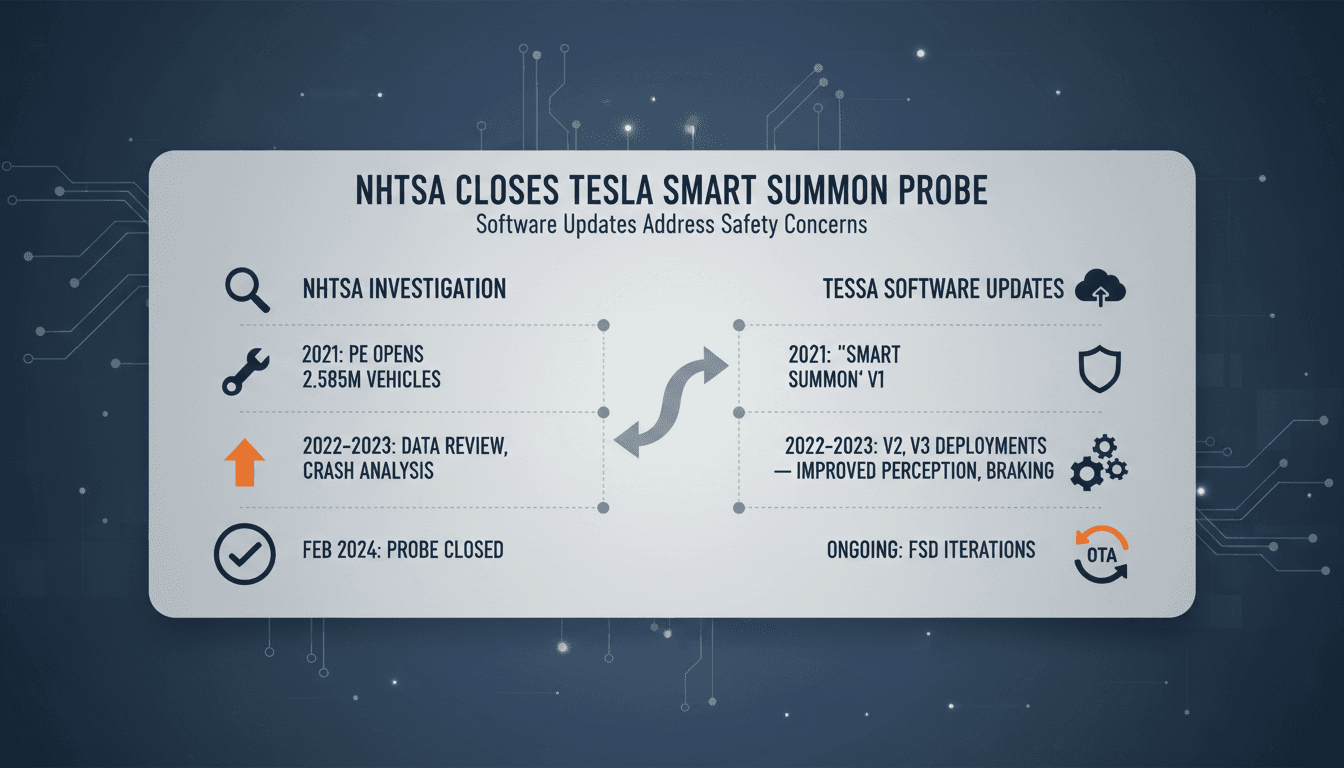
Here's what it means for you.
If you own a Tesla, the closure of this investigation signals continued confidence in the vehicle's advanced features without immediate concerns for recalls.
Why it matters
This decision reflects the evolving landscape of vehicle safety regulations and the balance between innovation and oversight in the automotive industry.
What happened (in 30 seconds)
- NHTSA closed its preliminary evaluation PE24033 into Tesla's Actually Smart Summon feature on April 6, 2026, after a year-long investigation.
- The probe examined 2.585 million vehicles and found 159 incidents of minor property damage, with no injuries or fatalities linked to the feature.
- Tesla implemented six over-the-air updates during the evaluation, enhancing the feature's safety and performance.
The context you actually need
- Actually Smart Summon is part of Tesla's Full Self-Driving software, allowing remote vehicle control in parking areas, which raised safety concerns.
- The investigation was prompted by reports of crashes where the feature failed to detect stationary obstacles, leading to scrutiny from regulators.
- Tesla's iterative software updates are a key part of its strategy to address safety concerns and improve user experience without traditional recalls.
What's really happening
The National Highway Traffic Safety Administration (NHTSA) initiated its preliminary evaluation PE24033 on January 6, 2025, due to a combination of consumer complaints and media reports highlighting incidents involving Tesla's Actually Smart Summon feature. This feature, which allows drivers to remotely maneuver their vehicles at low speeds, was integrated into Tesla's Full Self-Driving (FSD) system and deployed widely in 2024. The investigation encompassed approximately 2.585 million Tesla vehicles, including models S, X, 3, and Y manufactured between 2016 and 2025.
During the evaluation, NHTSA identified 159 incidents of minor property damage, primarily occurring in parking lots, with no injuries or fatalities reported. The investigation was fueled by one Vehicle Owner Questionnaire and three media-reported crashes where the Smart Summon feature failed to detect stationary obstacles, alongside 12 additional complaints related to the earlier Smart Summon feature.
In response to these findings, Tesla rolled out six over-the-air software updates aimed at enhancing the feature's safety. These updates improved camera blockage detection, dynamic object response, and overall environmental adaptability. The NHTSA's closing resume, dated April 3, 2026, concluded that there was insufficient evidence of a systemic defect within the Smart Summon feature, leading to the decision to close the investigation without a recall.
This closure is significant as it underscores the regulatory landscape's ongoing evolution in response to advanced driver assistance systems (ADAS). Tesla's approach of utilizing software updates to address safety concerns reflects a broader trend in the automotive industry, where manufacturers are increasingly relying on technology to enhance vehicle safety post-sale. The iterative nature of Tesla's software updates not only mitigates immediate safety risks but also reinforces the company's commitment to continuous improvement, a critical factor in maintaining consumer trust and regulatory compliance.
However, the closure of this investigation does not eliminate future scrutiny. NHTSA retains the authority to reopen investigations should new data emerge, particularly concerning reduced-visibility performance or other safety-related issues. This ongoing oversight highlights the delicate balance between fostering innovation in autonomous driving technology and ensuring public safety.
Who feels it first (and how)
- Tesla vehicle owners: They benefit from enhanced features without the disruption of a recall.
- Automotive regulators: They must navigate the complexities of overseeing rapidly evolving technologies.
- Insurance companies: They may adjust policies based on the perceived safety of advanced driver assistance systems.
- Competitors in the automotive industry: They are watching closely to gauge the impact of regulatory decisions on their own technologies.
What to watch next
- Future NHTSA investigations: Monitor for any new probes into Tesla or other manufacturers as more data on ADAS performance becomes available.
- Consumer feedback trends: Watch for shifts in consumer sentiment regarding the safety and reliability of Tesla's features, particularly after software updates.
- Legislative changes: Keep an eye on potential new regulations regarding autonomous driving technologies that could affect the entire automotive industry.
Tesla's Actually Smart Summon feature has been cleared of systemic defects.
Future regulatory scrutiny will continue as ADAS technology evolves.
The long-term impact of this closure on Tesla's market position and consumer trust.
Frequently Asked Questions
- Why it matters?
- This decision reflects the evolving landscape of vehicle safety regulations and the balance between innovation and oversight in the automotive industry.
- What happened (in 30 seconds)?
- NHTSA closed its preliminary evaluation PE24033 into Tesla's Actually Smart Summon feature on April 6, 2026, after a year-long investigation. The probe examined 2.585 million vehicles and found 159 incidents of minor property damage, with no injuries or fatalities linked to the feature. Tesla implemented six over-the-air updates during the evaluation, enhancing the feature's safety and performance.
- What's really happening?
- The National Highway Traffic Safety Administration (NHTSA) initiated its preliminary evaluation PE24033 on January 6, 2025, due to a combination of consumer complaints and media reports highlighting incidents involving Tesla's Actually Smart Summon feature. This feature, which allows drivers to remotely maneuver their vehicles at low speeds, was integrated into Tesla's Full Self-Driving (FSD) system and deployed widely in 2024. The investigation encompassed approximately 2.585 million Tesla vehi
- Who feels it first (and how)?
- Tesla vehicle owners: They benefit from enhanced features without the disruption of a recall. Automotive regulators: They must navigate the complexities of overseeing rapidly evolving technologies. Insurance companies: They may adjust policies based on the perceived safety of advanced driver assistance systems. Competitors in the automotive industry: They are watching closely to gauge the impact of regulatory decisions on their own technologies.
- What to watch next?
- Future NHTSA investigations: Monitor for any new probes into Tesla or other manufacturers as more data on ADAS performance becomes available. Consumer feedback trends: Watch for shifts in consumer sentiment regarding the safety and reliability of Tesla's features, particularly after software updates. Legislative changes: Keep an eye on potential new regulations regarding autonomous driving technologies that could affect the entire automotive industry.
Curated tech headlines including AI stories.
"Influential aggregator surfacing the day’s top tech/AI links."
— A47 Editor
The US NHTSA ends a 2025 probe into ~2.6M Tesla vehicles over the "Actually Smart Summon" driverless feature after finding it involved only low-speed incidents (Reuters)
The U.S. National Highway Traffic Safety Administration (NHTSA) has concluded its investigation into approximately 2.6 million Tesla vehicles regarding the 'Actually Smart Summon' driverless feature, determining that the incidents involved were limit...
Startup news with frequent AI coverage.
"Covers launches, funding, and product updates in AI."
— A47 Editor
Why safety regulators closed their investigation into Tesla’s remote parking feature
The National Highway Traffic Safety Administration (NHTSA) has closed its investigation into Tesla's remote parking feature, known as 'Actually Smart Summon,' concluding that only a small number of incidents occurred without any resulting injuries. T...
Capitol Hill news, legislation, and policy insight.
"The Hill specializes in U.S. politics and policy, with a focus on Capitol Hill developments and a reputation for insider reporting."
— A47 Editor
Regulator closes investigation into Tesla 'actually smart summon' feature
The National Highway Traffic Safety Administration (NHTSA) has concluded its investigation into Tesla's 'actually smart summon' feature, determining that incidents involving the feature were infrequent and not severe. The investigation was initiated ...
U.S. business news, corporate developments, and economy.
"The Wall Street Journal is respected for deep financial and economic reporting with a center-right editorial perspective."
— A47 Editor
NHTSA Ends Investigation Into Tesla’s Summon Feature
The National Highway Traffic Safety Administration (NHTSA) has concluded its investigation into Tesla's 'Actually Smart Summon' feature, citing a low frequency and severity of reported crashes as the primary reason for this decision. This marks a sig...