
Iranian Revolutionary Guard Navy Issues Destruction Threat to Unauthorized Ships in Strait of Hormuz
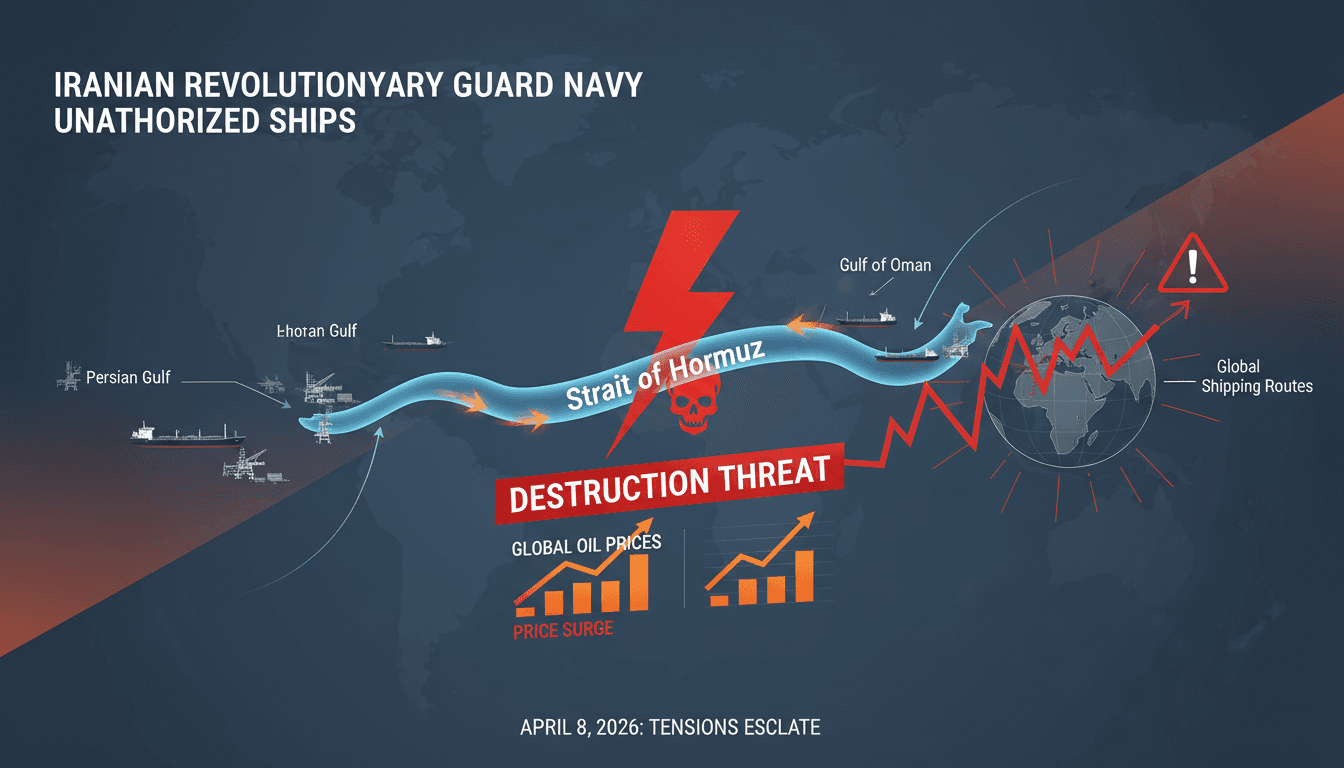
Here's what it means for you.
If you rely on global oil markets, the tensions in the Strait of Hormuz could impact fuel prices and supply chains.
Why it matters
The Strait of Hormuz is a critical chokepoint for global oil, with over 20% of the world's petroleum passing through, making any disruption a significant concern for economies worldwide.
What happened (in 30 seconds)
- April 8, 2026: Iran's Sepah navy threatened to destroy unauthorized foreign vessels in the Strait of Hormuz.
- April 7, 2026: U.S. President Donald Trump announced a fragile two-week ceasefire aimed at reopening the strait for safe passage.
- February 28, 2026: The conflict began with U.S.-Israeli strikes on Iranian targets, leading to Iranian retaliation and disruptions in oil flow.
The context you actually need
- The Strait of Hormuz is vital: It facilitates the transit of approximately 20 million barrels of oil daily, equivalent to about 20% of global petroleum liquids consumption.
- Escalating tensions: The conflict escalated after U.S.-Israeli military actions prompted Iran to threaten shipping routes, impacting global energy supplies and raising oil prices.
- Economic implications: The ceasefire announcement led to a temporary drop in oil prices and a surge in global stock markets, but uncertainty remains regarding future shipping safety.
What's really happening
The recent threats from the Iranian Revolutionary Guard Navy (IRGC Sepah) come in the wake of a fragile ceasefire agreement aimed at stabilizing the Strait of Hormuz, a crucial maritime route for global oil transport. The IRGC's warning to destroy unauthorized vessels underscores the precarious nature of this ceasefire, which was established after escalating military actions between Iran and a coalition of U.S. and Israeli forces.
The conflict began on February 28, 2026, when joint strikes targeted Iranian military assets, prompting Tehran to retaliate by deploying missiles and drones to disrupt shipping in the Strait. This strategic move was intended to exert economic pressure on the U.S. and its allies by threatening a vital artery for oil transport. The Iranian government has historically used its naval capabilities to assert control over this region, and the recent threats are a continuation of this strategy.
The ceasefire, announced by President Trump, aimed to restore safe passage through the strait, which is essential for global oil supplies. However, the IRGC's threats indicate that Iran is unwilling to relinquish its leverage over this critical maritime route. The situation creates a paradox: while the ceasefire may provide temporary relief to oil markets, the underlying tensions remain unresolved, and the potential for conflict persists.
For businesses and economies reliant on oil, this instability can lead to fluctuating prices and supply chain disruptions. The immediate aftermath of the ceasefire saw oil prices drop by up to 15%, but the threat of renewed hostilities looms large. Shipping companies are now faced with the dilemma of navigating a volatile region where the risk of military engagement could disrupt their operations.
Moreover, the geopolitical implications extend beyond the immediate conflict. Countries in the Gulf region, including the UAE, are closely monitoring developments, as any escalation could have direct consequences on their economies, particularly in sectors like trade and real estate, which are sensitive to fluctuations in oil prices.
In summary, while the ceasefire offers a temporary respite, the IRGC's threats highlight the ongoing volatility in the region and the potential for future disruptions that could impact global oil markets and economic stability.
Who feels it first (and how)
- Shipping companies: Firms like Maersk may face increased operational risks and insurance costs due to heightened military threats.
- Oil-dependent economies: Countries reliant on oil imports or exports will experience immediate impacts on fuel prices and economic stability.
- Investors: Market volatility may affect stock prices and investment strategies, particularly in energy sectors.
What to watch next
- Iran's military actions: Continued threats or military maneuvers could signal a shift in the conflict and affect shipping routes.
- Oil price fluctuations: Watch for changes in oil prices as markets react to developments in the Strait of Hormuz and broader geopolitical tensions.
- International diplomatic efforts: Any new negotiations or agreements involving Iran, the U.S., or regional allies could reshape the current landscape and influence market stability.
The Strait of Hormuz is a critical passage for global oil, with 20 million barrels transiting daily.
Continued tensions will affect oil prices and shipping operations in the region.
The long-term effectiveness of the ceasefire and its impact on regional stability remains uncertain.
Frequently Asked Questions
- Why it matters?
- The Strait of Hormuz is a critical chokepoint for global oil, with over 20% of the world's petroleum passing through, making any disruption a significant concern for economies worldwide.
- What happened (in 30 seconds)?
- April 8, 2026: Iran's Sepah navy threatened to destroy unauthorized foreign vessels in the Strait of Hormuz. April 7, 2026: U.S. President Donald Trump announced a fragile two-week ceasefire aimed at reopening the strait for safe passage. February 28, 2026: The conflict began with U.S.-Israeli strikes on Iranian targets, leading to Iranian retaliation and disruptions in oil flow.
- What's really happening?
- The recent threats from the Iranian Revolutionary Guard Navy (IRGC Sepah) come in the wake of a fragile ceasefire agreement aimed at stabilizing the Strait of Hormuz, a crucial maritime route for global oil transport. The IRGC's warning to destroy unauthorized vessels underscores the precarious nature of this ceasefire, which was established after escalating military actions between Iran and a coalition of U.S. and Israeli forces. The conflict began on February 28, 2026, when joint strikes tar
- Who feels it first (and how)?
- Shipping companies: Firms like Maersk may face increased operational risks and insurance costs due to heightened military threats. Oil-dependent economies: Countries reliant on oil imports or exports will experience immediate impacts on fuel prices and economic stability. Investors: Market volatility may affect stock prices and investment strategies, particularly in energy sectors.
- What to watch next?
- Iran's military actions: Continued threats or military maneuvers could signal a shift in the conflict and affect shipping routes. Oil price fluctuations: Watch for changes in oil prices as markets react to developments in the Strait of Hormuz and broader geopolitical tensions. International diplomatic efforts: Any new negotiations or agreements involving Iran, the U.S., or regional allies could reshape the current landscape and influence market stability.
Editor-curated FT homepage stories spanning markets, business, world, and opinion.
"The Financial Times is a globally respected business publication with a centrist/center-left tone and strong markets focus."
— A47 Editor
Iran demands crypto fees for ships passing Hormuz during ceasefire
Iran's oil exporters' union has announced that ships passing through the Strait of Hormuz during a two-week ceasefire with the United States will be required to pay tolls in cryptocurrency, with vessels monitored for weapons. This development comes a...
Tech startup news, programming trends, and discussions shared by the developer community.
"Hacker News is a community-driven source highlighting influential tech discussions, startup launches, and programming insights."
— A47 Editor
Iran demands Bitcoin fees for ships passing Hormuz during ceasefire
Iran has announced that it will require Bitcoin fees for ships passing through the Strait of Hormuz during a two-week ceasefire, a move that underscores the country's growing reliance on cryptocurrency amid ongoing geopolitical tensions.
Breaking news, politics, business, and entertainment from the U.S. and around the world.
"The New York Post is a tabloid-format newspaper known for its sensationalist headlines and conservative-leaning editorial tone."
— A47 Editor
Iran threatens to ‘destroy’ ships that pass through Strait of Hormuz — despite cease-fire pact
Iran's navy has issued a warning to foreign vessels, stating that any ship attempting to cross the Strait of Hormuz without permission from Tehran will be destroyed. This threat comes despite a recent ceasefire agreement, highlighting ongoing tension...