
NHTSA Closes Investigation into Tesla's Actually Smart Summon Feature After Minor Crashes
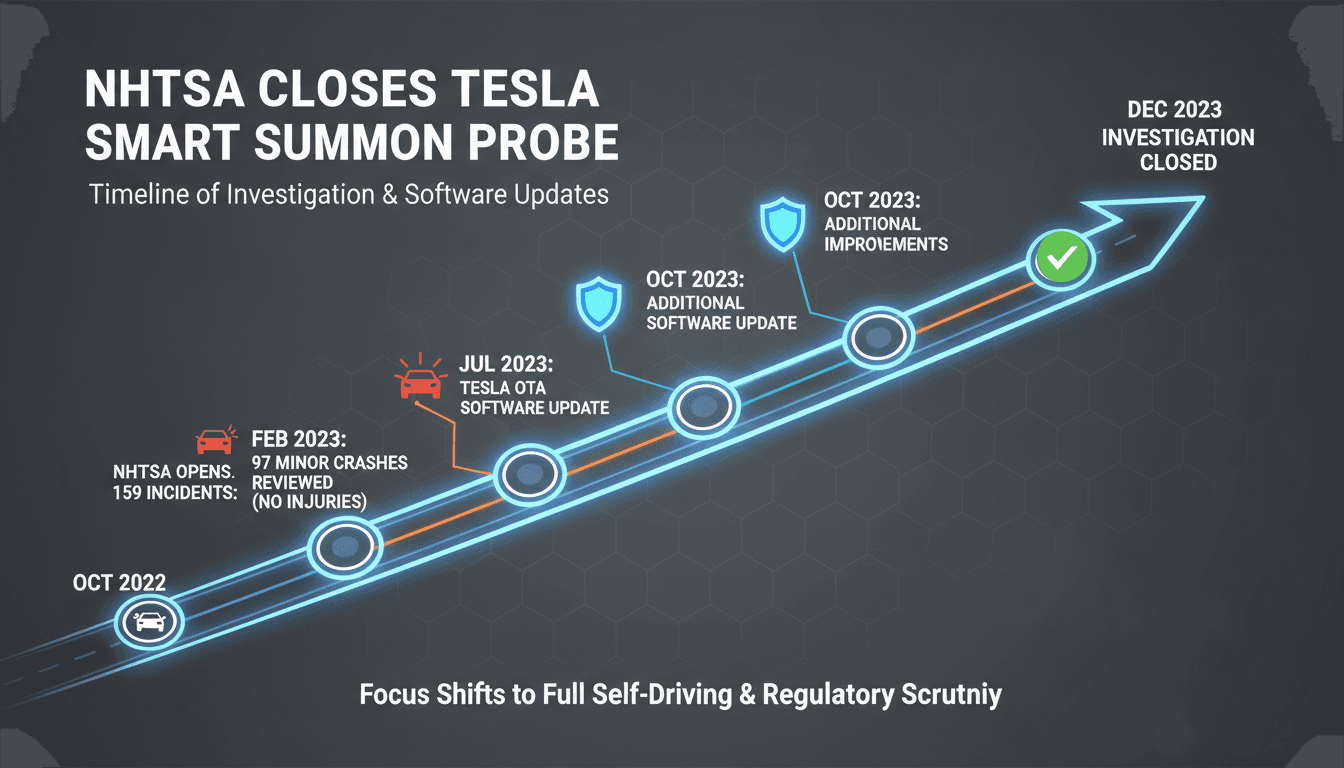
Here's what it means for you.
If you’re considering Tesla’s autonomous features, this closure indicates a regulatory green light, but with caveats about safety in specific conditions.
Why it matters
This decision reflects ongoing tensions in the autonomous vehicle market, balancing innovation against safety scrutiny.
What happened (in 30 seconds)
- NHTSA closed its investigation into Tesla's Actually Smart Summon (ASS) after reviewing 159 incidents, including 97 minor crashes.
- Tesla's software updates addressed issues like camera obstructions, allowing the company to avoid a recall.
- Ongoing scrutiny remains on Tesla's Full Self-Driving (FSD) technology, particularly in low-visibility conditions.
The context you actually need
- Tesla's ASS feature allows users to summon their vehicles remotely, part of the broader Full Self-Driving suite.
- NHTSA's investigation was initiated due to consumer complaints and data indicating crashes related to environmental factors.
- The closure comes amid heightened scrutiny of Tesla’s reliance on camera-only systems instead of LiDAR technology for navigation.
What's really happening
The NHTSA's closure of the investigation into Tesla's Actually Smart Summon (ASS) is a significant moment in the ongoing dialogue about the safety and viability of autonomous vehicle technologies. The investigation began on January 6, 2025, following reports of crashes linked to the ASS feature, which allows drivers to summon their vehicles remotely via smartphone. Tesla, known for its aggressive innovation strategy, cooperated with the NHTSA by providing extensive usage data and implementing six over-the-air software updates aimed at improving the system's performance in challenging conditions, such as snow that could obstruct cameras.
By April 3, 2026, the NHTSA had reviewed 159 incidents involving the ASS, confirming that 97 of these resulted in minor property damage, such as collisions with stationary objects, with no injuries reported. This outcome indicates that while the feature has encountered issues, the risks associated with its use have been sufficiently mitigated through software improvements. The NHTSA concluded that a recall was unnecessary, which is a notable win for Tesla amid ongoing scrutiny of its autonomous driving systems.
However, this closure does not eliminate the NHTSA's concerns about the broader implications of Tesla's technology. The agency has escalated its investigation into Tesla's Full Self-Driving (FSD) capabilities, particularly regarding performance in degraded visibility conditions. This reflects a growing recognition that while Tesla's innovations push the envelope in autonomous driving, they also raise significant safety questions that regulators must address. The absence of injuries in the ASS investigation does not preclude future risks, and the NHTSA will continue to monitor Tesla's developments closely.
Tesla's strategy of relying solely on vision-based systems, eschewing LiDAR technology, has been a point of contention within the industry. Critics argue that this approach may not provide the robustness needed for safe navigation in all conditions, especially as the company aims to expand its autonomous capabilities. The NHTSA's ongoing engineering analysis into FSD performance highlights the delicate balance between technological advancement and regulatory oversight.
In summary, while the closure of the ASS investigation marks a regulatory victory for Tesla, it also underscores the complexities and challenges the company faces as it navigates the evolving landscape of autonomous vehicle technology.
Who feels it first (and how)
- Tesla owners: They benefit from enhanced features and reduced regulatory scrutiny but must remain aware of potential limitations in adverse conditions.
- Regulators: They must balance innovation with safety, impacting future policies on autonomous vehicles.
- Automotive industry competitors: They watch Tesla's developments closely, as the outcomes influence their own strategies and regulatory approaches.
What to watch next
- Ongoing NHTSA analysis: Continued scrutiny of Tesla's FSD technology will reveal if further regulatory actions are needed, impacting Tesla's market position.
- Consumer adoption rates: Tracking how consumers respond to Tesla's autonomous features post-investigation can indicate market confidence in the technology.
- Technological advancements: Innovations in sensor technologies, such as LiDAR, may shift industry standards and influence Tesla's future strategies.
NHTSA closed the investigation into Tesla's ASS without a recall.
Ongoing scrutiny of Tesla's FSD technology will continue, potentially leading to further regulatory actions.
The long-term impact of this closure on Tesla's stock and consumer perception remains to be seen.
Frequently Asked Questions
- Why it matters?
- This decision reflects ongoing tensions in the autonomous vehicle market, balancing innovation against safety scrutiny.
- What happened (in 30 seconds)?
- NHTSA closed its investigation into Tesla's Actually Smart Summon (ASS) after reviewing 159 incidents, including 97 minor crashes. Tesla's software updates addressed issues like camera obstructions, allowing the company to avoid a recall. Ongoing scrutiny remains on Tesla's Full Self-Driving (FSD) technology, particularly in low-visibility conditions.
- What's really happening?
- The NHTSA's closure of the investigation into Tesla's Actually Smart Summon (ASS) is a significant moment in the ongoing dialogue about the safety and viability of autonomous vehicle technologies. The investigation began on January 6, 2025, following reports of crashes linked to the ASS feature, which allows drivers to summon their vehicles remotely via smartphone. Tesla, known for its aggressive innovation strategy, cooperated with the NHTSA by providing extensive usage data and implementing si
- Who feels it first (and how)?
- Tesla owners: They benefit from enhanced features and reduced regulatory scrutiny but must remain aware of potential limitations in adverse conditions. Regulators: They must balance innovation with safety, impacting future policies on autonomous vehicles. Automotive industry competitors: They watch Tesla's developments closely, as the outcomes influence their own strategies and regulatory approaches.
- What to watch next?
- Ongoing NHTSA analysis: Continued scrutiny of Tesla's FSD technology will reveal if further regulatory actions are needed, impacting Tesla's market position. Consumer adoption rates: Tracking how consumers respond to Tesla's autonomous features post-investigation can indicate market confidence in the technology. Technological advancements: Innovations in sensor technologies, such as LiDAR, may shift industry standards and influence Tesla's future strategies.
Stock market news, investing ideas, and trading analysis.
"TheStreet provides market news and retail-investor-focused analysis."
— A47 Editor
Tesla dodges more headaches as autonomous driving scores a win
Tesla received a favorable outcome from the National Highway Traffic Safety Administration (NHTSA), which has closed its investigation into the company's 'Actually Smart Summon' feature. This decision was influenced by the low frequency and severity ...
Consumer technology news with AI coverage.
"Gadget and tech site reporting on AI in products."
— A47 Editor
NHTSA closes probe into Tesla's remote parking crashes
The National Highway and Traffic Safety Administration (NHTSA) has concluded its investigation into Tesla's remote parking feature, determining that reported incidents were minor and occurred at low speeds. The evaluation, which began in January 2025...
Covers consumer technology, electronics, gadgets, and product reviews.
"Engadget is a trusted source for gadget reviews and consumer tech news, known for its hands-on analysis and industry coverage."
— A47 Editor
NHTSA closes probe into Tesla's remote parking crashes
The National Highway and Traffic Safety Administration (NHTSA) has concluded its investigation into Tesla's remote parking feature, determining that reported incidents were minor and occurred at low speeds. The evaluation, which began in January 2025...
Curated tech headlines including AI stories.
"Influential aggregator surfacing the day’s top tech/AI links."
— A47 Editor
The US NHTSA ends a 2025 probe into ~2.6M Tesla vehicles over the "Actually Smart Summon" driverless feature after finding it involved only low-speed incidents (Reuters)
The U.S. National Highway Traffic Safety Administration (NHTSA) has concluded its investigation into approximately 2.6 million Tesla vehicles regarding the 'Actually Smart Summon' driverless feature, determining that the incidents involved were limit...
U.S. business news, corporate developments, and economy.
"The Wall Street Journal is respected for deep financial and economic reporting with a center-right editorial perspective."
— A47 Editor
NHTSA Ends Investigation Into Tesla’s Summon Feature
The National Highway Traffic Safety Administration (NHTSA) has concluded its investigation into Tesla's 'Actually Smart Summon' feature, citing a low frequency and severity of reported crashes as the primary reason for this decision. This marks a sig...