
Ngogo Chimpanzee Community Experiences Lethal Fission and Raids
Here's what it means for you.
Understanding the dynamics of intergroup conflict among chimpanzees can enhance insights into social structures and conflict resolution, relevant for various professional fields including conservation, psychology, and anthropology.
Why it matters
This event highlights the complexities of social structures in animal communities, offering parallels to human societal conflicts that can inform both conservation strategies and social science research.
What happened (in 30 seconds)
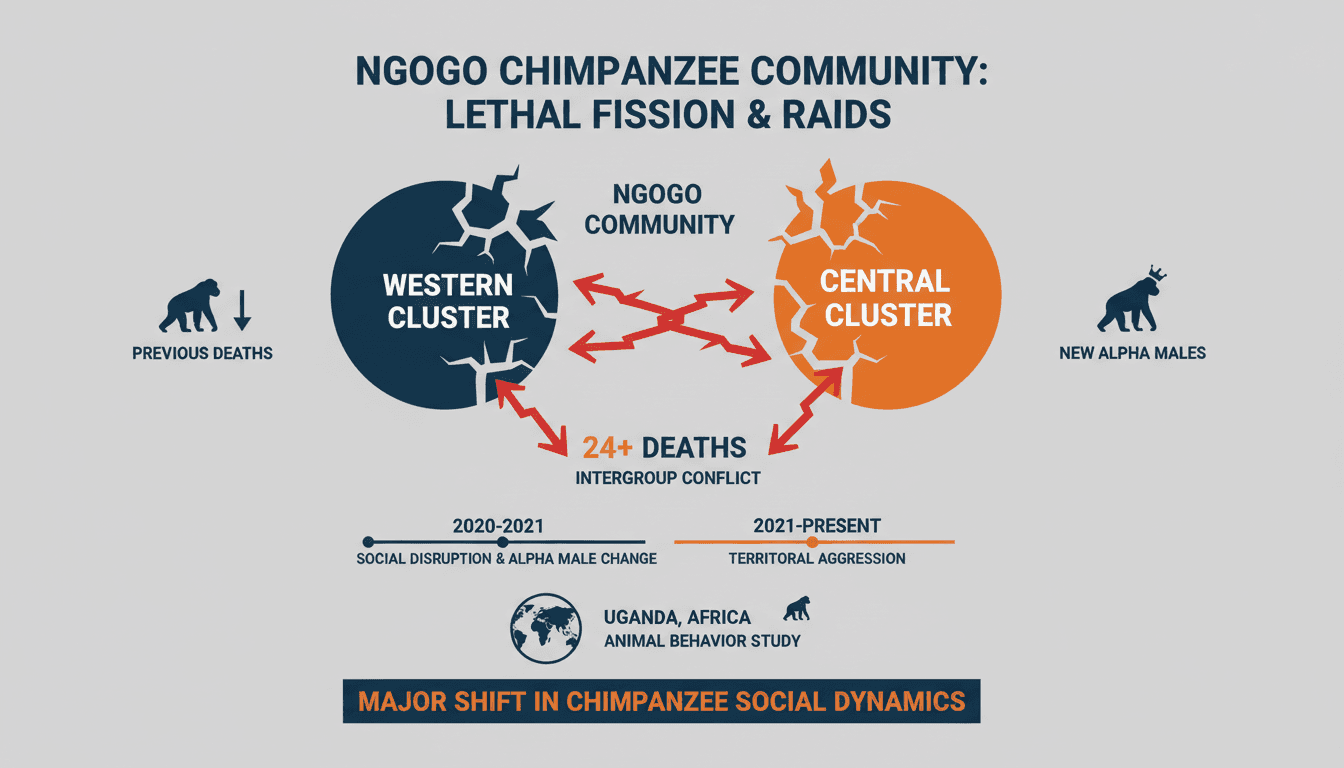
- On June 24, 2015, the Ngogo chimpanzee community split into Western and Central clusters, leading to violent intergroup raids.
- By 2022, Western males conducted 24 lethal raids on Central members, resulting in at least 24 deaths, including 7 adult males and 17 infants.
- The community's full separation was achieved by 2018, with former associates treated as strangers, indicating a profound social shift.
The context you actually need
- The Ngogo community has been studied since 1995, growing large due to abundant food resources in Kibale National Park.
- Prior deaths in 2014 disrupted social networks, leading to a power vacuum and subsequent fission along pre-existing subpopulation lines.
- Genetic evidence shows no mixed-parentage offspring after the fission, indicating a complete breakdown of social bonds between the two clusters.
What's really happening
The fission of the Ngogo chimpanzee community is a striking example of how social structures can fracture under stress, leading to lethal intergroup conflict. This phenomenon began with a series of deaths in 2014, likely due to disease, which disrupted established social networks. The loss of key individuals—especially dominant males—created a power vacuum that precipitated the rise of a new alpha male, Jackson. His ascension marked a turning point, as it coincided with the spatial polarization of the community into Western and Central clusters.
The subsequent raids conducted by Western males on Central territory were not merely acts of aggression; they were driven by a combination of resource competition and social reorganization. The Western cluster, feeling threatened and emboldened by their new leadership, initiated lethal attacks that resulted in significant fatalities. By 2022, the death toll reached 24 chimpanzees, including both adults and infants, underscoring the severity of the conflict.
This situation is further complicated by genetic evidence indicating a complete cessation of mixed-parentage offspring after the fission. This suggests that the social ties that once bound the two groups have been irrevocably severed, leading to a scenario where former kin are now treated as adversaries. The implications of this are profound, as they not only highlight the fragility of social bonds in animal communities but also draw parallels to human societal conflicts, where similar dynamics can lead to violence and division.
The Ngogo Chimpanzee Project researchers have documented these events meticulously, contributing to a growing body of literature that explores the intersection of social structure, aggression, and resource competition in primate behavior. The ongoing monitoring of these chimpanzees provides critical insights into the long-term consequences of such fissions, which may serve as a model for understanding conflict in other species, including humans.
Who feels it first (and how)
- Conservationists: Need to adapt strategies for managing chimpanzee populations in light of increased aggression and territoriality.
- Researchers: Gain insights into social dynamics that can inform studies on primate behavior and intergroup conflict.
- Local communities: May experience indirect effects through changes in wildlife behavior and conservation policies.
What to watch next
- Continued monitoring of the Ngogo community: Observations will reveal how social structures evolve post-conflict and whether reconciliation occurs.
- Research publications: Look for new studies that may draw parallels between chimpanzee and human conflict, potentially influencing social science theories.
- Conservation policy changes: Watch for shifts in strategies aimed at mitigating human-wildlife conflict as a result of findings from the Ngogo Chimpanzee Project.
The Ngogo chimpanzee community underwent fission, leading to lethal intergroup conflict.
The social dynamics observed may inform broader theories on conflict in social species, including humans.
The long-term effects of this conflict on the Ngogo community's social structure and population dynamics remain to be fully understood.
Frequently Asked Questions
- Why it matters?
- This event highlights the complexities of social structures in animal communities, offering parallels to human societal conflicts that can inform both conservation strategies and social science research.
- What happened (in 30 seconds)?
- On June 24, 2015, the Ngogo chimpanzee community split into Western and Central clusters, leading to violent intergroup raids. By 2022, Western males conducted 24 lethal raids on Central members, resulting in at least 24 deaths, including 7 adult males and 17 infants. The community's full separation was achieved by 2018, with former associates treated as strangers, indicating a profound social shift.
- What's really happening?
- The fission of the Ngogo chimpanzee community is a striking example of how social structures can fracture under stress, leading to lethal intergroup conflict. This phenomenon began with a series of deaths in 2014, likely due to disease, which disrupted established social networks. The loss of key individuals—especially dominant males—created a power vacuum that precipitated the rise of a new alpha male, Jackson. His ascension marked a turning point, as it coincided with the spatial polarization
- Who feels it first (and how)?
- Conservationists: Need to adapt strategies for managing chimpanzee populations in light of increased aggression and territoriality. Researchers: Gain insights into social dynamics that can inform studies on primate behavior and intergroup conflict. Local communities: May experience indirect effects through changes in wildlife behavior and conservation policies.
- What to watch next?
- Continued monitoring of the Ngogo community: Observations will reveal how social structures evolve post-conflict and whether reconciliation occurs. Research publications: Look for new studies that may draw parallels between chimpanzee and human conflict, potentially influencing social science theories. Conservation policy changes: Watch for shifts in strategies aimed at mitigating human-wildlife conflict as a result of findings from the Ngogo Chimpanzee Project.
Health trends, medical research, and fitness reporting.
"The New York Times is a globally recognized newspaper offering authoritative reporting with a center-left editorial stance."
— A47 Editor
These Chimps Began the Bloodiest ‘War’ on Record. No One Knows Why.
A long-running conflict among chimpanzees in a Ugandan park has been identified as one of the bloodiest 'wars' on record, with researchers puzzled over the reasons behind this violent behavior. The study of this conflict may offer insights into the o...
Independent journalism covering technology, AI, and digital culture.
"An independent newsroom by veteran tech reporters known for critical, investigative coverage of AI and tech power."
— A47 Editor
World’s Largest Group of Chimps Waging Deadly ‘Civil War,’ Scientists Discover
Scientists have discovered that the Ngogo group of wild chimpanzees is experiencing a deadly 'civil war,' resulting in the deaths of at least 24 chimpanzees. This conflict has led to a significant division within the group, transforming former allies...
Scientific research, space, environment, and health coverage.
"The New York Times is a globally recognized newspaper offering authoritative reporting with a center-left editorial stance."
— A47 Editor
These Chimps Began the Bloodiest ‘War’ on Record. No One Knows Why.
A long-running conflict among chimpanzees in a Ugandan park has been identified as one of the bloodiest recorded, raising questions about the reasons behind such violent behavior. Researchers are investigating the implications of this conflict to bet...
Scientific discoveries, health, technology, and natural phenomena.
"Live Science reports on scientific discoveries, health, technology, and natural phenomena with a popular science tone."
— A47 Editor
Chimpanzees in Uganda are locked in a deadly 'civil war' after their group split apart — and scientists don't know why
A recent observation in Uganda has revealed that chimpanzees are engaged in a deadly conflict, referred to as a 'civil war,' following a split within their group. This unprecedented behavior has left scientists puzzled, as the reasons behind the frac...