
US Naval Blockade of Iranian Ports Enforced in Strait of Hormuz
Here's what it means for you.
Rising oil prices and supply chain disruptions could impact your business costs and travel expenses.
What happened
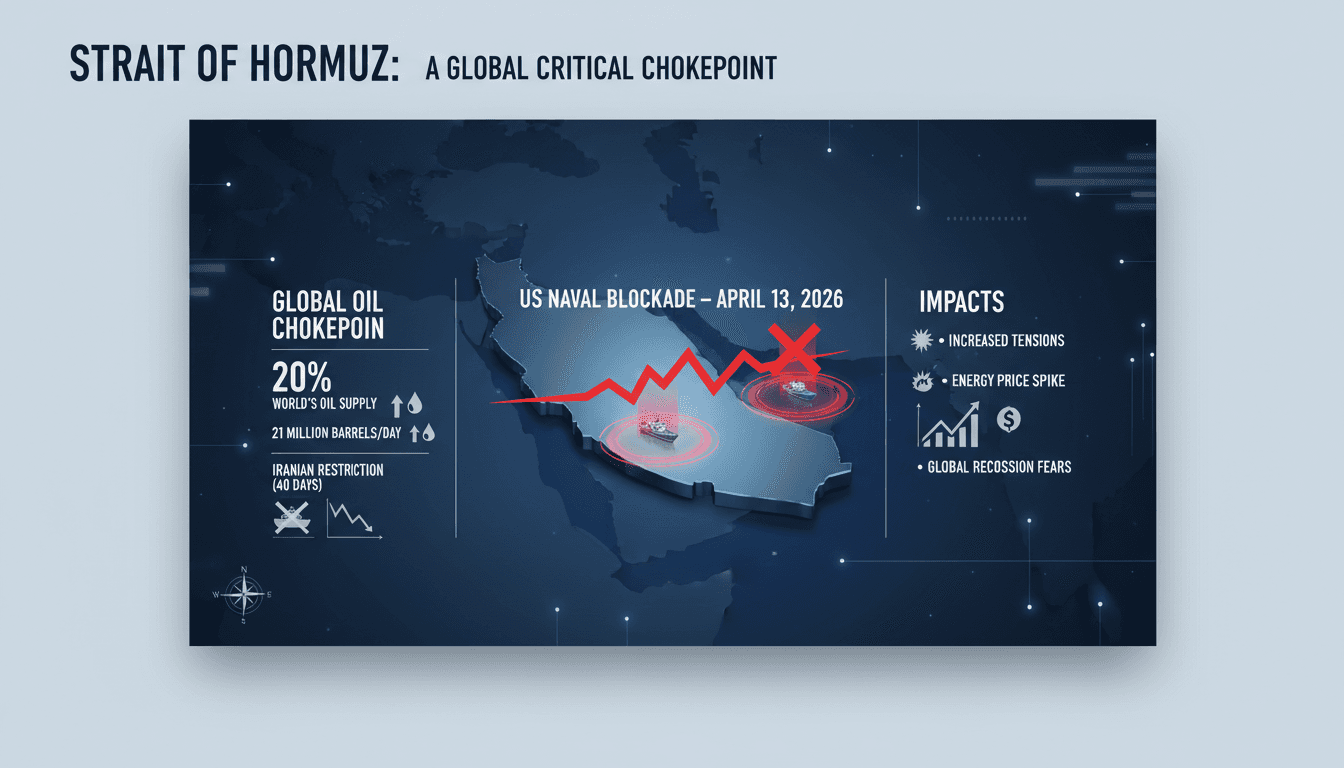
The U.S. Navy has enforced a naval blockade on Iranian ports since April 13, 2026, in response to Iran's restrictions on maritime traffic through the Strait of Hormuz.
The Context
- Escalated tensions: The blockade follows Iran's 40-day restriction on shipping, which affected 20-25% of global seaborne oil trade and drove oil prices above $100 per barrel.
- International response: Countries like China, the UK, and France have opposed the blockade, with China planning to ignore it and the UK and France leading a 30-nation initiative for navigation restoration.
- Economic impact: Crude oil prices surged past $105 per barrel, stranding vessels and disrupting global natural gas shipments, leading to increased gasoline prices in the U.S.
The Number
of global seaborne oil trade transits the Strait of Hormuz, making this blockade a critical factor in global energy supply and pricing.
Takeaway
As the blockade continues, expect ongoing volatility in oil prices and potential shifts in global shipping routes.
Arabic-language UAE newspaper coverage focused on domestic affairs, public institutions, business, society, and regional developments.
"Al Khaleej coverage generally reflects a mainstream UAE editorial lens with strong attention to public affairs, institutions, and regional developments."
— A47 Editor
كيف يتم تطبيق «حصار ترامب» على مضيق هرمز ؟
The Strait of Hormuz has recently been utilized by the Iranian government as a tool for international leverage, indicating a shift in its strategic importance in regional politics. This development comes after weeks of heightened tensions surrounding...
Arabic-language reporting on global and regional news.
"BBC Arabic is part of the BBC, generally regarded for editorial standards and broad international coverage."
— A47 Editor
ما هي الممرات المائية التي تفرض رسوماً للعبور؟
Tensions continue to rise in the Strait of Hormuz as Iran plans to impose transit fees on vessels passing through this strategic waterway. This development raises concerns about the implications for international shipping and trade routes, given the ...
Editor-curated FT homepage stories spanning markets, business, world, and opinion.
"The Financial Times is a globally respected business publication with a centrist/center-left tone and strong markets focus."
— A47 Editor
Fees for seas: a history of taxing waterways
Iran has implemented a new toll system requiring oil tankers passing through the strategically significant Strait of Hormuz to pay in cryptocurrency, reviving historical maritime taxation practices reminiscent of the Ottoman Sultans and Danish kings....
Editor-curated FT homepage stories spanning markets, business, world, and opinion.
"The Financial Times is a globally respected business publication with a centrist/center-left tone and strong markets focus."
— A47 Editor
US-Iran talks at a ‘stalemate’ over Strait of Hormuz, negotiators say
US-Iran negotiations have reached a stalemate regarding the Strait of Hormuz, following the passage of two American warships through the contested waterway for the first time since the onset of the conflict. This development underscores the ongoing m...
Global political, business, and cultural coverage from WSJ international desks.
"The Wall Street Journal offers extensive international reporting with a reputation for financial insight and a center-right editorial stance."
— A47 Editor
The Ships Sailing Through Iran’s Controlled ‘Tollbooth’
Over the past month, more than a hundred crossings have been recorded through the Strait of Hormuz, a critical maritime route controlled by Iran. This increase in shipping traffic comes amid a newly implemented toll system by Iran, requiring oil tank...
Real-time updates, analysis, and reports on the blockchain and cryptocurrency sectors.
"Crypto News delivers real-time updates, analysis, and reports on the blockchain and cryptocurrency sectors."
— A47 Editor
Iran Bitcoin toll report raises questions over oil ship payments
Iran has introduced a new toll system requiring oil tankers to pay fees in Bitcoin for passage through the strategically significant Strait of Hormuz. This decision aligns with a ceasefire agreement with the United States, marking a notable shift in ...
Arabic-language UAE newspaper coverage focused on domestic affairs, public institutions, business, society, and regional developments.
"Al Khaleej coverage generally reflects a mainstream UAE editorial lens with strong attention to public affairs, institutions, and regional developments."
— A47 Editor
إيران في ورطة كبيرة بعد زرعها الألغام في مضيق هرمز
Since the ceasefire, Iran has struggled to fully reopen the Strait of Hormuz to maritime traffic, following the planting of mines in the area. This situation has raised concerns about the safety and security of one of the world's most crucial shippin...