
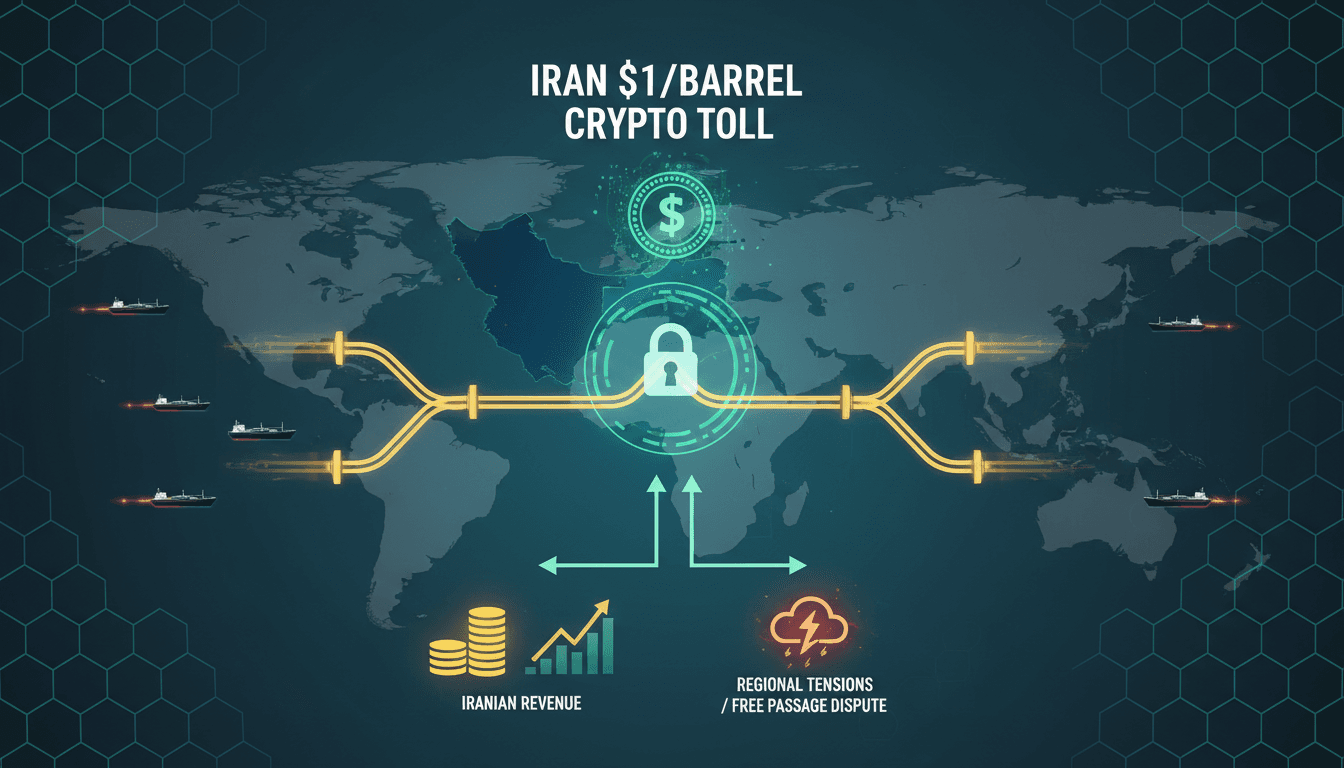
Iran Implements $1-per-Barrel Cryptocurrency Toll for Oil Transit Through Strait of Hormuz
Here's what it means for you.
If you rely on global oil markets, this new toll could influence fuel prices and supply stability.
Why it matters
This toll introduces a new layer of complexity to oil transit, potentially reshaping global energy economics.
What happened (in 30 seconds)
- On April 8, 2026, Iran formalized a toll of approximately $1 per barrel for oil tankers transiting the Strait of Hormuz, payable in Bitcoin or stablecoins.
- The Iranian Revolutionary Guard Corps (IRGC) enforces this toll amid a two-week ceasefire with the United States, requiring vessels to submit cargo manifests for assessment.
- This move aims to generate revenue resistant to sanctions while exerting control over maritime traffic in a critical global chokepoint.
The context you actually need
- The Strait of Hormuz is crucial for global oil supply, handling about 20% of the world's oil, making this toll significant for international trade.
- Prior to this toll, Iran had already been informally collecting fees in yuan and stablecoins due to a blockade initiated during the US-Iran conflict.
- The IRGC's control over maritime traffic allows Iran to selectively enforce these tolls, impacting vessels flagged by countries perceived as hostile.
What's really happening
The implementation of a $1-per-barrel toll for oil tankers transiting the Strait of Hormuz marks a significant shift in how Iran manages its maritime operations and revenue generation. This toll is not merely a financial maneuver; it reflects Iran's strategic response to ongoing geopolitical tensions, particularly its fraught relationship with the United States and its efforts to circumvent economic sanctions.
The toll system was formalized during a fragile ceasefire with the US, which suggests Iran is leveraging this period to establish a new revenue stream that is less susceptible to international sanctions. By requiring payments in cryptocurrencies, Iran can potentially bypass traditional banking systems that are often targeted by sanctions. This approach not only provides Iran with a steady flow of income but also positions it as a player in the evolving landscape of digital currencies.
The IRGC's enforcement of this toll is indicative of Iran's broader strategy to exert control over the Strait of Hormuz, a vital maritime corridor for global oil supply. With approximately 20 million barrels of oil typically transiting this route daily, the potential revenue from this toll could reach $20 million per day, assuming compliance from a significant number of vessels. This revenue is crucial for Iran, especially in a context where its economy has been strained by sanctions and military conflicts.
Moreover, the toll system allows Iran to selectively permit or deny passage to vessels based on their flags, effectively using economic leverage to influence international shipping routes. This selective enforcement could lead to increased tensions with Gulf states and shipping operators who may view the toll as an illegal imposition under international law. The reaction from Gulf states, particularly the UAE and Oman, highlights the contentious nature of this toll, as they have publicly denounced it.
As the situation evolves, the implications for global oil prices and supply chains could be profound. With Brent crude prices already exceeding $100 per barrel, any disruptions or increased costs associated with this toll could further exacerbate economic volatility in the region and beyond. The ripple effects of this toll could be felt in fuel prices, shipping costs, and overall market stability, making it a key development to monitor in the coming weeks.
Who feels it first (and how)
- International Oil Companies: Increased operational costs due to the toll may affect profit margins and pricing strategies.
- Shipping Operators: Compliance with the toll could lead to higher shipping fees, impacting logistics and supply chain management.
- Consumers in Oil-Dependent Economies: Rising fuel prices may lead to increased costs for goods and services, affecting household budgets.
- Regional Governments: Countries reliant on oil exports may face economic pressure if shipping costs rise or if tensions escalate.
What to watch next
- Compliance Rates: Monitor how many vessels comply with the toll and the impact on shipping traffic through the Strait of Hormuz.
- Oil Price Fluctuations: Watch for changes in Brent crude prices as the market reacts to this new toll and its implications for supply.
- Geopolitical Developments: Keep an eye on US-Iran negotiations and regional responses, as these could influence the longevity and enforcement of the toll.
The toll is set at $1 per barrel, payable in cryptocurrencies.
Increased tensions between Iran and Gulf states, as well as potential pushback from international shipping operators.
The long-term sustainability of this toll and its impact on global oil supply dynamics.
Frequently Asked Questions
- Why it matters?
- This toll introduces a new layer of complexity to oil transit, potentially reshaping global energy economics.
- What happened (in 30 seconds)?
- On April 8, 2026, Iran formalized a toll of approximately $1 per barrel for oil tankers transiting the Strait of Hormuz, payable in Bitcoin or stablecoins. The Iranian Revolutionary Guard Corps (IRGC) enforces this toll amid a two-week ceasefire with the United States, requiring vessels to submit cargo manifests for assessment. This move aims to generate revenue resistant to sanctions while exerting control over maritime traffic in a critical global chokepoint.
- What's really happening?
- The implementation of a $1-per-barrel toll for oil tankers transiting the Strait of Hormuz marks a significant shift in how Iran manages its maritime operations and revenue generation. This toll is not merely a financial maneuver; it reflects Iran's strategic response to ongoing geopolitical tensions, particularly its fraught relationship with the United States and its efforts to circumvent economic sanctions. The toll system was formalized during a fragile ceasefire with the US, which suggest
- Who feels it first (and how)?
- International Oil Companies: Increased operational costs due to the toll may affect profit margins and pricing strategies. Shipping Operators: Compliance with the toll could lead to higher shipping fees, impacting logistics and supply chain management. Consumers in Oil-Dependent Economies: Rising fuel prices may lead to increased costs for goods and services, affecting household budgets. Regional Governments: Countries reliant on oil exports may face economic pressure if shipping costs rise or i
- What to watch next?
- Compliance Rates: Monitor how many vessels comply with the toll and the impact on shipping traffic through the Strait of Hormuz. Oil Price Fluctuations: Watch for changes in Brent crude prices as the market reacts to this new toll and its implications for supply. Geopolitical Developments: Keep an eye on US-Iran negotiations and regional responses, as these could influence the longevity and enforcement of the toll.
Real-time updates, analysis, and reports on the blockchain and cryptocurrency sectors.
"Crypto News delivers real-time updates, analysis, and reports on the blockchain and cryptocurrency sectors."
— A47 Editor
Iran wants to turn the Strait of Hormuz into a $1-per-barrel Bitcoin tollbooth
Iran has announced plans to charge oil tankers $1 per barrel in Bitcoin to transit the strategically vital Strait of Hormuz during a two-week ceasefire with the United States. This toll system, implemented by the Islamic Revolutionary Guard Corps (IR...
Global business headlines with AI angles.
"General business outlet that frequently covers AI."
— A47 Editor
Iran's Hormuz Toll Plan Sparks Rift As Ceasefire Leaves Shipping Rules Unclear
Iran's recent announcement to impose a toll on vessels transiting through the Strait of Hormuz has intensified tensions following a fragile ceasefire with the U.S. This plan, reportedly charging $2 million per ship, is framed by Iran as a response to...
Covers Bitcoin plus altcoin news, market updates, and educational resources.
"Bitcoin.com provides news, market data, and guides focused on Bitcoin and the wider crypto industry."
— A47 Editor
Report: Iran Charges Crypto and Yuan Tolls for Strait of Hormuz Oil Tanker Passage
Iran's Islamic Revolutionary Guard Corps (IRGC) has introduced a toll system at the Strait of Hormuz, requiring oil tankers to pay fees in stablecoins or Chinese yuan for passage through this vital maritime route. This decision reflects Iran's strate...
News, analysis, and thought leadership focusing exclusively on Bitcoin.
"Bitcoin Magazine is one of the original publications devoted to Bitcoin, offering in-depth news, analysis, and commentary."
— A47 Editor
Iran to Accept Bitcoin for Strait of Hormuz Transit as Ceasefire Takes Hold
Iran has announced that it will begin accepting Bitcoin as a toll for ships transiting the strategically vital Strait of Hormuz, coinciding with a ceasefire agreement between the U.S. and Iran. This move ties the cryptocurrency to a critical global e...