
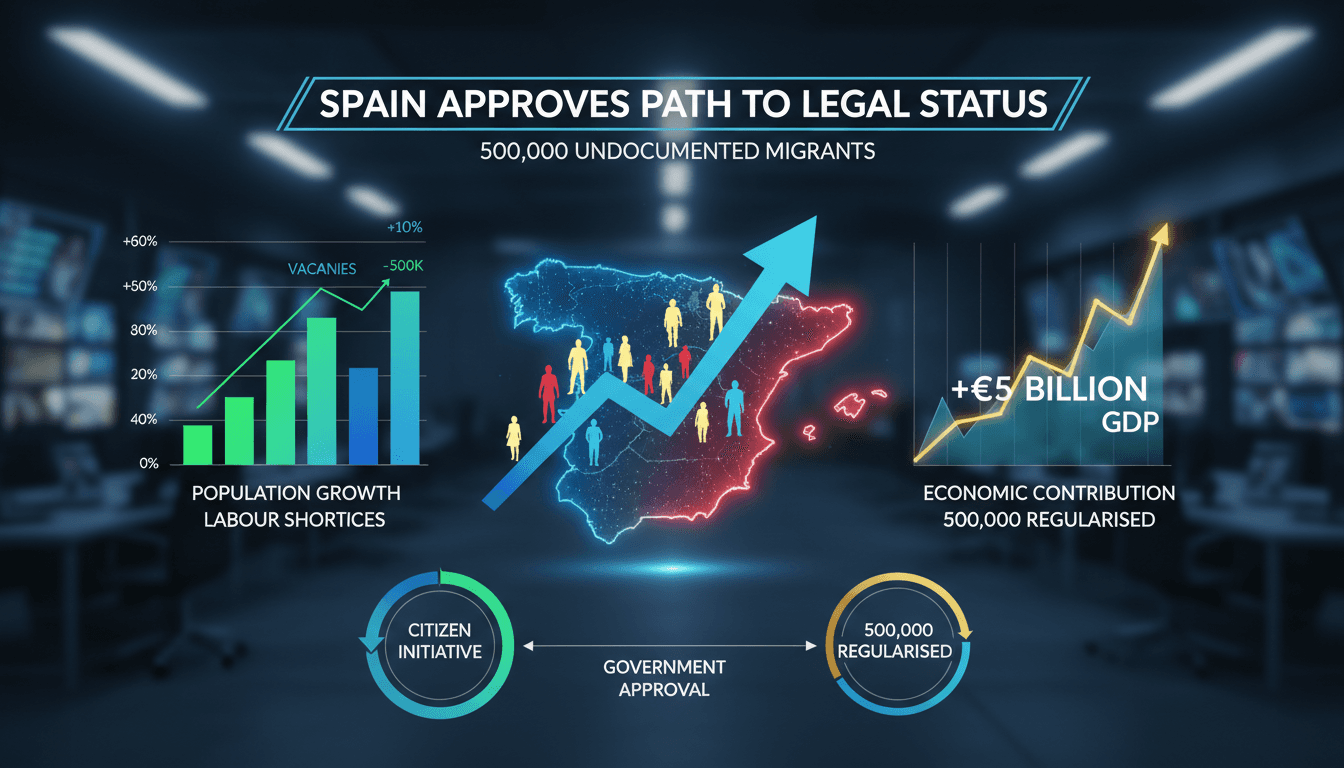
Spanish Government Approves Regularisation for 500,000 Undocumented Migrants
Here's what it means for you.
If you’re in the EU or have business ties to Spain, this policy could reshape labor dynamics and economic contributions in the region.
Why it matters
This regularisation addresses labor shortages in Spain while also responding to demographic challenges, potentially influencing migration policies across Europe.
What happened (in 30 seconds)
- On April 14, 2026, the Spanish government approved a decree to regularise approximately 500,000 undocumented migrants.
- Applications opened on April 16 and will be accepted until June 30, 2026, requiring proof of residence and a clean criminal record.
- The initiative is backed by demographic pressures and economic needs, marking the seventh regularisation effort in 40 years.
The context you actually need
- Spain's population is ageing, with low fertility rates leading to a reliance on foreign-born residents, who now exceed 10 million.
- An estimated 840,000 undocumented migrants are currently part of the workforce, highlighting the economic necessity of this regularisation.
- Previous regularisation efforts have legalised 1.75 million individuals since 1986, indicating a historical pattern of addressing undocumented migration.
What's really happening
The Spanish government's decision to regularise around 500,000 undocumented migrants is a strategic response to pressing demographic and economic challenges. With an ageing population and declining birth rates, Spain faces a labor shortage that threatens its economic stability. The regularisation programme aims to integrate undocumented migrants into the formal economy, thereby enhancing their contributions to social security and public services.
This initiative is not merely a humanitarian gesture; it is a calculated move to bolster the workforce. The Spanish Council of Ministers has identified that a significant portion of the undocumented population is already working in essential sectors, such as agriculture, construction, and services. By granting legal status, the government can ensure these workers are protected under labor laws, which could lead to improved working conditions and increased tax revenues.
The programme also reflects a broader trend in European migration policy, where countries are beginning to recognise the economic value of undocumented migrants. As Spain embarks on this regularisation, it sets a precedent that may influence other EU nations grappling with similar demographic issues. The political landscape surrounding immigration in Spain is complex, with opposition parties like the People's Party (PP) and far-right Vox expressing strong dissent. They argue that such measures could encourage further irregular migration, framing the regularisation as a potential "pull factor."
However, the government counters this narrative by emphasizing the need for a balanced approach to immigration that acknowledges both humanitarian and economic imperatives. The support from business groups and the Catholic Church indicates a societal recognition of the contributions that migrants make to the economy.
As applications for the programme are processed, the immediate challenge lies in managing the influx of applicants. Immigration unions have already threatened strikes due to insufficient resources, highlighting the operational hurdles that could impede the programme's success. The government must navigate these challenges while ensuring that the regularisation process is efficient and equitable.
Who feels it first (and how)
- Undocumented migrants: They will gain legal status, allowing them to work legally and access social services.
- Employers in sectors with labor shortages: They may benefit from a more stable and legally recognized workforce.
- Local communities: They could see increased economic activity and diversity, but may also experience tensions related to immigration.
- Political parties: The ruling party may gain support from progressive voters, while opposition parties could leverage dissent to rally their base.
What to watch next
- Application processing times: Delays could lead to public dissatisfaction and protests, impacting the government's credibility.
- Economic contributions of regularised migrants: Monitoring how these individuals integrate into the workforce will provide insights into the programme's success.
- Political reactions: Watch for potential legal challenges from opposition parties, which could shape future immigration policies.
The regularisation programme is active and applications are being accepted until June 30, 2026.
Increased economic contributions from regularised migrants will be observed, benefiting sectors facing labor shortages.
The long-term political implications of this regularisation on Spain's immigration policy and public sentiment remain uncertain.
Frequently Asked Questions
- Why it matters?
- This regularisation addresses labor shortages in Spain while also responding to demographic challenges, potentially influencing migration policies across Europe.
- What happened (in 30 seconds)?
- On April 14, 2026, the Spanish government approved a decree to regularise approximately 500,000 undocumented migrants. Applications opened on April 16 and will be accepted until June 30, 2026, requiring proof of residence and a clean criminal record. The initiative is backed by demographic pressures and economic needs, marking the seventh regularisation effort in 40 years.
- What's really happening?
- The Spanish government's decision to regularise around 500,000 undocumented migrants is a strategic response to pressing demographic and economic challenges. With an ageing population and declining birth rates, Spain faces a labor shortage that threatens its economic stability. The regularisation programme aims to integrate undocumented migrants into the formal economy, thereby enhancing their contributions to social security and public services. This initiative is not merely a humanitarian ges
- Who feels it first (and how)?
- Undocumented migrants: They will gain legal status, allowing them to work legally and access social services. Employers in sectors with labor shortages: They may benefit from a more stable and legally recognized workforce. Local communities: They could see increased economic activity and diversity, but may also experience tensions related to immigration. Political parties: The ruling party may gain support from progressive voters, while opposition parties could leverage dissent to rally th
- What to watch next?
- Application processing times: Delays could lead to public dissatisfaction and protests, impacting the government's credibility. Economic contributions of regularised migrants: Monitoring how these individuals integrate into the workforce will provide insights into the programme's success. Political reactions: Watch for potential legal challenges from opposition parties, which could shape future immigration policies.
UAE-based English-language newspaper covering regional politics, economics, and global affairs.
"The National reflects Emirati policy perspectives while maintaining international editorial standards."
— A47 Editor
Spain to give legal status to 500,000 undocumented migrants
The Spanish government has approved a new amnesty program that will allow approximately 500,000 undocumented migrants to apply for legal status, marking a significant policy shift in response to rising anti-immigration sentiments across Europe. This ...
Global news coverage with extensive reporting on Middle Eastern conflicts and geopolitics.
"Al Jazeera is a Qatar-based broadcaster known for wide regional coverage and alternative perspectives."
— A47 Editor
Spanish government approves amnesty programme for undocumented immigrants
The Spanish government has approved a new amnesty programme that could allow approximately 500,000 undocumented immigrants to apply for legal status, marking a significant policy shift amid rising anti-immigration sentiments across Europe. This initi...
Comprehensive coverage of Middle Eastern and global issues.
"Al Jazeera is a prominent voice from the Global South, especially the Middle East, with an emphasis on underreported stories."
— A47 Editor
Spanish government approves amnesty programme for undocumented immigrants
The Spanish government has approved a new amnesty programme that could allow approximately 500,000 undocumented immigrants to apply for legal status, marking a significant policy shift amid rising anti-immigration sentiments across Europe. This initi...
International news, politics, and culture.
"Sky News is a UK-based 24-hour channel known for fast-breaking news and political coverage."
— A47 Editor
Spain finalises move which could see 500,000 undocumented migrants apply for legal status
Spain's government has finalized an amnesty measure that could allow approximately 500,000 undocumented migrants to apply for legal status, a move announced by Prime Minister Pedro Sanchez. This initiative is seen as a significant step towards addres...
Pan-Arab news coverage spanning politics, business, sports, and regional affairs.
"Asharq Al-Awsat reflects a broad Arab editorial perspective with strong attention to regional geopolitics."
— A47 Editor
إسبانيا تقرّ قانون عفو يشمل مئات الآلاف من المهاجرين
Spain's Minister of Migration, Ilma Saiz, announced on Tuesday that individuals who meet the required criteria can now apply for a residence and work permit valid for one year. This new amnesty law is expected to benefit hundreds of thousands of migr...