
Critical Design Flaw in Anthropic's Model Context Protocol Exposes 200,000 Servers to Vulnerability
Here's what it means for you.
If you rely on AI tools that utilize Anthropic's Model Context Protocol, your systems may be at risk of exploitation.
Why it matters
This vulnerability exposes a critical weakness in the AI software supply chain, potentially affecting thousands of applications and services globally.
What happened (in 30 seconds)
- Ox Security disclosed a design flaw in Anthropic's Model Context Protocol (MCP) on April 16, 2026, affecting up to 200,000 servers.
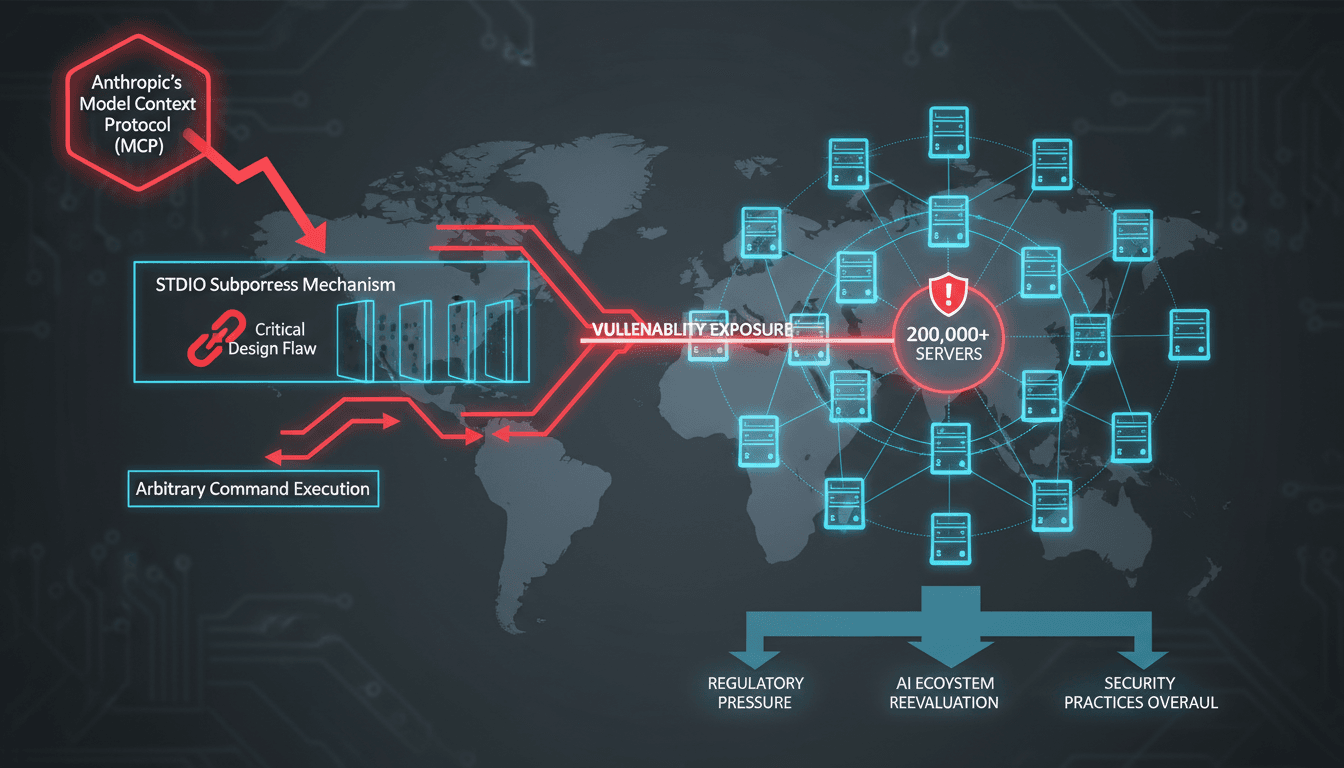
- The flaw allows remote code execution through an unprotected STDIO subprocess mechanism, impacting various programming languages and downstream projects.
- Anthropic responded by issuing updated security guidance but did not implement a fundamental architectural fix.
The context you actually need
- Anthropic launched the Model Context Protocol (MCP) in November 2024 as an open standard for AI applications, leading to rapid adoption across multiple programming languages.
- Ox Security's investigation began in November 2025, revealing the vulnerability amid increasing scrutiny over AI tool security.
- The flaw's propagation to downstream projects like LangFlow and Flowise raises concerns about the broader implications for the AI ecosystem.
What's really happening
The vulnerability in Anthropic's Model Context Protocol (MCP) stems from its STDIO subprocess mechanism, which executes arbitrary operating system commands without proper sanitization. This design flaw allows malicious actors to exploit the protocol, leading to potential remote code execution on affected servers. With an estimated 200,000 servers at risk, the implications are significant for the global AI ecosystem.
Anthropic introduced MCP as an open standard to facilitate interoperability among AI applications, large language models (LLMs), and external data sources. However, the rapid adoption of MCP across various programming languages—including Python, TypeScript, Java, and Rust—has created a vast software supply chain that is now vulnerable. The flaw was identified by Ox Security during their research, which began in late 2025, highlighting the need for robust security measures in AI tools.
Despite the severity of the vulnerability, Anthropic's response has been criticized for lacking a comprehensive architectural fix. Instead, the company issued guidance to restrict the use of STDIO adapters, effectively shifting the burden of security onto developers and implementers of the protocol. This has led to frustration within the developer community, as many feel that the responsibility for securing their applications has been inadequately addressed by the protocol's creators.
The situation is further complicated by the interconnected nature of the AI software ecosystem. As the flaw propagates to downstream projects, the potential for exploitation increases, creating a ripple effect that could impact numerous applications and services. Over 10 high or critical Common Vulnerabilities and Exposures (CVEs) have already been assigned to affected tools, indicating the widespread nature of the issue.
In summary, the MCP vulnerability underscores the importance of proactive security measures in the rapidly evolving AI landscape. As developers and organizations continue to adopt AI tools, the need for secure protocols and standards becomes increasingly critical to protect against potential threats.
Who feels it first (and how)
- Developers using MCP in their applications may face immediate security risks and increased workloads to implement workarounds.
- Companies relying on AI tools that utilize MCP could experience operational disruptions or data breaches.
- Security teams will need to allocate resources to audit and mitigate vulnerabilities in affected systems.
What to watch next
- Anthropic's response: Monitor if Anthropic will implement a fundamental fix to the MCP architecture, which could restore confidence in the protocol.
- Developer community actions: Watch for how developers adapt to the guidance provided by Anthropic and whether they pursue alternative solutions.
- Emerging vulnerabilities: Keep an eye on new vulnerabilities that may arise from the ongoing use of MCP and its downstream projects.
The MCP vulnerability exposes 200,000 servers to potential exploitation.
Developers will face increased scrutiny and pressure to secure their applications against this vulnerability.
The long-term impact on the adoption of MCP and similar protocols in the AI ecosystem remains uncertain.
Frequently Asked Questions
- Why it matters?
- This vulnerability exposes a critical weakness in the AI software supply chain, potentially affecting thousands of applications and services globally.
- What happened (in 30 seconds)?
- Ox Security disclosed a design flaw in Anthropic's Model Context Protocol (MCP) on April 16, 2026, affecting up to 200,000 servers. The flaw allows remote code execution through an unprotected STDIO subprocess mechanism, impacting various programming languages and downstream projects. Anthropic responded by issuing updated security guidance but did not implement a fundamental architectural fix.
- What's really happening?
- The vulnerability in Anthropic's Model Context Protocol (MCP) stems from its STDIO subprocess mechanism, which executes arbitrary operating system commands without proper sanitization. This design flaw allows malicious actors to exploit the protocol, leading to potential remote code execution on affected servers. With an estimated 200,000 servers at risk, the implications are significant for the global AI ecosystem. Anthropic introduced MCP as an open standard to facilitate interoperability amo
- Who feels it first (and how)?
- Developers using MCP in their applications may face immediate security risks and increased workloads to implement workarounds. Companies relying on AI tools that utilize MCP could experience operational disruptions or data breaches. Security teams will need to allocate resources to audit and mitigate vulnerabilities in affected systems.
- What to watch next?
- Anthropic's response: Monitor if Anthropic will implement a fundamental fix to the MCP architecture, which could restore confidence in the protocol. Developer community actions: Watch for how developers adapt to the guidance provided by Anthropic and whether they pursue alternative solutions. Emerging vulnerabilities: Keep an eye on new vulnerabilities that may arise from the ongoing use of MCP and its downstream projects.
Biting coverage of AI/ML software and vendors.
"Known for skeptical, incisive reporting on enterprise tech."
— A47 Editor
Anthropic won't own MCP 'design flaw' putting 200K servers at risk, researchers say
Security researchers have identified a significant design flaw in Anthropic's Model Context Protocol (MCP), which could potentially compromise up to 200,000 servers, allowing for a complete takeover. This flaw raises questions about the robustness of...
Consumer tech news, reviews, and buying guides for gadgets and electronics.
"TechRadar is known for comprehensive buying advice, hardware reviews, and consumer tech news targeted at mainstream audiences."
— A47 Editor
'This is not a traditional coding error': Experts flag potentially critical security issues at the heart of Anthropic's MCP, exposes 150 million downloads and thousands of servers to complete takeover
Experts have raised alarms regarding critical security vulnerabilities within Anthropic's MCP, potentially exposing 150 million downloads and thousands of servers to complete takeover. Despite these concerns, Anthropic maintains that its tools are fu...
Biting coverage of AI/ML software and vendors.
"Known for skeptical, incisive reporting on enterprise tech."
— A47 Editor
Agents hooked into GitHub can steal creds – but Anthropic, Google, and Microsoft haven't warned users
Security researchers have discovered vulnerabilities in three AI agents integrated with GitHub Actions, allowing them to execute prompt injection attacks to steal sensitive API keys and access tokens. Despite these findings, companies like Anthropic,...