
Campbell Wilson Resigns as Air India CEO Amid Financial and Regulatory Challenges
Here's what it means for you.
The resignation of Air India's CEO could signal significant shifts in airline operations and travel dynamics, especially for those reliant on Indian routes.
Why it matters
This leadership change comes at a critical juncture for Air India, which faces mounting financial losses and operational challenges that could impact global travel networks.
What happened (in 30 seconds)
- Campbell Wilson resigned as CEO of Air India on April 7, 2026, after overseeing a turnaround since Tata Group's acquisition in 2022.
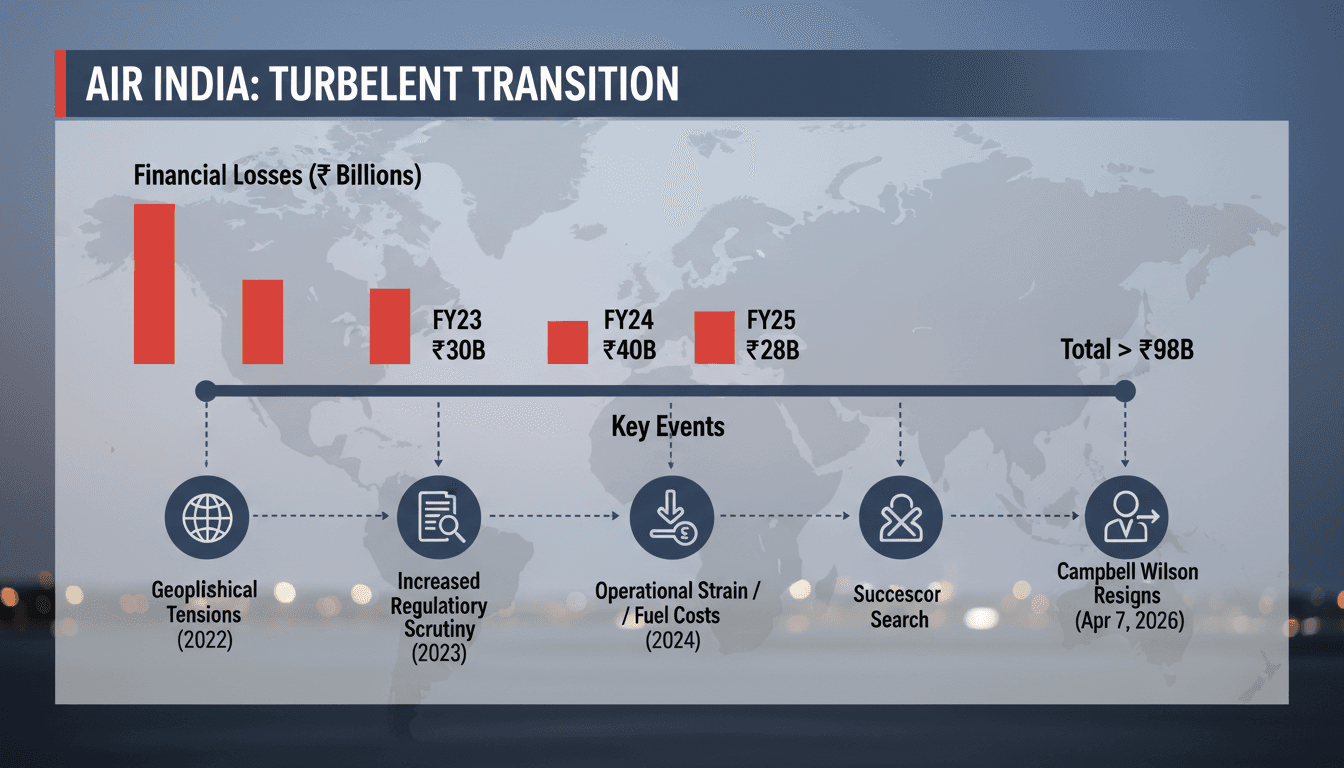
- Air India reported combined losses exceeding ₹98 billion ($1.05 billion) for the fiscal year 2024-2025, compounded by regulatory scrutiny and geopolitical tensions.
- Wilson will serve a six-month notice period to ensure a smooth transition as the airline seeks a successor amid ongoing operational pressures.
The context you actually need
- Air India has struggled financially for years, with its privatization in 2022 marking a pivotal attempt at revitalization under Tata Group.
- The June 2025 crash of Flight 171 intensified regulatory scrutiny, leading to increased oversight and operational challenges for the airline.
- Geopolitical tensions in the Middle East have disrupted flight operations, particularly affecting routes crucial for the Indian expatriate community in the Gulf.
What's really happening
Campbell Wilson's resignation as CEO of Air India is not just a routine leadership change; it reflects deeper systemic issues within the airline and the broader aviation industry. Since Tata Group's acquisition in January 2022, Wilson has been at the forefront of a significant turnaround strategy aimed at revitalizing Air India, which had long been plagued by inefficiencies and financial losses. Under his leadership, the airline made substantial strides, including merging four airlines, expanding its fleet by adding 100 aircraft, and placing a massive order for 600 new planes. However, these efforts were overshadowed by a series of crises.
The June 12, 2025, crash of Flight 171, which resulted in the tragic loss of 260 lives, marked a turning point for Air India. This incident not only triggered intense regulatory scrutiny but also raised serious questions about the airline's safety protocols and operational readiness. The subsequent regulatory reprimands have put additional pressure on the airline, making it increasingly difficult for it to operate smoothly.
Moreover, geopolitical tensions, particularly the ongoing conflicts in the Middle East, have further complicated Air India's operational landscape. The airline has faced significant disruptions, including a ban on flights over Pakistan's airspace, which has limited its ability to serve key international routes. These challenges have led to a staggering combined loss of ₹98.08 billion ($1.05 billion) for Air India and its low-cost subsidiary, Air India Express, in the fiscal year 2024-2025.
Wilson's decision to step down is seen as a strategic move to allow new leadership to take the reins as the airline prepares for major fleet deliveries starting in 2027. The search for a successor is critical, as the new CEO will need to navigate the complex landscape of regulatory scrutiny, financial recovery, and operational challenges. Analysts have noted the difficulty in finding a suitable leader, especially following the recent appointment of Willie Walsh at IndiGo, which raises the stakes for Air India's future.
Who feels it first (and how)
- Airline Employees: Staff may face uncertainty regarding job security and operational changes as a new CEO is appointed.
- Travelers: Passengers, particularly the Indian expatriate community in the Gulf, may experience disruptions in flight availability and service quality.
- Investors: Stakeholders in the aviation sector will closely monitor Air India's recovery trajectory and leadership effectiveness, impacting investment decisions.
What to watch next
- Leadership Transition: The appointment of a new CEO will be crucial in shaping Air India's strategic direction and operational recovery.
- Regulatory Developments: Increased safety audits and regulatory scrutiny will likely affect operational capabilities and route availability.
- Geopolitical Stability: Any changes in Middle Eastern conflict dynamics could influence Air India's flight operations and profitability.
Air India is facing significant financial losses and operational challenges.
The search for a new CEO will be challenging, impacting the airline's strategic direction.
The long-term effects of geopolitical tensions on Air India's operations remain uncertain.
Frequently Asked Questions
- Why it matters?
- This leadership change comes at a critical juncture for Air India, which faces mounting financial losses and operational challenges that could impact global travel networks.
- What happened (in 30 seconds)?
- Campbell Wilson resigned as CEO of Air India on April 7, 2026, after overseeing a turnaround since Tata Group's acquisition in 2022. Air India reported combined losses exceeding ₹98 billion ($1.05 billion) for the fiscal year 2024-2025, compounded by regulatory scrutiny and geopolitical tensions. Wilson will serve a six-month notice period to ensure a smooth transition as the airline seeks a successor amid ongoing operational pressures.
- What's really happening?
- Campbell Wilson's resignation as CEO of Air India is not just a routine leadership change; it reflects deeper systemic issues within the airline and the broader aviation industry. Since Tata Group's acquisition in January 2022, Wilson has been at the forefront of a significant turnaround strategy aimed at revitalizing Air India, which had long been plagued by inefficiencies and financial losses. Under his leadership, the airline made substantial strides, including merging four airlines, expandin
- Who feels it first (and how)?
- Airline Employees: Staff may face uncertainty regarding job security and operational changes as a new CEO is appointed. Travelers: Passengers, particularly the Indian expatriate community in the Gulf, may experience disruptions in flight availability and service quality. Investors: Stakeholders in the aviation sector will closely monitor Air India's recovery trajectory and leadership effectiveness, impacting investment decisions.
- What to watch next?
- Leadership Transition: The appointment of a new CEO will be crucial in shaping Air India's strategic direction and operational recovery. Regulatory Developments: Increased safety audits and regulatory scrutiny will likely affect operational capabilities and route availability. Geopolitical Stability: Any changes in Middle Eastern conflict dynamics could influence Air India's flight operations and profitability.
U.S. business news, corporate developments, and economy.
"The Wall Street Journal is respected for deep financial and economic reporting with a center-right editorial perspective."
— A47 Editor
Air India CEO Resigns Amid Industry Headwinds
Campbell Wilson has resigned as CEO of Air India, a decision that comes earlier than expected as his term was originally set to conclude in 2027. This resignation follows a series of operational challenges and significant financial losses that have p...
Corporate news, economic trends, and markets with UK and global scope.
"BBC News is widely regarded as reputable and impartial, with a public service mandate."
— A47 Editor
Air India CEO steps down early as losses mount
Campbell Wilson has stepped down as CEO of Air India earlier than expected, with his term originally set to conclude in 2027. His resignation comes amid the airline's mounting financial losses and operational challenges, which have significantly impa...