
U.S. Supreme Court Vacates Steve Bannon's Contempt Convictions
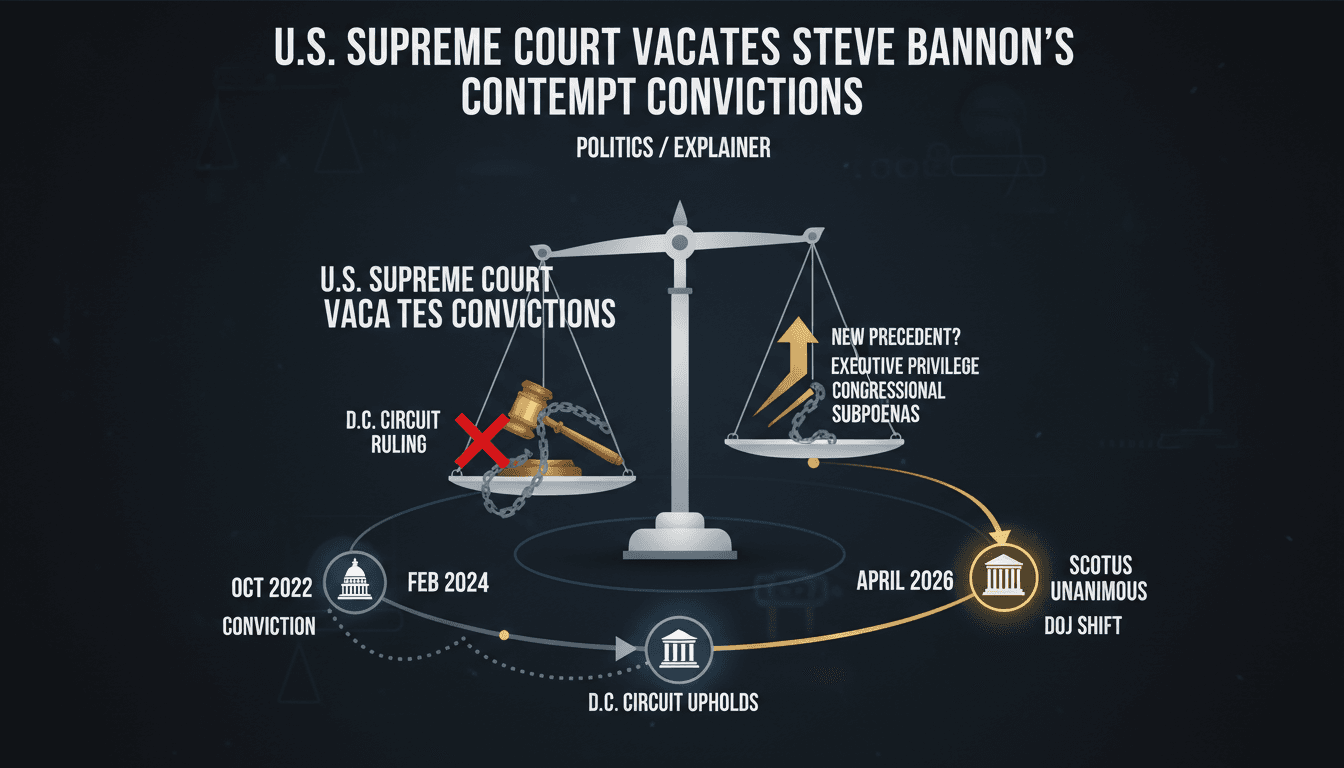
Here's what it means for you.
If you’re in a sector affected by political scrutiny, this ruling could signal a shift in how contempt of Congress cases are handled in the future.
Why it matters
This ruling could reshape the landscape of political accountability and the enforcement of congressional subpoenas.
What happened (in 30 seconds)
- On April 6, 2026, the U.S. Supreme Court unanimously vacated Steve Bannon's contempt convictions, allowing for potential dismissal.
- The case stems from Bannon's refusal to comply with a subpoena from the House Select Committee investigating the January 6 Capitol attack.
- The Department of Justice has indicated it no longer supports the prosecution, aligning with a broader reassessment of January 6-related cases.
The context you actually need
- Bannon was convicted in July 2022 for contempt of Congress after refusing to testify, serving four months in prison.
- The DOJ's shift in stance follows a political climate where over 1,500 individuals related to January 6 received pardons from former President Trump.
- The Supreme Court's decision reflects a growing trend of judicial leniency in politically charged cases, potentially impacting future congressional oversight.
What's really happening
The Supreme Court's vacatur of Steve Bannon's contempt convictions is a significant legal maneuver that highlights the intersection of law, politics, and executive privilege. The unanimous decision came at the joint request of Bannon and the Department of Justice (DOJ), indicating a rare moment of alignment between a former Trump advisor and the federal government. This case is rooted in Bannon's refusal to comply with a subpoena issued by the House Select Committee investigating the January 6 Capitol attack, which has been a focal point of political contention in the U.S.
Bannon's initial conviction in July 2022, which resulted in a four-month prison sentence, was viewed by many as a critical test of congressional authority. However, the DOJ's reassessment under the Trump administration, particularly after the 2025 inauguration, suggests a shift in the political landscape. The DOJ determined that pursuing the case no longer served the interests of justice, a sentiment echoed by Trump's pardoning of numerous individuals linked to January 6. This context is crucial as it reveals the underlying incentives driving the DOJ's motion to dismiss the indictment against Bannon.
The Supreme Court's decision to remand the case back to the lower courts for further proceedings signals a potential end to this legal saga. The D.C. Circuit Court now faces the task of considering the DOJ's motion to dismiss, which is expected to lead to formal dismissal. This outcome could set a precedent for how similar cases are handled in the future, particularly those involving executive privilege and congressional subpoenas. The implications extend beyond Bannon, as this ruling may embolden other individuals facing contempt charges, potentially leading to a chilling effect on congressional oversight.
Moreover, the ruling reflects a broader cultural shift in the U.S. legal landscape, where political affiliations may increasingly influence judicial outcomes. As the lines between law and politics blur, the implications for accountability and governance could be profound, raising questions about the future of congressional authority and the enforcement of subpoenas.
Who feels it first (and how)
- Political figures: Those involved in congressional investigations may feel empowered or deterred based on this ruling.
- Legal professionals: Attorneys specializing in political law will need to adapt strategies in light of changing precedents.
- Activists and watchdog organizations: Groups focused on government accountability may reassess their approaches to oversight and legal challenges.
What to watch next
- DOJ's motion to dismiss: The outcome of this motion will clarify the future of contempt cases and congressional authority.
- Future congressional subpoenas: How Congress responds to this ruling may indicate a shift in their willingness to enforce subpoenas against political figures.
- Political climate: The broader implications of this ruling on political accountability and executive privilege will be worth monitoring as the 2026 elections approach.
The Supreme Court vacated Bannon's contempt convictions.
The DOJ's motion to dismiss will be granted, leading to Bannon's indictment being dismissed.
The long-term impact on congressional authority and future contempt cases remains uncertain.
Frequently Asked Questions
- Why it matters?
- This ruling could reshape the landscape of political accountability and the enforcement of congressional subpoenas.
- What happened (in 30 seconds)?
- On April 6, 2026, the U.S. Supreme Court unanimously vacated Steve Bannon's contempt convictions, allowing for potential dismissal. The case stems from Bannon's refusal to comply with a subpoena from the House Select Committee investigating the January 6 Capitol attack. The Department of Justice has indicated it no longer supports the prosecution, aligning with a broader reassessment of January 6-related cases.
- What's really happening?
- The Supreme Court's vacatur of Steve Bannon's contempt convictions is a significant legal maneuver that highlights the intersection of law, politics, and executive privilege. The unanimous decision came at the joint request of Bannon and the Department of Justice (DOJ), indicating a rare moment of alignment between a former Trump advisor and the federal government. This case is rooted in Bannon's refusal to comply with a subpoena issued by the House Select Committee investigating the January 6 C
- Who feels it first (and how)?
- Political figures: Those involved in congressional investigations may feel empowered or deterred based on this ruling. Legal professionals: Attorneys specializing in political law will need to adapt strategies in light of changing precedents. Activists and watchdog organizations: Groups focused on government accountability may reassess their approaches to oversight and legal challenges.
- What to watch next?
- DOJ's motion to dismiss: The outcome of this motion will clarify the future of contempt cases and congressional authority. Future congressional subpoenas: How Congress responds to this ruling may indicate a shift in their willingness to enforce subpoenas against political figures. Political climate: The broader implications of this ruling on political accountability and executive privilege will be worth monitoring as the 2026 elections approach.
Conservative-leaning coverage of current events.
"Fox News is a highly influential conservative news outlet known for right-leaning political commentary and coverage."
— A47 Editor
Supreme Court clears path for DOJ to erase Steve Bannon's Jan 6 conviction
The U.S. Supreme Court has cleared the way for the Department of Justice (DOJ) to dismiss the contempt case against Steve Bannon, a former advisor to Donald Trump, by vacating a lower court ruling that upheld his conviction. This decision sends the c...
Coverage of national news and issues shaping the United States, including politics, economy, and society.
"The Wall Street Journal is one of the most respected financial and news publications in the U.S., known for its rigorous reporting and center-right editorial perspective."
— A47 Editor
Supreme Court Paves Way for Dismissal of Steve Bannon’s Criminal Case
The U.S. Supreme Court has vacated a lower court ruling that upheld Steve Bannon's criminal conviction for contempt of Congress, sending the case back to the D.C. Circuit Court of Appeals for further consideration. This decision may pave the way for ...
News across North, Central, and South America including politics and economics.
"France 24 is viewed as a globally focused outlet with balanced coverage and a European perspective."
— A47 Editor
US Supreme Court paves way to drop Capitol riot charges against ex-Trump ally Steve Bannon
The US Supreme Court has cleared the way for the Justice Department to potentially drop criminal charges against Steve Bannon, a former ally of Donald Trump, who was previously convicted for defying a congressional subpoena related to the January 6 C...
Coverage of national news and events from across the United States.
"HuffPost is known for its progressive editorial stance, offering opinionated yet comprehensive coverage on social, political, and cultural topics."
— A47 Editor
Steve Bannon Wins Supreme Court Order Likely To Lead To Dismissal Of Contempt Of Congress Conviction
Steve Bannon, a longtime ally of former President Trump, has secured a Supreme Court order that is likely to lead to the dismissal of his criminal conviction for contempt of Congress. The Court vacated a lower court ruling that upheld his conviction,...