
White House Study Challenges Banking Lobby's Yield Ban Argument in CLARITY Act Negotiations
Here's what it means for you.
If you’re involved in finance or digital assets, the outcome of the CLARITY Act negotiations could reshape the landscape of stablecoin investments and banking practices.
Why it matters
The ongoing debate over stablecoin yields could significantly influence the $280 billion global stablecoin market and the broader financial ecosystem.
What happened (in 30 seconds)
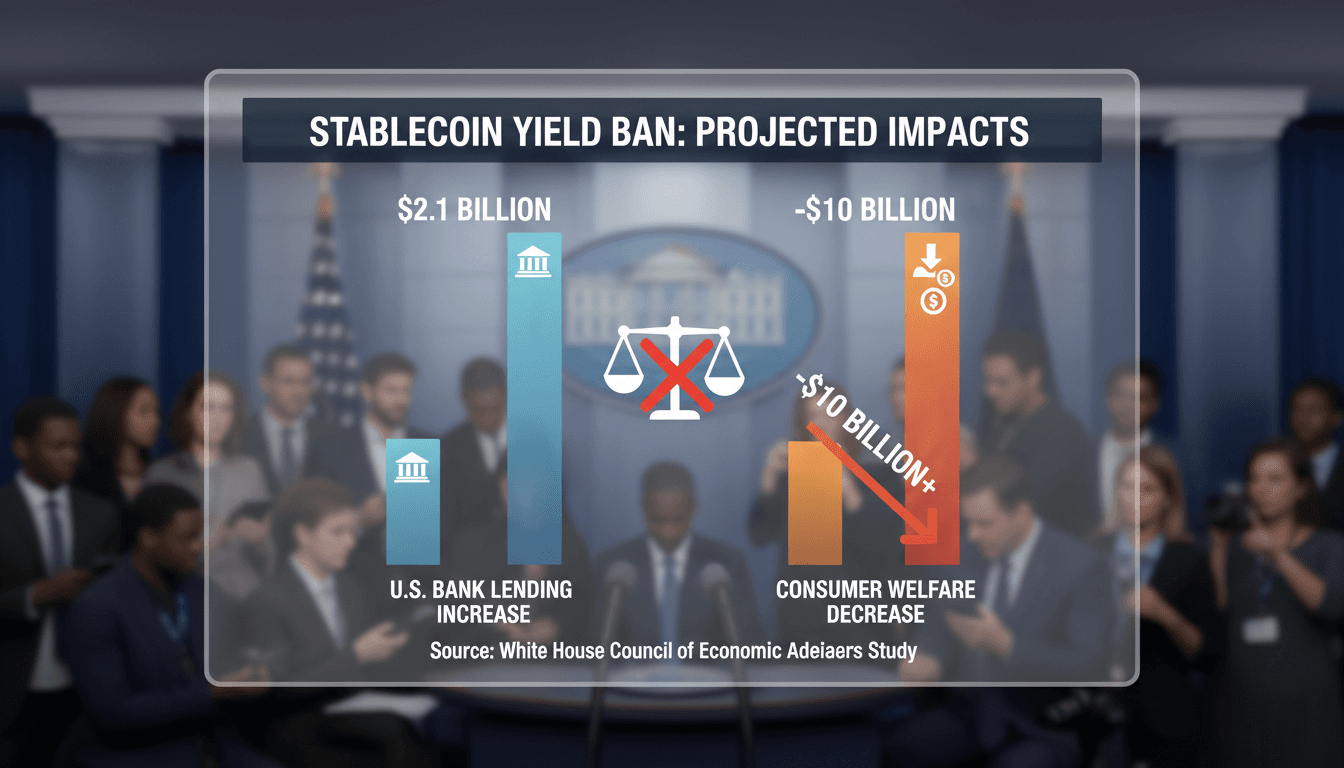
- April 8, 2026: The White House Council of Economic Advisers released a study indicating that banning yields on stablecoins would only increase U.S. bank lending by $2.1 billion.
- April 15, 2026: This finding undermined the American Bankers Association's arguments for a yield ban as part of the Digital Asset Market CLARITY Act negotiations.
- Current Status: The CLARITY Act is pending Senate Banking Committee markup, with negotiations on yield provisions nearing a compromise.
The context you actually need
- The CLARITY Act: Introduced in May 2025, the act aims to clarify regulatory oversight of digital assets, particularly stablecoins, which have seen rapid growth.
- Banking Concerns: The American Bankers Association argues that interest-bearing stablecoins threaten traditional banking by drawing deposits away from community banks.
- Market Dynamics: The stablecoin market's expansion has raised questions about the balance between innovation in digital finance and the stability of traditional banking systems.
What's really happening
The recent study by the White House Council of Economic Advisers has brought to light the limited impact of prohibiting yields on stablecoins. The projected increase of $2.1 billion in U.S. bank lending represents a mere 0.02% of outstanding loans, raising questions about the validity of the banking lobby's claims. The American Bankers Association has been advocating for a ban on stablecoin yields, arguing that these yields undermine traditional banking by incentivizing consumers to withdraw funds from banks in favor of higher returns from stablecoins.
However, the study suggests that the potential benefits of such a ban are minimal compared to the projected consumer welfare loss of $800 million. This discrepancy highlights a critical tension between the interests of traditional banks and the burgeoning digital asset market. As the Senate Banking Committee prepares to mark up the CLARITY Act, the findings from the Council of Economic Advisers could shift the narrative, pushing lawmakers to reconsider the implications of a yield ban.
The CLARITY Act itself aims to provide regulatory clarity by delineating the roles of the SEC and CFTC in overseeing digital assets. This is particularly important as the stablecoin market continues to grow, currently valued at over $280 billion. The act's provisions on stablecoin reserves and yields are contentious, with banks fearing that competition from interest-bearing stablecoins could erode their deposit bases and lending capabilities.
As negotiations progress, key figures such as Treasury Secretary Scott Bessent and SEC Chair Paul Atkins have publicly endorsed the CLARITY Act, signaling a potential compromise that could allow for some form of yield on stablecoins. Coinbase's Chief Legal Officer, Paul Grewal, has also indicated that a deal on yields may be imminent, suggesting that the market could see a more favorable regulatory environment for stablecoins.
This evolving landscape underscores the need for a balanced approach that considers both the innovation potential of digital assets and the stability of traditional banking systems. As the Senate Banking Committee prepares for markup, the outcome of these negotiations will have far-reaching implications for both sectors.
Who feels it first (and how)
- Community Banks: May experience reduced deposits if stablecoin yields remain competitive.
- Digital Asset Investors: Could benefit from clearer regulations and potential yield opportunities.
- Regulators: Will need to navigate the complexities of balancing innovation with financial stability.
What to watch next
- Senate Banking Committee Markup: The timing and outcomes of the markup will indicate the direction of stablecoin regulation.
- Market Reactions: Watch for shifts in stablecoin volumes and investor sentiment as negotiations unfold.
- Consumer Behavior: Changes in consumer preferences towards stablecoins versus traditional banking products could signal broader market trends.
The CLARITY Act is currently pending Senate Banking Committee markup.
A compromise on stablecoin yields may emerge, influenced by the recent study.
The long-term impact on community banks and the overall stability of the banking system remains to be seen.
Frequently Asked Questions
- Why it matters?
- The ongoing debate over stablecoin yields could significantly influence the $280 billion global stablecoin market and the broader financial ecosystem.
- What happened (in 30 seconds)?
- April 8, 2026: The White House Council of Economic Advisers released a study indicating that banning yields on stablecoins would only increase U.S. bank lending by $2.1 billion. April 15, 2026: This finding undermined the American Bankers Association's arguments for a yield ban as part of the Digital Asset Market CLARITY Act negotiations. Current Status: The CLARITY Act is pending Senate Banking Committee markup, with negotiations on yield provisions nearing a compromise.
- What's really happening?
- The recent study by the White House Council of Economic Advisers has brought to light the limited impact of prohibiting yields on stablecoins. The projected increase of $2.1 billion in U.S. bank lending represents a mere 0.02% of outstanding loans, raising questions about the validity of the banking lobby's claims. The American Bankers Association has been advocating for a ban on stablecoin yields, arguing that these yields undermine traditional banking by incentivizing consumers to withdraw fun
- Who feels it first (and how)?
- Community Banks: May experience reduced deposits if stablecoin yields remain competitive. Digital Asset Investors: Could benefit from clearer regulations and potential yield opportunities. Regulators: Will need to navigate the complexities of balancing innovation with financial stability.
- What to watch next?
- Senate Banking Committee Markup: The timing and outcomes of the markup will indicate the direction of stablecoin regulation. Market Reactions: Watch for shifts in stablecoin volumes and investor sentiment as negotiations unfold. Consumer Behavior: Changes in consumer preferences towards stablecoins versus traditional banking products could signal broader market trends.
Real-time updates, analysis, and reports on the blockchain and cryptocurrency sectors.
"Crypto News delivers real-time updates, analysis, and reports on the blockchain and cryptocurrency sectors."
— A47 Editor
White House study undercuts bank lobby as CLARITY Act yield fight intensifies
A recent White House study has concluded that banning yields on stablecoins would have minimal impact on U.S. bank lending, while potentially harming consumers by reducing their returns. This finding reshapes the ongoing debate surrounding the CLARIT...
News and analysis on Bitcoin, altcoins, and blockchain innovation.
"Bitcoinist delivers news and analysis on Bitcoin, altcoins, and blockchain innovation with a focus on market trends and industry updates."
— A47 Editor
ABA Challenges White House Report On Stablecoins, Flags Major Concerns
The American Bankers Association (ABA) has publicly challenged the White House Council of Economic Advisers (CEA) regarding its recent report on stablecoins, which is linked to the proposed CLARITY Act. The ABA argues that the CEA's analysis misrepre...
News and analysis on Bitcoin, altcoins, and blockchain innovation.
"Bitcoinist delivers news and analysis on Bitcoin, altcoins, and blockchain innovation with a focus on market trends and industry updates."
— A47 Editor
Crypto Traders On Alert: Is CLARITY The Last Chance To Protect Stablecoin Yield?
U.S. Senator Thom Tillis is expected to unveil a compromise draft of the CLARITY Act this week, aimed at resolving the ongoing dispute over stablecoin yields between banks and the cryptocurrency sector. This legislative effort comes as negotiations h...
Covers blockchain, cryptocurrency news, project analysis, and market insights.
"Cointelegraph is a leading crypto-focused media outlet known for timely news, analysis, and educational content related to blockchain and digital assets."
— A47 Editor
Banks challenge White House report on stablecoin yields
The American Bankers Association (ABA) has raised concerns regarding a recent White House report that downplays the potential impact of stablecoin yields on bank deposits, particularly for smaller community banks. The ABA argues that these yields cou...
Covers Bitcoin plus altcoin news, market updates, and educational resources.
"Bitcoin.com provides news, market data, and guides focused on Bitcoin and the wider crypto industry."
— A47 Editor
American Bankers Association Warns White House Is Underestimating Stablecoin Yield Risks to Lending and Deposit Stability
The American Bankers Association (ABA) has expressed concerns that the White House is underestimating the risks associated with stablecoin yields, which could impact lending and deposit stability in the banking sector. The ABA's warning comes amid on...
Covers blockchain, cryptocurrency news, project analysis, and market insights.
"CoinDesk is a well-established cryptocurrency and blockchain news provider, offering comprehensive insights, market data, and industry research."
— A47 Editor
Bankers rebuff White House claim that stablecoin yield doesn't threaten deposits
The American Bankers Association has challenged the White House's assertion that stablecoin yields do not pose a threat to bank deposits, citing a recent study that critiques the government's economic analysis.