
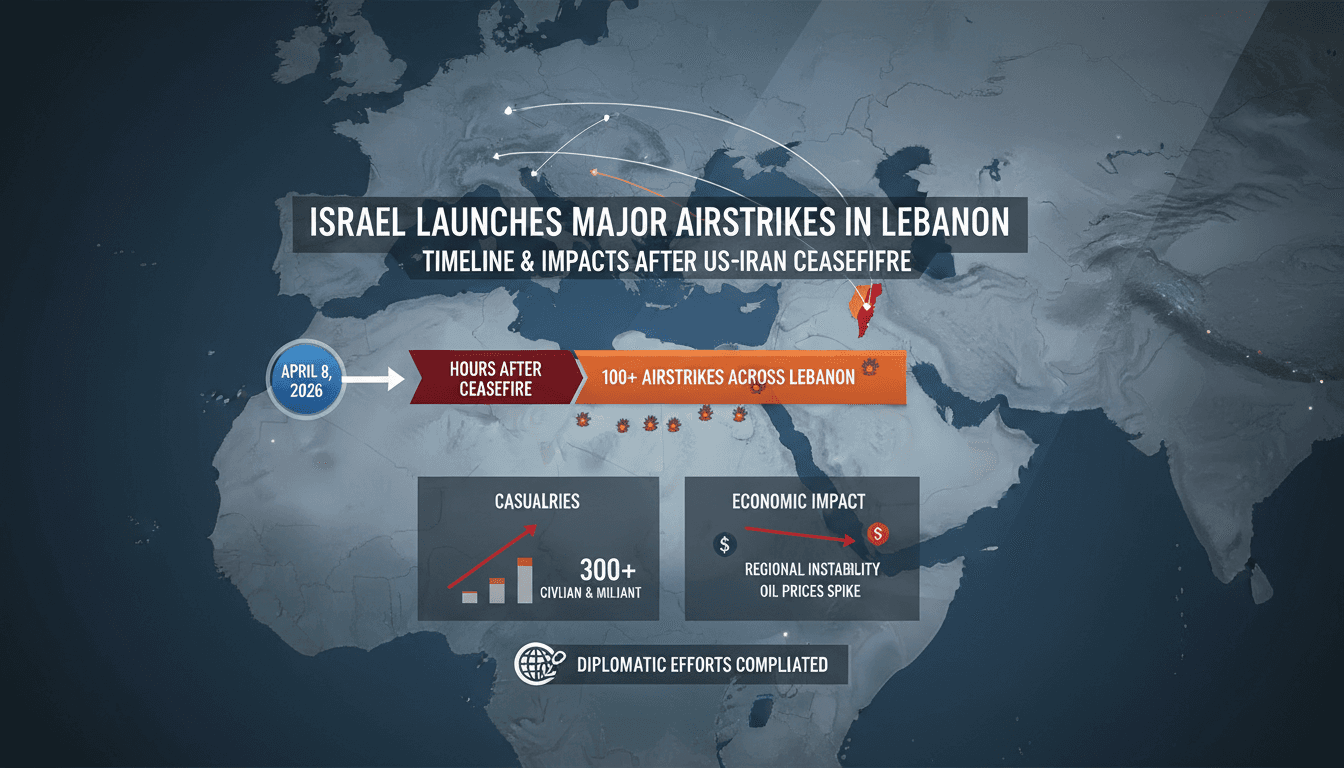
Israel Launches Major Airstrikes in Lebanon Following US-Iran Ceasefire Announcement
Here's what it means for you.
The escalation in Lebanon could impact global markets and regional stability, affecting your investments and travel plans.
Why it matters
The airstrikes signify a critical escalation in the US-Israel-Iran conflict, with potential ripple effects on international markets and geopolitical stability.
What happened (in 30 seconds)
- Israel launched over 100 airstrikes across Lebanon, targeting Hezbollah infrastructure, resulting in at least 182 deaths and over 890 injuries.
- The strikes occurred hours after a US-brokered ceasefire between the US and Iran, which Israel claims did not apply to operations against Hezbollah.
- Lebanese officials condemned the strikes as violations of international law, while Hezbollah vowed retaliation, escalating tensions in the region.
The context you actually need
- The conflict reignited on February 28, 2026, following US and Israeli actions against Iran, prompting Hezbollah missile fire and subsequent Israeli bombardment.
- A previous ceasefire between Israel and Hezbollah had been violated nearly daily, with Israel conducting around 700 airstrikes since November 2024.
- The recent ceasefire was intended to halt direct exchanges but was contested regarding its applicability to Hezbollah, complicating the regional dynamics.
What's really happening
The recent Israeli airstrikes on Lebanon represent a significant escalation in a conflict that has been simmering for years. The strikes targeted over 100 Hezbollah sites, including command centers and missile launchers, within a rapid 10-minute barrage. This operation was conducted without prior warnings, leading to high civilian casualties in densely populated areas. The Israeli military justified its actions as necessary for protecting its northern border from perceived threats posed by Hezbollah, which is backed by Iran.
The backdrop to this violence is a complex web of geopolitical tensions involving the US, Israel, Iran, and their respective allies. The ceasefire brokered by the US aimed to stop direct hostilities between the US and Iran, but Israel's interpretation excluded Hezbollah, leading to a stark divergence in how different parties view the ceasefire's applicability. While the US and Israel see Hezbollah as a separate entity, Iran and its allies argue for a broader interpretation that includes Lebanon.
This incident underscores the fragility of peace in the region, as both sides are entrenched in their positions. The Lebanese government has condemned the airstrikes, calling for international intervention, while Hezbollah has paused its attacks but vowed to retaliate, indicating that the conflict may escalate further. The UN has also called for an immediate halt to hostilities, but the effectiveness of such appeals remains uncertain given the historical context of the region.
The economic implications of this conflict are significant. The ongoing violence and instability have already led to a 16% drop in Dubai's stock index since late February 2026, wiping out approximately $120 billion across UAE exchanges. The tourism sector is also feeling the pressure, with a 25% decline in housing sales and a decrease in visitor numbers, impacting local businesses and residents' livelihoods. This economic downturn is likely to exacerbate social tensions within the UAE, as residents grapple with the fallout from regional instability.
Who feels it first (and how)
- Investors: Those with stakes in Middle Eastern markets may see immediate impacts on their portfolios due to volatility.
- Tourism sector: Businesses reliant on tourism in Dubai and surrounding areas may face declining revenues as travel fears increase.
- Local residents: Individuals in Lebanon and the UAE may experience heightened insecurity and economic pressures due to the conflict's escalation.
What to watch next
- Hezbollah's response: Monitoring Hezbollah's military actions in response to the airstrikes will be crucial in assessing the potential for further escalation.
- International diplomatic efforts: Watch for any new initiatives from global powers aimed at de-escalating tensions and enforcing ceasefire agreements.
- Market reactions: Keep an eye on stock market trends in the UAE and broader Middle East, as investor sentiment may shift rapidly based on developments in the conflict.
The airstrikes resulted in significant casualties and international condemnation.
Hezbollah will respond militarily, potentially escalating the conflict further.
The effectiveness of international diplomatic efforts to de-escalate the situation remains uncertain.
Frequently Asked Questions
- Why it matters?
- The airstrikes signify a critical escalation in the US-Israel-Iran conflict, with potential ripple effects on international markets and geopolitical stability.
- What happened (in 30 seconds)?
- Israel launched over 100 airstrikes across Lebanon, targeting Hezbollah infrastructure, resulting in at least 182 deaths and over 890 injuries. The strikes occurred hours after a US-brokered ceasefire between the US and Iran, which Israel claims did not apply to operations against Hezbollah. Lebanese officials condemned the strikes as violations of international law, while Hezbollah vowed retaliation, escalating tensions in the region.
- What's really happening?
- The recent Israeli airstrikes on Lebanon represent a significant escalation in a conflict that has been simmering for years. The strikes targeted over 100 Hezbollah sites, including command centers and missile launchers, within a rapid 10-minute barrage. This operation was conducted without prior warnings, leading to high civilian casualties in densely populated areas. The Israeli military justified its actions as necessary for protecting its northern border from perceived threats posed by Hezbo
- Who feels it first (and how)?
- Investors: Those with stakes in Middle Eastern markets may see immediate impacts on their portfolios due to volatility. Tourism sector: Businesses reliant on tourism in Dubai and surrounding areas may face declining revenues as travel fears increase. Local residents: Individuals in Lebanon and the UAE may experience heightened insecurity and economic pressures due to the conflict's escalation.
- What to watch next?
- Hezbollah's response: Monitoring Hezbollah's military actions in response to the airstrikes will be crucial in assessing the potential for further escalation. International diplomatic efforts: Watch for any new initiatives from global powers aimed at de-escalating tensions and enforcing ceasefire agreements. Market reactions: Keep an eye on stock market trends in the UAE and broader Middle East, as investor sentiment may shift rapidly based on developments in the conflict.
International coverage of politics, culture, and current affairs.
"BBC News is widely regarded as a reputable international news organization, known for its impartial tone and public service mandate."
— A47 Editor
Lebanon thought there was a ceasefire - then Israel unleashed deadly blitz
Following a ceasefire agreement between the US and Iran, Israel launched extensive airstrikes on Lebanon, asserting that the ceasefire does not apply to the region. The military operations have resulted in hundreds of casualties and widespread panic ...
Capitol Hill news, legislation, and policy insight.
"The Hill specializes in U.S. politics and policy, with a focus on Capitol Hill developments and a reputation for insider reporting."
— A47 Editor
Fears mount as US, Iran ceasefire appears to crumble
Tensions are escalating as the recently agreed two-week ceasefire between the United States and Iran appears to be crumbling, following a surge in Israeli airstrikes on Lebanon and Iran's response of blocking oil tankers in the Strait of Hormuz. This...
Global markets, investing, and macroeconomics from a premier financial newsroom.
"Bloomberg is respected for in-depth financial reporting and data-driven analysis."
— A47 Editor
Israeli Strikes in Lebanon Strain Fragile Iran Truce
Israeli military strikes in Lebanon have escalated tensions, undermining a fragile ceasefire agreement between the United States and Iran. This situation arises just before critical discussions aimed at stabilizing the region, particularly concerning...
News from the United States including domestic politics, society, and culture.
"The Guardian is known for its progressive editorial stance and in-depth analysis, often advocating for social justice, environmental issues, and liberal values."
— A47 Editor
Will deadly Israeli attacks in Lebanon shatter US-Iran ceasefire? | The Latest
Israel has escalated its bombing campaign in Lebanon, leading to significant casualties and prompting Iran to threaten a withdrawal from the recently established ceasefire with the United States. The strikes, targeting Hezbollah, have resulted in hun...
Top international stories selected by The Guardian editors.
"The Guardian is known for its progressive editorial stance and in-depth analysis."
— A47 Editor
Will deadly Israeli attacks in Lebanon shatter US-Iran ceasefire? | The Latest
Israel has escalated its bombing campaign in Lebanon, leading to significant casualties and prompting Iran to threaten a withdrawal from the recently established ceasefire with the United States. The strikes, targeting Hezbollah, have resulted in hun...