
Anthropic and OpenAI unveil specialized AI models marking a shift to workflow-native systems
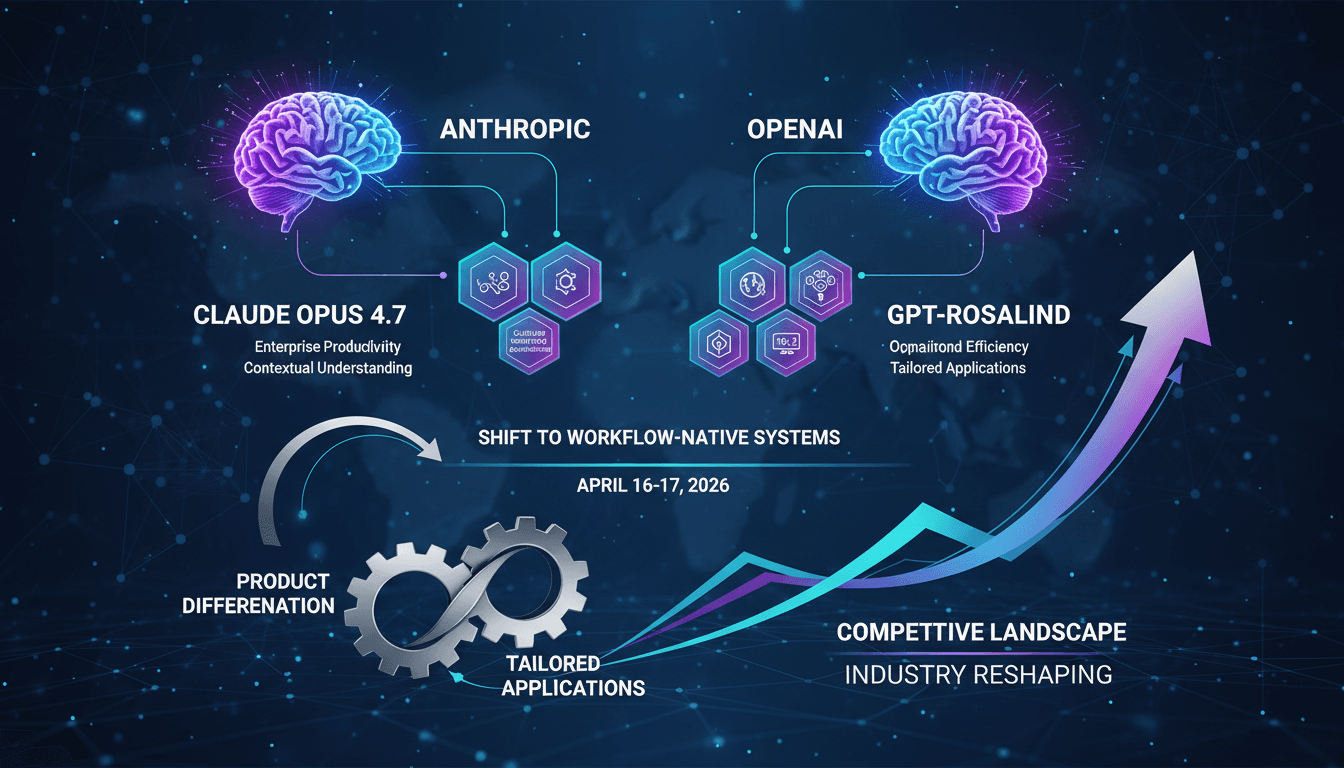
Here's what it means for you.
As businesses increasingly adopt specialized AI tools, your workflow efficiency and productivity could see significant improvements.
Why it matters
The shift to domain-specific AI models reflects a growing demand for tailored solutions in enterprise applications, impacting how industries operate.
What happened (in 30 seconds)
- Anthropic and OpenAI launched new AI models: On April 16-17, 2026, Anthropic introduced Claude Opus 4.7 and Claude Design, while OpenAI released GPT-Rosalind and Codex.
- Focus on specialized reasoning: These models are designed for specific tasks in software engineering, visual design, and life sciences, marking a departure from generalist AI.
- Intensifying competition: The announcements highlight a competitive landscape where product differentiation is prioritized over raw performance metrics.
The context you actually need
- Rivalry between key players: Anthropic, founded by ex-OpenAI executives, has been in a sustained competition with OpenAI since its inception in 2021.
- Market pressures: The AI sector is responding to compute constraints and safety concerns, leading to a pivot toward specialized models that meet enterprise needs.
- Investor expectations: With projections of trillion-dollar scaling in AI, there is a pressing demand for revenue-generating products that can deliver tangible results.
What's really happening
The recent launches by Anthropic and OpenAI signify a strategic pivot in the AI landscape, moving from generalist models to specialized reasoning engines. This transition is driven by a combination of market demands, technological advancements, and competitive pressures.
As enterprises increasingly seek AI solutions that can integrate seamlessly into their workflows, the need for domain-specific capabilities has become paramount. For instance, Claude Opus 4.7 enhances coding and multi-step reasoning, achieving an impressive 87.6% on the SWE-bench Verified benchmark. Similarly, OpenAI's GPT-Rosalind targets biology and drug discovery, while Codex focuses on tool use and persistent workflows. This specialization allows businesses to leverage AI in ways that directly enhance productivity and operational efficiency.
The competitive landscape is intensifying, with both companies racing to differentiate their offerings. This shift is not merely about performance metrics; it’s about creating tools that solve specific problems within industries. As a result, the focus is on developing AI systems that can be integrated into existing workflows, rather than standalone models that require significant adaptation.
Moreover, the backdrop of rising enterprise demand is critical. Investors are pushing for products that can generate revenue, leading to a strategic emphasis on practical applications of AI. The success of these specialized models could redefine how businesses approach technology adoption, making it essential for companies to stay ahead of the curve.
In this context, the implications extend beyond just the tech sector. Industries such as biotech, design, and software engineering stand to benefit significantly from these advancements. The ability to harness AI tools tailored to specific tasks can lead to faster innovation cycles and improved outcomes, ultimately reshaping competitive dynamics across various sectors.
Who feels it first (and how)
- Software engineers: Enhanced coding capabilities and multi-step reasoning tools will streamline development processes.
- Biotech researchers: Access to specialized models like GPT-Rosalind will accelerate drug discovery and biological research.
- Design professionals: Claude Design will facilitate collaborative visual artifact creation, improving project outcomes.
- Enterprise decision-makers: Leaders will need to adapt strategies to integrate these specialized AI tools into their operations effectively.
What to watch next
- Adoption rates of specialized AI tools: Monitoring how quickly businesses implement these models will indicate their effectiveness and market acceptance.
- Performance benchmarks: Keep an eye on how these new models perform in real-world applications compared to their predecessors.
- Investor sentiment: Changes in funding and investment in AI startups will reflect confidence in the specialized AI market.
The launch of Claude Opus 4.7, Claude Design, GPT-Rosalind, and Codex has occurred.
Increased adoption of specialized AI tools across various industries will lead to enhanced productivity.
The long-term impact on the competitive landscape and how companies will adapt to these changes remains to be seen.
Frequently Asked Questions
- Why it matters?
- The shift to domain-specific AI models reflects a growing demand for tailored solutions in enterprise applications, impacting how industries operate.
- What happened (in 30 seconds)?
- Anthropic and OpenAI launched new AI models: On April 16-17, 2026, Anthropic introduced Claude Opus 4.7 and Claude Design, while OpenAI released GPT-Rosalind and Codex. Focus on specialized reasoning: These models are designed for specific tasks in software engineering, visual design, and life sciences, marking a departure from generalist AI. Intensifying competition: The announcements highlight a competitive landscape where product differentiation is prioritized over raw performance metrics.
- What's really happening?
- The recent launches by Anthropic and OpenAI signify a strategic pivot in the AI landscape, moving from generalist models to specialized reasoning engines. This transition is driven by a combination of market demands, technological advancements, and competitive pressures. As enterprises increasingly seek AI solutions that can integrate seamlessly into their workflows, the need for domain-specific capabilities has become paramount. For instance, Claude Opus 4.7 enhances coding and multi-step rea
- Who feels it first (and how)?
- Software engineers: Enhanced coding capabilities and multi-step reasoning tools will streamline development processes. Biotech researchers: Access to specialized models like GPT-Rosalind will accelerate drug discovery and biological research. Design professionals: Claude Design will facilitate collaborative visual artifact creation, improving project outcomes. Enterprise decision-makers: Leaders will need to adapt strategies to integrate these specialized AI tools into their operations effective
- What to watch next?
- Adoption rates of specialized AI tools: Monitoring how quickly businesses implement these models will indicate their effectiveness and market acceptance. Performance benchmarks: Keep an eye on how these new models perform in real-world applications compared to their predecessors. Investor sentiment: Changes in funding and investment in AI startups will reflect confidence in the specialized AI market.
Curated ML/AI research and tools for practitioners.
"Weekly research summaries and tool highlights."
— A47 Editor
The Sequence Radar #845: Last Week in AI: Anthropic and OpenAI Enter a New Phase
Last week, both Anthropic and OpenAI made significant advancements in artificial intelligence, with Anthropic's valuation reaching $380 billion and OpenAI launching its new cybersecurity model, GPT-5.4-Cyber. These developments mark a new phase in th...
U.S. company headlines: M&A, product launches, legal/regulatory actions, and leadership moves.
"U.S.-centric corporate tape; good for tracking single-name catalysts."
— A47 Editor
Anthropic CEO meets Trump officials as tensions ease over new AI model
Dario Amodei, CEO of Anthropic, recently met with officials from the Trump administration as tensions surrounding the company's new AI model, Claude Mythos, appear to be easing. This meeting is part of ongoing discussions about the model's deployment...
Business tech stories, startups, and innovation coverage.
"The Los Angeles Times is a major West Coast newspaper offering in-depth reporting with a liberal editorial tone and strong regional focus."
— A47 Editor
Trump orders federal agencies to stop using Anthropic's AI after clash with Pentagon
Former President Donald Trump has ordered federal agencies to cease using Anthropic's AI technology, particularly its chatbot Claude, following a conflict with the Pentagon over concerns regarding surveillance and autonomous weapons. This directive r...
Business tech stories, startups, and innovation coverage.
"The Los Angeles Times is a major West Coast newspaper offering in-depth reporting with a liberal editorial tone and strong regional focus."
— A47 Editor
Chabria: The Pentagon is demanding to use Claude AI as it pleases. Claude told me that's 'dangerous'
Defense Secretary Pete Hegseth has issued a stern ultimatum to Anthropic, the company behind Claude AI, demanding full access to the AI tool by Friday or face severe repercussions. This demand comes amid ongoing tensions between the Pentagon and Anth...
U.S. national news with a West Coast perspective.
"The Los Angeles Times is a major West Coast newspaper offering in-depth reporting with a liberal editorial tone and strong regional focus."
— A47 Editor
Chabria: The Pentagon is demanding to use Claude AI as it pleases. Claude told me that's 'dangerous'
Defense Secretary Pete Hegseth has demanded Anthropic grant the Pentagon unrestricted access to its Claude AI system by Friday, warning of severe repercussions if the company refuses.
Business tech stories, startups, and innovation coverage.
"The Los Angeles Times is a major West Coast newspaper offering in-depth reporting with a liberal editorial tone and strong regional focus."
— A47 Editor
Battle of the AI brands: What's behind the bad blood between OpenAI and Anthropic
OpenAI and Anthropic have been publicly exchanging criticisms as they compete for dominance in the artificial intelligence sector, highlighting a growing rivalry between the two companies. This tension has been exacerbated by Anthropic's recent decis...