
US Senate Rejects War Powers Resolution Amid Ongoing US-Iran Conflict
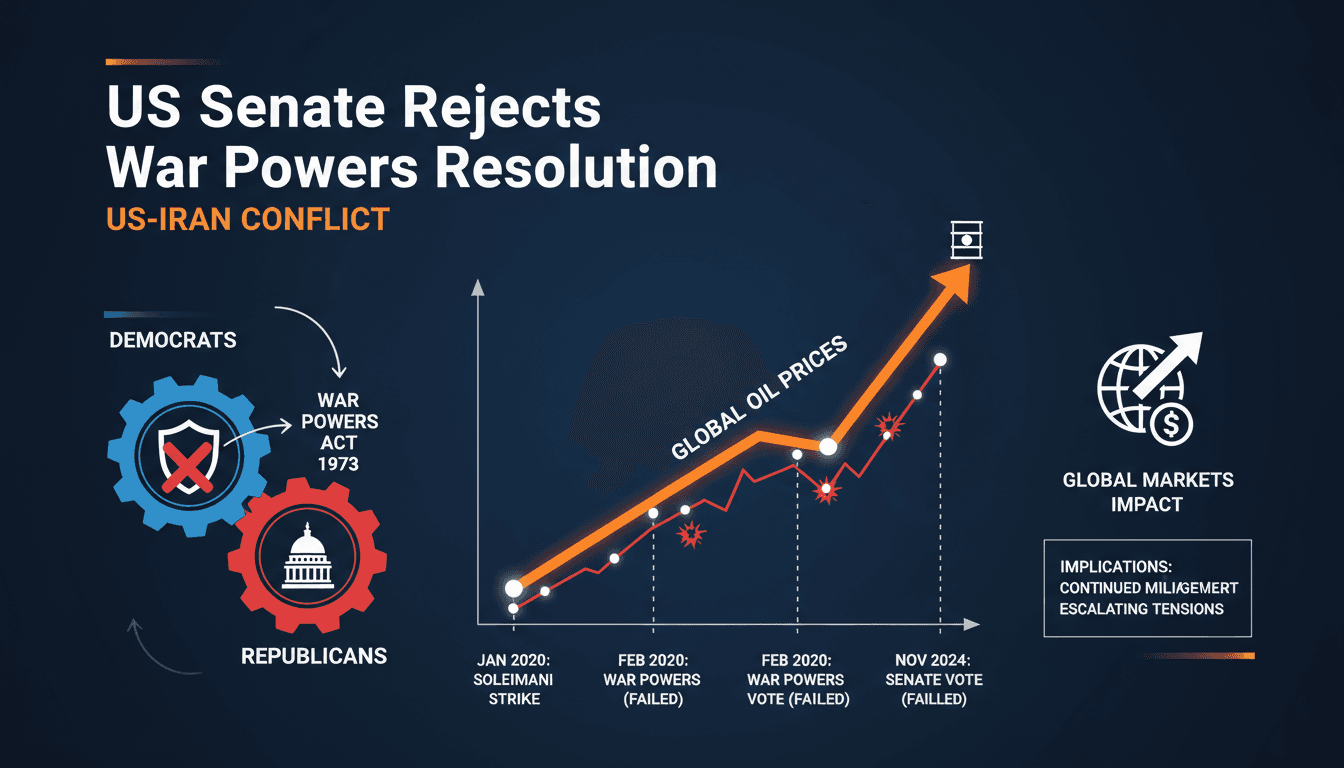
Here's what it means for you.
If you rely on global oil markets or are affected by geopolitical tensions, this ongoing conflict could impact your costs and economic stability.
Why it matters
The Senate's failure to limit military operations against Iran signals ongoing instability in oil markets, affecting global supply chains and prices.
What happened (in 30 seconds)
- The Senate voted 47-52 against a War Powers Resolution aimed at limiting military actions against Iran, marking the fourth rejection of such measures.
- Democrats, led by Tim Kaine and Chris Murphy, sought to require congressional approval for continued hostilities initiated by President Trump.
- A fragile ceasefire persists amid a US naval blockade of the Strait of Hormuz, with tensions remaining high due to sanctions and threats to regional shipping.
The context you actually need
- The US-Iran war began on February 28, 2026, following joint US-Israeli airstrikes that targeted Iranian military sites and leadership.
- The War Powers Resolution of 1973 mandates congressional approval for military actions beyond 60 days, which is approaching as the conflict escalates.
- The blockade of the Strait of Hormuz has significant implications for global oil transit, affecting prices and supply chains worldwide.
What's really happening
The rejection of the War Powers Resolution reflects a deepening partisan divide in the Senate regarding military engagement and foreign policy. Senate Democrats have been increasingly vocal about the need for congressional oversight in military operations, particularly in light of the ongoing US-Iran conflict that began with airstrikes on February 28, 2026. The strikes, which included the assassination of Iranian Supreme Leader Ali Khamenei, have escalated tensions significantly, leading to a US naval blockade of the Strait of Hormuz.
This blockade, enforced by US Central Command, has disrupted approximately 20% of global oil transit, causing a spike in oil prices. Following the blockade announcement, US crude oil prices peaked at $104.24 per barrel, reflecting an over 8% surge. This price increase is not just a statistic; it translates into higher costs for consumers and businesses reliant on oil and imported goods. The blockade's impact is felt acutely in regions like Dubai, where residents are experiencing elevated fuel and import costs, driving inflation pressures in a trade-dependent economy.
The Senate's failure to pass the resolution indicates a lack of consensus on how to approach the conflict, with Republicans largely opposing the measure. This division is compounded by the political implications of the war, as Republicans accuse Democrats of undermining national security by seeking to limit military action against Iran. The ongoing conflict and the Senate's stance could lead to further military escalation, especially as the War Powers Resolution's 60-day limit approaches on May 1, 2026.
As the situation evolves, Senate Democrats have pledged to continue pushing for accountability through weekly votes, indicating a strategy to keep the issue in the public eye and pressure their Republican counterparts. This ongoing political maneuvering, combined with the volatile situation in the Middle East, suggests that the conflict will remain a focal point of US foreign policy discussions.
Who feels it first (and how)
- Consumers in oil-dependent regions: Higher fuel prices and increased costs for goods.
- Businesses reliant on imports: Supply chain disruptions leading to inflation.
- Investors in global markets: Volatility in stock indices and commodities.
- Geopolitical analysts and policymakers: Increased scrutiny on US foreign policy and military strategy.
What to watch next
- Weekly Senate votes on war powers: These will indicate the level of congressional pushback against military actions and could influence public sentiment.
- Oil price fluctuations: Watch for changes in crude oil prices as they reflect the ongoing impact of the blockade and military actions.
- International diplomatic efforts: Monitor peace talks and negotiations involving key players like Pakistan and the UK, which could affect the ceasefire and regional stability.
The US-Iran conflict is ongoing, with significant implications for global oil markets.
Continued political maneuvering in the Senate regarding military oversight and accountability.
The long-term effects of the blockade on global supply chains and economic stability.
Frequently Asked Questions
- Why it matters?
- The Senate's failure to limit military operations against Iran signals ongoing instability in oil markets, affecting global supply chains and prices.
- What happened (in 30 seconds)?
- The Senate voted 47-52 against a War Powers Resolution aimed at limiting military actions against Iran, marking the fourth rejection of such measures. Democrats, led by Tim Kaine and Chris Murphy, sought to require congressional approval for continued hostilities initiated by President Trump. A fragile ceasefire persists amid a US naval blockade of the Strait of Hormuz, with tensions remaining high due to sanctions and threats to regional shipping.
- What's really happening?
- The rejection of the War Powers Resolution reflects a deepening partisan divide in the Senate regarding military engagement and foreign policy. Senate Democrats have been increasingly vocal about the need for congressional oversight in military operations, particularly in light of the ongoing US-Iran conflict that began with airstrikes on February 28, 2026. The strikes, which included the assassination of Iranian Supreme Leader Ali Khamenei, have escalated tensions significantly, leading to a US
- Who feels it first (and how)?
- Consumers in oil-dependent regions: Higher fuel prices and increased costs for goods. Businesses reliant on imports: Supply chain disruptions leading to inflation. Investors in global markets: Volatility in stock indices and commodities. Geopolitical analysts and policymakers: Increased scrutiny on US foreign policy and military strategy.
- What to watch next?
- Weekly Senate votes on war powers: These will indicate the level of congressional pushback against military actions and could influence public sentiment. Oil price fluctuations: Watch for changes in crude oil prices as they reflect the ongoing impact of the blockade and military actions. International diplomatic efforts: Monitor peace talks and negotiations involving key players like Pakistan and the UK, which could affect the ceasefire and regional stability.
International coverage from The Guardian's global desks.
"The Guardian is known for its progressive editorial stance and in-depth analysis."
— A47 Editor
US Senate fails to pass war powers resolution for fourth time – as it happened
The US Senate has failed to pass a war powers resolution for the fourth time, amidst ongoing tensions between the US and Iran, as President Donald Trump criticizes NATO allies for not supporting his military actions. This failure reflects the complex...
Right-of-center views on political news.
"The Washington Times is a conservative-leaning newspaper known for its political coverage and advocacy of right-of-center viewpoints."
— A47 Editor
Democrats' war powers resolution dies in Senate, more expected
Senate Democrats' war powers resolution aimed at limiting President Trump's military authority in Iran failed in the Senate, as Minority Leader Charles E. Schumer announced plans to continue introducing similar measures until the conflict ends.
Arabic-language UAE newspaper coverage focused on domestic affairs, public institutions, business, society, and regional developments.
"Al Khaleej coverage generally reflects a mainstream UAE editorial lens with strong attention to public affairs, institutions, and regional developments."
— A47 Editor
الديمقراطيون يواصلون السعي لكبح سلطات ترامب في حرب إيران
The U.S. Senate is set to vote on Wednesday on the latest effort led by Democratic members to limit President Donald Trump's war powers, as party leaders pledged on Tuesday to continue introducing such measures as long as the conflict with Iran persi...
Regional coverage and analysis focused on politics, diplomacy, and business across the Middle East.
"Al-Monitor is known for analytical reporting on Middle East politics and policy developments."
— A47 Editor
US Democrats will try, and try again, to rein in Trump's Iran war powers
The U.S. Senate is set to vote on a Democratic-led resolution aimed at limiting President Donald Trump's war powers regarding Iran, with party leaders indicating they will continue to pursue such measures as long as military actions persist. Democrat...