
TSMC to Invest $56 Billion in AI Chip Production Expansion
Here's what it means for you.
The surge in AI chip demand could reshape job markets and tech landscapes globally.
Why it matters
This capital expenditure signals a pivotal shift in semiconductor supply chains, impacting industries reliant on advanced computing.
What happened (in 30 seconds)
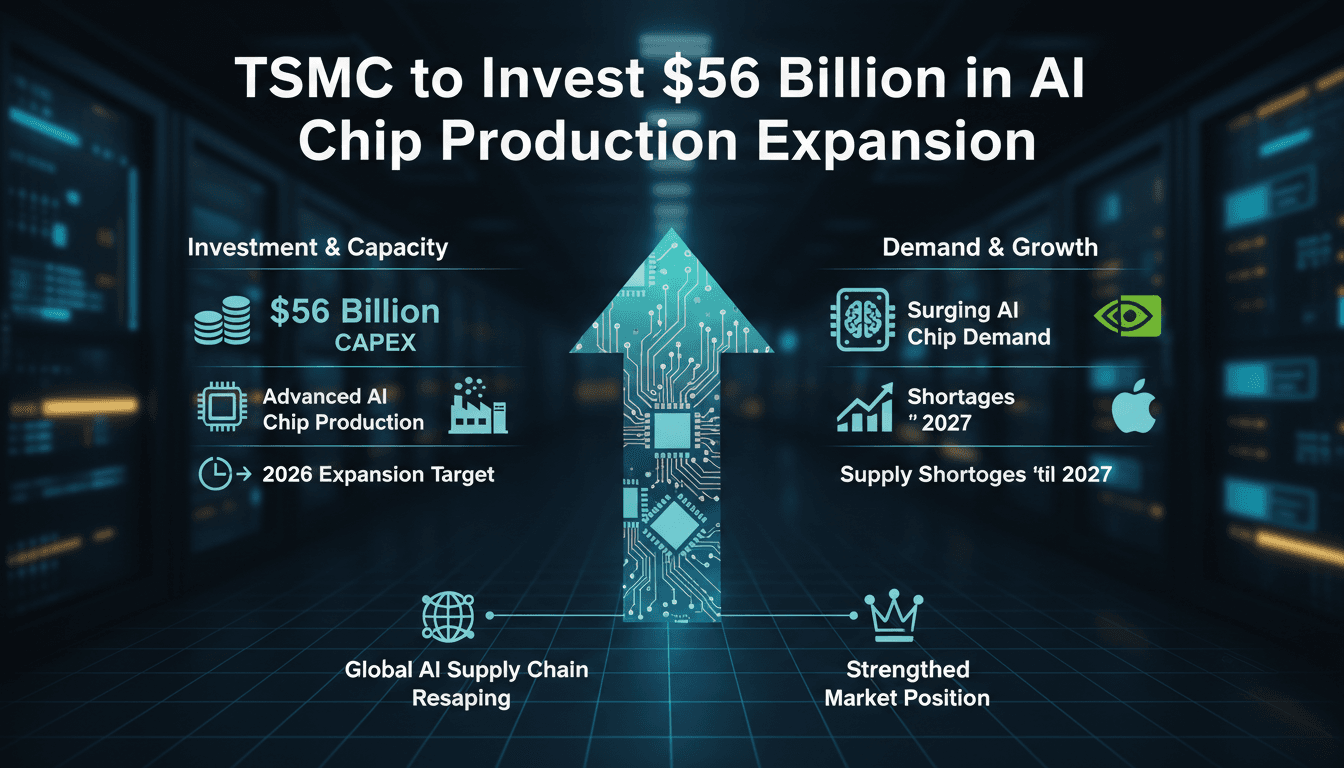
- TSMC announced a capital expenditure increase to nearly $56 billion for 2026 to expand AI chip production.
- New fabrication facilities will be established in Taiwan, the U.S., and Japan, addressing ongoing supply shortages.
- Demand from major tech players like Nvidia, AMD, and Apple is driving TSMC's market share growth from 54% in 2020 to 72% in 2026.
The context you actually need
- AI boom: The demand for AI infrastructure has surged since 2023, with hyperscalers investing heavily in generative AI technologies.
- Geopolitical factors: Tensions in the Middle East have affected supply chains but have not diminished the demand for AI chips.
- Competitive landscape: While competitors like Samsung and Intel are expanding, TSMC maintains a significant technological edge with its advanced node processes.
What's really happening
On April 17, 2026, TSMC's CEO C.C. Wei revealed a substantial increase in the company's capital expenditure, raising it to nearly $56 billion for the year. This decision is primarily driven by the soaring demand for AI chips, particularly those manufactured using advanced 3-nanometer technology. TSMC's expansion plans include new fabrication facilities in Taiwan, the United States, and Japan, with the first new fab in Taiwan expected to be operational by the first half of 2027. The U.S. facility is slated for late 2027, and the Japanese facility will follow in 2028.
The semiconductor industry is currently grappling with persistent supply shortages, which are projected to last through 2027 and beyond. TSMC's expansion is a direct response to this challenge, as the company aims to ramp up production to meet the needs of major clients like Nvidia, AMD, and Apple. Analysts have noted that demand for 2nm and 3nm chips is expected to exceed supply significantly, with projections indicating a need for 400,000 to 450,000 wafers per month, while TSMC can only supply 300,000 to 350,000.
TSMC's strategic focus on advanced packaging technologies, such as CoWoS and CoPoS, further enhances its competitive position. The company has allocated over 50% of its CoWoS capacity to Nvidia, underscoring the strong partnership between the two firms. Additionally, TSMC's 2nm production began in late 2025, with the A14 node expected to deliver performance gains of 15-30% by 2028.
Despite geopolitical tensions affecting supply chains, particularly in helium and neon, TSMC's leadership in the semiconductor market remains unshaken. The company's yield advantage of over five years on its N3 and N2 processes positions it favorably against competitors. As TSMC continues to expand its capabilities, it is also welcoming competition, which could broaden customer choices and stimulate further innovation in the industry.
Who feels it first (and how)
- Tech companies: Major players like Nvidia, AMD, and Apple will benefit from increased chip availability.
- Semiconductor workers: Job opportunities in fabrication and advanced manufacturing will rise, particularly in the U.S. and Taiwan.
- Investors: Stakeholders in TSMC and related sectors may see increased returns as demand for AI chips grows.
What to watch next
- Capacity expansion timelines: Monitor the progress of TSMC's new fabs and their impact on supply chain dynamics.
- Market share shifts: Watch for changes in TSMC's market share as competitors ramp up their production capabilities.
- AI demand trends: Keep an eye on the evolving landscape of AI applications and how they influence semiconductor requirements.
TSMC's capital expenditure for 2026 is set at nearly $56 billion.
Continued demand for AI chips will drive further investments in semiconductor manufacturing.
The long-term effects of geopolitical tensions on supply chains and production capabilities remain uncertain.
Frequently Asked Questions
- Why it matters?
- This capital expenditure signals a pivotal shift in semiconductor supply chains, impacting industries reliant on advanced computing.
- What happened (in 30 seconds)?
- TSMC announced a capital expenditure increase to nearly $56 billion for 2026 to expand AI chip production. New fabrication facilities will be established in Taiwan, the U.S., and Japan, addressing ongoing supply shortages. Demand from major tech players like Nvidia, AMD, and Apple is driving TSMC's market share growth from 54% in 2020 to 72% in 2026.
- What's really happening?
- On April 17, 2026, TSMC's CEO C.C. Wei revealed a substantial increase in the company's capital expenditure, raising it to nearly $56 billion for the year. This decision is primarily driven by the soaring demand for AI chips, particularly those manufactured using advanced 3-nanometer technology. TSMC's expansion plans include new fabrication facilities in Taiwan, the United States, and Japan, with the first new fab in Taiwan expected to be operational by the first half of 2027. The U.S. facility
- Who feels it first (and how)?
- Tech companies: Major players like Nvidia, AMD, and Apple will benefit from increased chip availability. Semiconductor workers: Job opportunities in fabrication and advanced manufacturing will rise, particularly in the U.S. and Taiwan. Investors: Stakeholders in TSMC and related sectors may see increased returns as demand for AI chips grows.
- What to watch next?
- Capacity expansion timelines: Monitor the progress of TSMC's new fabs and their impact on supply chain dynamics. Market share shifts: Watch for changes in TSMC's market share as competitors ramp up their production capabilities. AI demand trends: Keep an eye on the evolving landscape of AI applications and how they influence semiconductor requirements.
Electronics industry news including AI chips.
"Covers semiconductors and embedded AI trends."
— A47 Editor
TSMC Chases Soaring AI Demand
TSMC is accelerating its chip production capabilities to meet the surging demand from artificial intelligence (AI) companies, amidst looming shortages in the semiconductor industry. The company aims to enhance its output to support the growing needs ...
Business, investment, entrepreneurship, leadership, and innovation.
"Forbes is known for its coverage of business leaders, market trends, and entrepreneurial ventures with a pro-business editorial stance."
— A47 Editor
TSMC's Record Quarter Proves AI Is Still An Industrial Story
Taiwan Semiconductor Manufacturing Company (TSMC) reported a record quarter, with a 45.2% year-over-year revenue growth for March 2026, driven by strong demand for artificial intelligence (AI) technologies. CEO C.C. Wei emphasized that the company wi...
Curated tech headlines including AI stories.
"Influential aggregator surfacing the day’s top tech/AI links."
— A47 Editor
TSMC CEO C.C. Wei says TSMC checked with customers about AI demand and was reassured that it was still strong amid the Iran war, as it raises revenue forecasts (Wall Street Journal)
TSMC CEO C.C. Wei announced that the company has confirmed strong demand for AI products from its customers, despite the ongoing conflict in Iran, leading TSMC to raise its revenue forecasts. The company anticipates revenue growth exceeding 30% as it...
Curated tech headlines including AI stories.
"Influential aggregator surfacing the day’s top tech/AI links."
— A47 Editor
TSMC reports Q1 revenue up 35.1% YoY to ~$35B, net income up 58.3% YoY to ~$18B, both above est., and says 7nm or smaller chips were ~74% of its wafer revenue (Dylan Butts/CNBC)
Taiwan Semiconductor Manufacturing Company (TSMC) reported a 35.1% year-over-year increase in Q1 revenue, reaching approximately $35 billion, and a net income rise of 58.3% to around $18 billion, both figures surpassing estimates. The company noted t...