
Ngogo Chimpanzee Community Experiences Lethal Aggression Following Group Split
Here's what it means for you.
Understanding the dynamics of intraspecies conflict in chimpanzees can provide insights into social behavior and conflict resolution in human societies.
Why it matters
This study sheds light on the evolutionary origins of intergroup violence, with potential implications for understanding human social structures.
What happened (in 30 seconds)
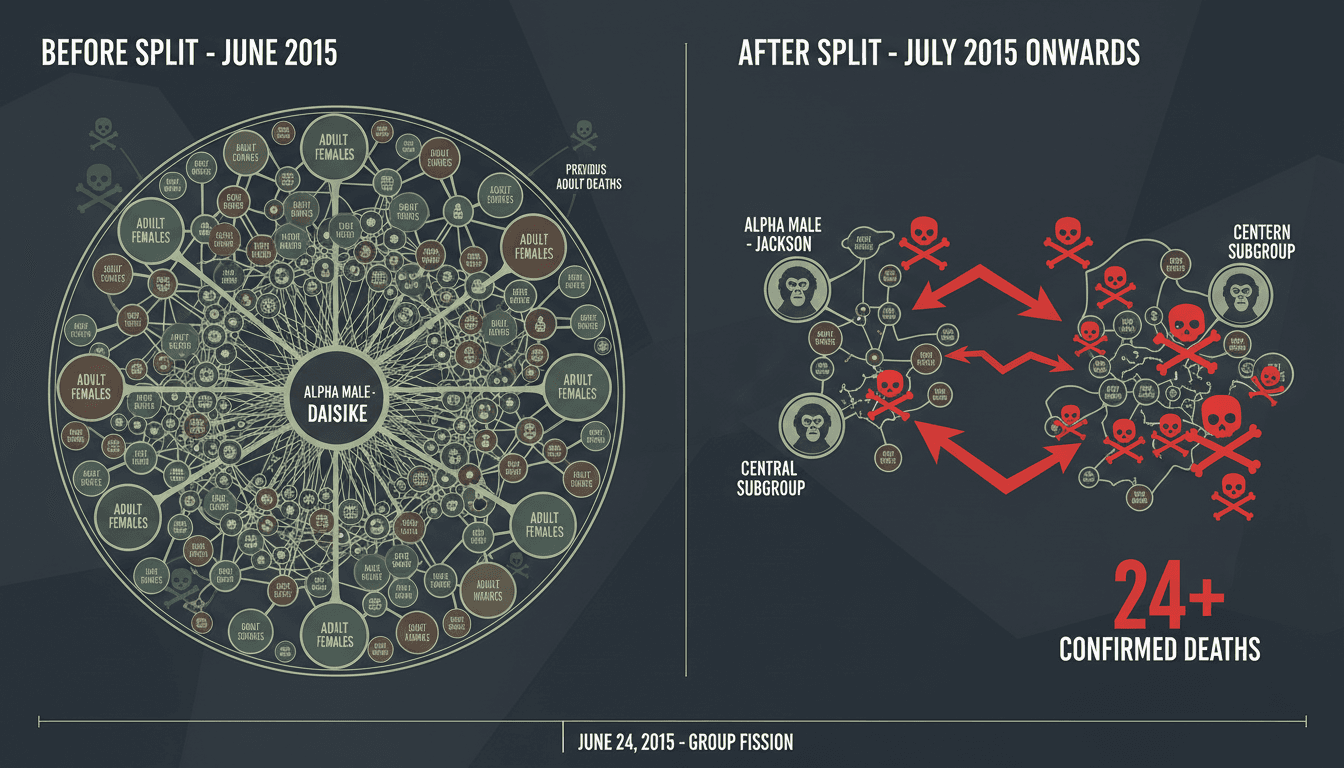
- The Ngogo chimpanzee community in Uganda split into two hostile subgroups in June 2015, leading to lethal aggression.
- At least 24 confirmed deaths resulted from coordinated raids by the smaller Western subgroup on the Central subgroup.
- Research led by Aaron Sandel highlighted the transformation of social relationships into lethal rivalries without resource scarcity or external provocation.
The context you actually need
- The Ngogo community is the largest known wild chimpanzee group, monitored since the 1970s, with a peak population of over 200 individuals.
- Social networks within the community were disrupted by multiple adult deaths in 2014, which likely destabilized existing relationships and alliances.
- Lethal raids escalated from 2018 to 2024, with the Western subgroup targeting key Central males, indicating a shift from social interaction to violent conflict.
What's really happening
The Ngogo chimpanzee community's fission into two hostile groups is a rare and significant event in primate behavior, illustrating how social dynamics can rapidly shift towards aggression. The community, which had historically engaged in cooperative behaviors such as grooming and patrolling, experienced a breakdown in these interactions following a series of adult male deaths in 2014. These deaths likely severed critical social ties, leading to a power vacuum and increased tensions.
By June 2015, the Central subgroup initiated aggressive encounters with the Western subgroup, marking the beginning of a violent conflict. This shift was not driven by resource scarcity—an important factor in many animal conflicts—but rather by the disruption of social networks and the emergence of new leadership dynamics. The transition of alpha males, particularly from Miles to Jackson, coincided with rising tensions and territorial disputes.
As the Western subgroup began to patrol borders and engage in lethal raids, the conflict escalated dramatically. Between 2018 and 2024, the Western subgroup killed seven adult males from the Central subgroup, including the alpha male Jackson in 2022, and 17 infants. The absence of reciprocal killings from the Central subgroup highlights a one-sided aggression that may be rooted in the new social structures formed post-fission.
This situation provides a unique opportunity for researchers to analyze the evolutionary implications of such intergroup violence. Primatologists are drawing parallels to human conflict and examining the roles of females in spatial dynamics and group cohesion. The ongoing nature of this conflict raises questions about the long-term stability of social structures in primate communities and the potential for similar behaviors in human societies.
Who feels it first (and how)
- Primatologists and researchers: They will analyze the implications for evolutionary biology and social behavior.
- Conservationists: They may need to adapt strategies for monitoring and protecting chimpanzee populations amid rising violence.
- Local communities: Those living near Kibale National Park may experience indirect effects through changes in wildlife behavior and conservation policies.
What to watch next
- Further research publications: New studies may provide insights into the long-term effects of this conflict on chimpanzee social structures and behaviors.
- Changes in group dynamics: Observations of how the remaining Central subgroup adapts or retaliates could inform understanding of conflict resolution in primates.
- Conservation strategies: Monitoring how conservation efforts evolve in response to this conflict will be crucial for the future of chimpanzee populations.
The Ngogo chimpanzee community has experienced a lethal fission resulting in confirmed deaths.
The ongoing conflict will continue to influence social dynamics and behaviors within the community.
The long-term implications for chimpanzee conservation and the potential for similar conflicts in other primate groups remain uncertain.
Frequently Asked Questions
- Why it matters?
- This study sheds light on the evolutionary origins of intergroup violence, with potential implications for understanding human social structures.
- What happened (in 30 seconds)?
- The Ngogo chimpanzee community in Uganda split into two hostile subgroups in June 2015, leading to lethal aggression. At least 24 confirmed deaths resulted from coordinated raids by the smaller Western subgroup on the Central subgroup. Research led by Aaron Sandel highlighted the transformation of social relationships into lethal rivalries without resource scarcity or external provocation.
- What's really happening?
- The Ngogo chimpanzee community's fission into two hostile groups is a rare and significant event in primate behavior, illustrating how social dynamics can rapidly shift towards aggression. The community, which had historically engaged in cooperative behaviors such as grooming and patrolling, experienced a breakdown in these interactions following a series of adult male deaths in 2014. These deaths likely severed critical social ties, leading to a power vacuum and increased tensions. By June 201
- Who feels it first (and how)?
- Primatologists and researchers: They will analyze the implications for evolutionary biology and social behavior. Conservationists: They may need to adapt strategies for monitoring and protecting chimpanzee populations amid rising violence. Local communities: Those living near Kibale National Park may experience indirect effects through changes in wildlife behavior and conservation policies.
- What to watch next?
- Further research publications: New studies may provide insights into the long-term effects of this conflict on chimpanzee social structures and behaviors. Changes in group dynamics: Observations of how the remaining Central subgroup adapts or retaliates could inform understanding of conflict resolution in primates. Conservation strategies: Monitoring how conservation efforts evolve in response to this conflict will be crucial for the future of chimpanzee populations.
Health trends, medical research, and fitness reporting.
"The New York Times is a globally recognized newspaper offering authoritative reporting with a center-left editorial stance."
— A47 Editor
These Chimps Began the Bloodiest ‘War’ on Record. No One Knows Why.
A long-running conflict among chimpanzees in a Ugandan park has been identified as one of the bloodiest 'wars' on record, with researchers puzzled over the reasons behind this violent behavior. The study of this conflict may offer insights into the o...
Independent journalism covering technology, AI, and digital culture.
"An independent newsroom by veteran tech reporters known for critical, investigative coverage of AI and tech power."
— A47 Editor
World’s Largest Group of Chimps Waging Deadly ‘Civil War,’ Scientists Discover
Scientists have discovered that the Ngogo group of wild chimpanzees is experiencing a deadly 'civil war,' resulting in the deaths of at least 24 chimpanzees. This conflict has led to a significant division within the group, transforming former allies...
Scientific research, space, environment, and health coverage.
"The New York Times is a globally recognized newspaper offering authoritative reporting with a center-left editorial stance."
— A47 Editor
These Chimps Began the Bloodiest ‘War’ on Record. No One Knows Why.
A long-running conflict among chimpanzees in a Ugandan park has been identified as one of the bloodiest recorded, raising questions about the reasons behind such violent behavior. Researchers are investigating the implications of this conflict to bet...
Science and technology stories including AI.
"Longstanding science magazine with thoughtful AI coverage."
— A47 Editor
Two hundred chimpanzees are embroiled in a ‘civil war’
The Ngogo group of chimpanzees, the largest known group of its kind, has split into two factions and is currently engaged in a violent conflict, resulting in the deaths of at least 24 individuals. This unprecedented 'civil war' has transformed former...
Scientific research, technology, environment, and society.
"Scientific American is one of the oldest and most authoritative science magazines, known for deep dives into science, technology, and society."
— A47 Editor
Two hundred chimpanzees are embroiled in a ‘civil war’
The Ngogo group of chimpanzees, the largest known group of its kind, has split into two factions and is currently engaged in a violent conflict, resulting in the deaths of at least 24 individuals. This unprecedented 'civil war' has transformed former...