
Shinhan Bank Initiates $2.1 Billion Share Sale of Samsung Electronics Stock
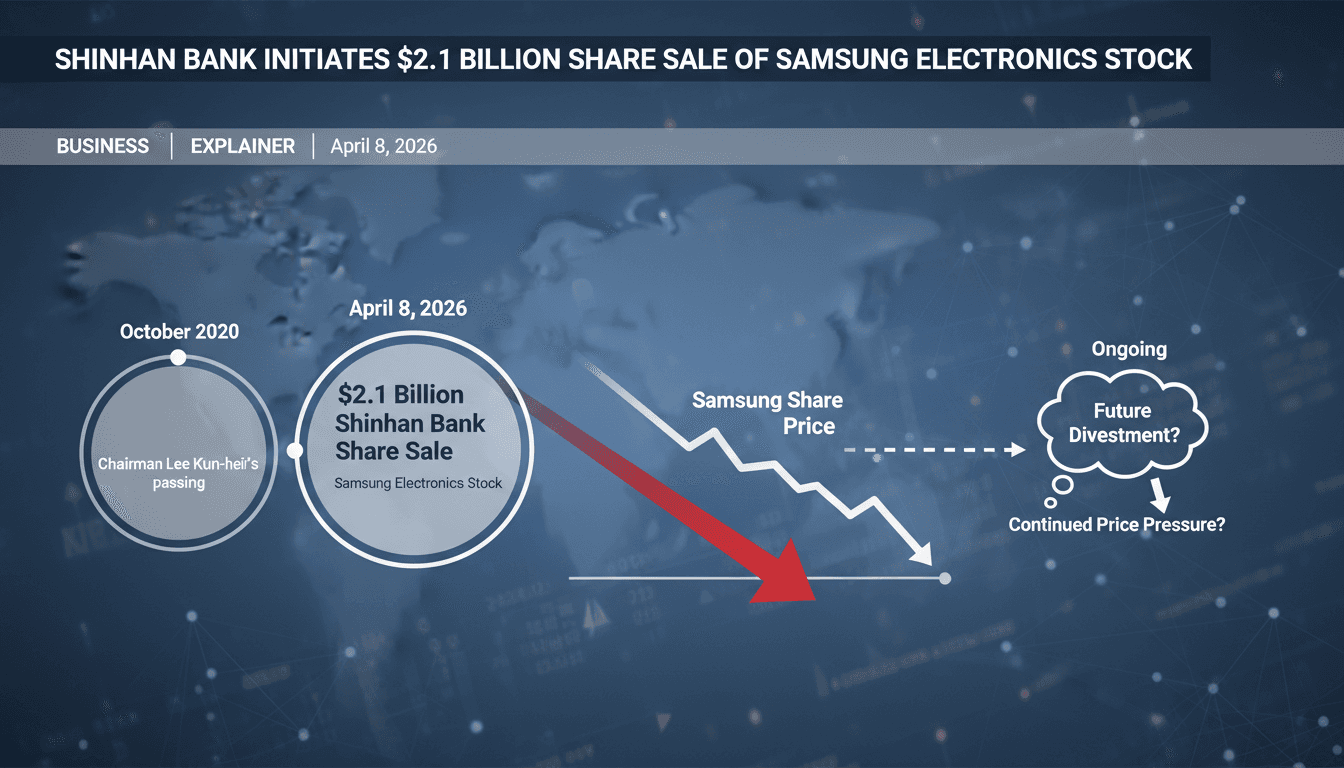
Here's what it means for you.
If you’re involved in global markets, this share sale could signal shifts in investment strategies and market stability.
Why it matters
This transaction reflects ongoing financial maneuvers in major corporations that can influence stock market dynamics and investor confidence.
What happened (in 30 seconds)
- On April 8, 2026, Shinhan Bank launched a $2.1 billion share sale of Samsung Electronics stock via an accelerated bookbuild process.
- This move is part of a series of share sales aimed at liquidating holdings to cover inheritance tax liabilities from the estate of the late chairman, Lee Kun-hee.
- Market reactions are pending as the bookbuild progresses, but historical sales show limited downward pressure on Samsung shares.
The context you actually need
- Shinhan Bank has facilitated multiple share sales for the Lee family, totaling over 12 trillion won in inheritance tax liabilities.
- Previous transactions included a 17.7 million share sale valued at approximately $1.2 billion in October 2025 and a 15 million share sale in January 2026 worth around $2 billion.
- Samsung's stock has shown resilience amid these sales, buoyed by strong demand for AI semiconductors, which has driven share price rallies.
What's really happening
On April 8, 2026, Shinhan Bank initiated a $2.1 billion share sale of Samsung Electronics, marking a significant move in the ongoing financial strategy of the Lee family, Samsung's founding family. This transaction is part of a broader effort to liquidate shares held in trust by Shinhan Bank to settle inheritance tax obligations exceeding 12 trillion won (approximately $10 billion) stemming from the estate of the late chairman, Lee Kun-hee.
The share sale is structured as an accelerated block trade, a method that allows for quick execution and typically involves selling shares at a discount to the volume-weighted average price (VWAP) during a short bookbuild period. This approach is designed to attract institutional investors who can absorb large volumes of stock without significantly impacting the market price. The specifics of the sale, including the number of shares and pricing range, were outlined in a term sheet accessed by Reuters, indicating a well-planned strategy to minimize market disruption.
Historically, similar transactions have shown that while there may be initial volatility, Samsung's stock has tended to recover quickly. The previous sales in October 2025 and January 2026, despite their scale, resulted in limited downward pressure on share prices, suggesting strong underlying demand for Samsung's products, particularly in the AI semiconductor sector. This resilience is crucial as it indicates investor confidence in Samsung's long-term growth prospects, even amid significant share disposals by major stakeholders.
The ongoing liquidation efforts also highlight the complex interplay between family-owned businesses and financial markets, particularly in South Korea, where inheritance tax laws can compel significant asset sales. As the Lee family continues to navigate these financial obligations, the implications for Samsung's stock and the broader market will be closely monitored by investors and analysts alike.
Who feels it first (and how)
- Institutional investors: Likely to be the primary buyers in the block trade, influencing market dynamics.
- Samsung shareholders: Current shareholders may experience short-term volatility but could benefit from long-term price recovery.
- Market analysts: They will closely monitor the sale's impact on Samsung's stock and broader market sentiment.
What to watch next
- Completion of the bookbuild: The final pricing and volume will indicate market appetite and investor confidence.
- Samsung's stock performance: Watch for any significant price movements post-sale, which could signal broader market trends.
- Regulatory responses: Keep an eye on any reactions from Korean financial regulators regarding market stability and investor protections.
Shinhan Bank is executing a $2.1 billion share sale of Samsung Electronics.
The sale will attract institutional investors and may influence Samsung's stock price in the short term.
The long-term impact on Samsung's market position and the Lee family's financial strategy remains to be seen.
Frequently Asked Questions
- Why it matters?
- This transaction reflects ongoing financial maneuvers in major corporations that can influence stock market dynamics and investor confidence.
- What happened (in 30 seconds)?
- On April 8, 2026, Shinhan Bank launched a $2.1 billion share sale of Samsung Electronics stock via an accelerated bookbuild process. This move is part of a series of share sales aimed at liquidating holdings to cover inheritance tax liabilities from the estate of the late chairman, Lee Kun-hee. Market reactions are pending as the bookbuild progresses, but historical sales show limited downward pressure on Samsung shares.
- What's really happening?
- On April 8, 2026, Shinhan Bank initiated a $2.1 billion share sale of Samsung Electronics, marking a significant move in the ongoing financial strategy of the Lee family, Samsung's founding family. This transaction is part of a broader effort to liquidate shares held in trust by Shinhan Bank to settle inheritance tax obligations exceeding 12 trillion won (approximately $10 billion) stemming from the estate of the late chairman, Lee Kun-hee. The share sale is structured as an accelerated block
- Who feels it first (and how)?
- Institutional investors: Likely to be the primary buyers in the block trade, influencing market dynamics. Samsung shareholders: Current shareholders may experience short-term volatility but could benefit from long-term price recovery. Market analysts: They will closely monitor the sale's impact on Samsung's stock and broader market sentiment.
- What to watch next?
- Completion of the bookbuild: The final pricing and volume will indicate market appetite and investor confidence. Samsung's stock performance: Watch for any significant price movements post-sale, which could signal broader market trends. Regulatory responses: Keep an eye on any reactions from Korean financial regulators regarding market stability and investor protections.
Market-moving headlines impacting equities, bonds, and related risk assets.
"Real-time catalysts and volatility drivers across indices and sectors."
— A47 Editor
Samsung Electronics’ shareholder Shinhan Bank launches $2.1 billion share sale - term sheet
Shinhan Bank, a major shareholder of Samsung Electronics, has initiated a share sale valued at $2.1 billion, aiming to enhance its capital structure and liquidity. This move comes as Samsung Electronics forecasts a robust operating profit of 57.2 tri...
Technology business and AI-related headlines.
"Data-driven tech newsroom with global scope."
— A47 Editor
Samsung Holder Seeks to Sell Up to $2.1 Billion in Block Trade
A shareholder of Samsung Electronics Co. is planning to sell their remaining shares in the company for up to 3.1 trillion won (approximately $2.1 billion) through a block trade, marking one of the largest such transactions in South Korea, as reported...
Technology business news, market impacts, and innovation trends.
"Bloomberg is a premier financial and tech news provider, respected for its in-depth reporting and analytical rigor."
— A47 Editor
Samsung Holder Seeks to Sell Up to $2.1 Billion in Block Trade
A shareholder of Samsung Electronics Co. is planning to sell their remaining shares in the company through a block trade valued at up to 3.1 trillion won ($2.1 billion), marking one of the largest such transactions in South Korea, as reported by Bloo...