
Global Central Banks Shift from Rate Cuts to Potential Hikes Amid Iran War Oil Price Surge
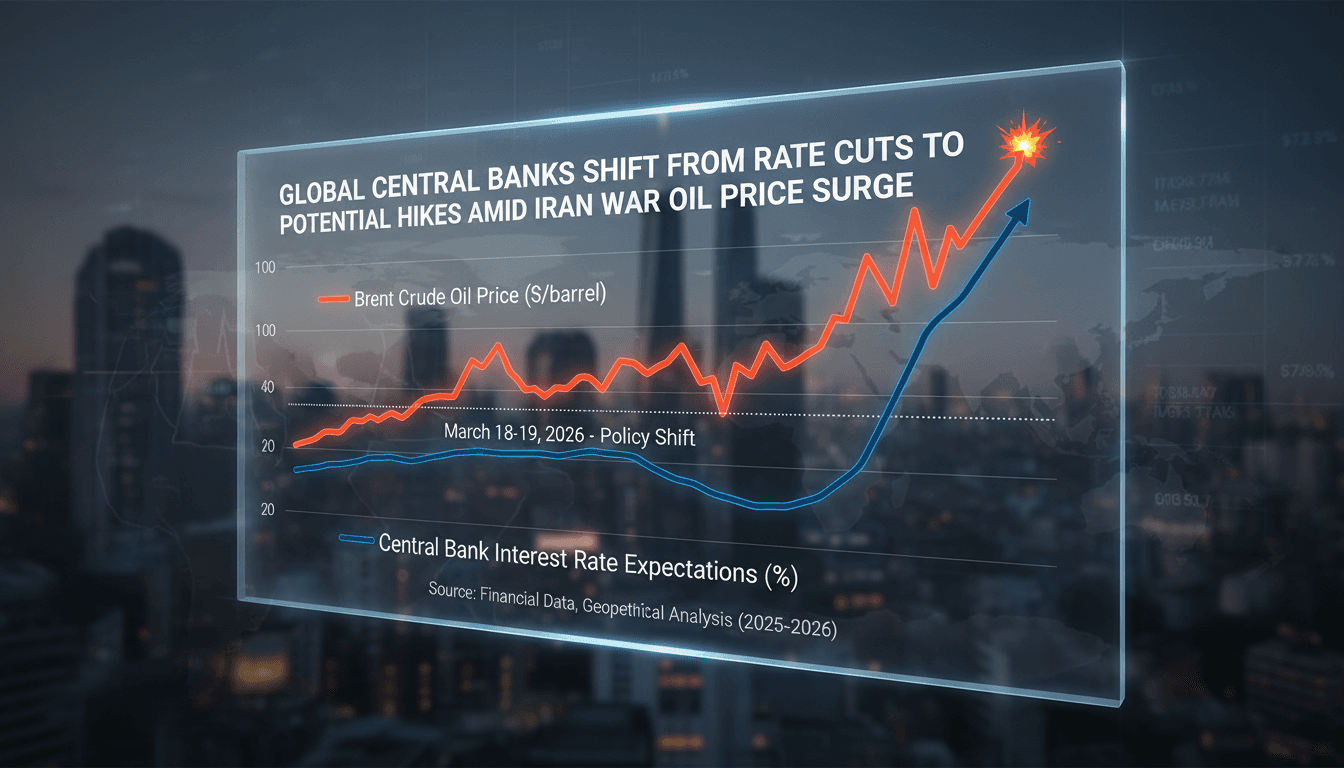
Here's what it means for you.
If you rely on stable prices for energy or investments, this shift in central bank policy could impact your financial planning.
Why it matters
The synchronized decision by major central banks reflects a critical pivot in monetary policy amidst rising inflation pressures, directly affecting global economic stability.
What happened (in 30 seconds)
- Central banks held rates steady: The U.S. Federal Reserve, European Central Bank, and Bank of England maintained their benchmark interest rates during meetings on March 18–19, 2026.
- Oil prices surged: Brent crude oil prices exceeded $100 per barrel due to geopolitical tensions from the Iran War, which began on February 28, 2026.
- Market expectations shifted: Anticipations of rate cuts for 2026 were replaced with expectations of potential rate hikes as central banks reassessed inflation risks.
The context you actually need
- Iran War's impact: The conflict disrupted oil supplies, particularly affecting the Strait of Hormuz, a critical global shipping route, leading to significant price increases.
- Inflation concerns: Pre-war forecasts predicted rate cuts; however, the war's escalation has prompted fears of stagflation, forcing central banks to reconsider their strategies.
- Synchronized meetings: This was the first coordinated meeting of the G4 central banks since December 2021, highlighting the urgency of the situation.
What's really happening
The 2026 Iran War, ignited by U.S.-Israeli strikes on February 28, has led to a significant disruption in global oil supplies, particularly affecting the Strait of Hormuz. This geopolitical crisis has driven Brent crude prices to settle at $103.42 per barrel, a 3.2% increase following Iranian strikes on UAE ports that halved the country's oil output. The surge in oil prices has intensified inflationary pressures, particularly in energy-import-dependent economies, prompting a reevaluation of monetary policy by major central banks.
In the lead-up to the March 18–19 meetings, markets had anticipated a series of rate cuts from the Federal Reserve, ECB, and BOE, with expectations of over 50 basis points in cuts for the year. However, the onset of stagflation risks, characterized by stagnant economic growth coupled with rising inflation, has led to a hawkish pivot. The Federal Reserve maintained its target range at 3.50%–3.75%, while the ECB and BOE held their rates at 2% and 3.75%, respectively. This decision was underscored by a unanimous emphasis on vigilance against potential supply shocks stemming from the ongoing conflict.
The implications of this shift are profound. As central banks signal readiness to tighten monetary policy, markets have begun to reprice expectations. Fed futures have eliminated anticipated cuts, while the ECB's Euribor indicates a potential tightening of 50 basis points, raising the year-end rate to 4.00% for the BOE. This shift not only affects interest rates but also has broader implications for global investment, consumer spending, and economic growth.
As equity markets reacted negatively to the news, with stocks declining and bond yields rising, brokerages adjusted their forecasts to reflect the new reality of potential rate hikes. The International Energy Agency (IEA) has prepared additional strategic reserves to mitigate the impact of supply disruptions, while UAE authorities have partially halted oil exports from Fujairah. The rhetoric from central banks has shifted to emphasize the dual mandate of controlling inflation while supporting economic growth, indicating a readiness to act if inflation persists.
Who feels it first (and how)
- Consumers: Higher energy prices will lead to increased costs for goods and services, impacting household budgets.
- Investors: Changes in interest rate expectations can affect stock and bond markets, influencing investment strategies.
- Businesses: Companies reliant on stable energy costs may face increased operational expenses, affecting profitability.
- Residents of Dubai: Local disruptions from the Iran War could lead to fuel shortages and elevated energy costs, impacting daily life and economic stability.
What to watch next
- Oil price trends: Monitoring Brent crude prices will be crucial as they directly influence inflation and central bank policies.
- Central bank communications: Pay attention to statements from the Federal Reserve, ECB, and BOE regarding their outlook on inflation and potential rate adjustments.
- Economic indicators: Keep an eye on inflation metrics and GDP growth rates in major economies to gauge the broader economic impact of the Iran War.
Central banks are currently holding rates steady amid rising inflation risks.
Market expectations will continue to shift towards potential rate hikes in response to sustained inflation.
The long-term economic impact of the Iran War on global supply chains and energy prices remains uncertain.
Frequently Asked Questions
- Why it matters?
- The synchronized decision by major central banks reflects a critical pivot in monetary policy amidst rising inflation pressures, directly affecting global economic stability.
- What happened (in 30 seconds)?
- Central banks held rates steady: The U.S. Federal Reserve, European Central Bank, and Bank of England maintained their benchmark interest rates during meetings on March 18–19, 2026. Oil prices surged: Brent crude oil prices exceeded $100 per barrel due to geopolitical tensions from the Iran War, which began on February 28, 2026. Market expectations shifted: Anticipations of rate cuts for 2026 were replaced with expectations of potential rate hikes as central banks reassessed inflation risks.
- What's really happening?
- The 2026 Iran War, ignited by U.S.-Israeli strikes on February 28, has led to a significant disruption in global oil supplies, particularly affecting the Strait of Hormuz. This geopolitical crisis has driven Brent crude prices to settle at $103.42 per barrel, a 3.2% increase following Iranian strikes on UAE ports that halved the country's oil output. The surge in oil prices has intensified inflationary pressures, particularly in energy-import-dependent economies, prompting a reevaluation of mone
- Who feels it first (and how)?
- Consumers: Higher energy prices will lead to increased costs for goods and services, impacting household budgets. Investors: Changes in interest rate expectations can affect stock and bond markets, influencing investment strategies. Businesses: Companies reliant on stable energy costs may face increased operational expenses, affecting profitability. Residents of Dubai: Local disruptions from the Iran War could lead to fuel shortages and elevated energy costs, impacting daily life and economic st
- What to watch next?
- Oil price trends: Monitoring Brent crude prices will be crucial as they directly influence inflation and central bank policies. Central bank communications: Pay attention to statements from the Federal Reserve, ECB, and BOE regarding their outlook on inflation and potential rate adjustments. Economic indicators: Keep an eye on inflation metrics and GDP growth rates in major economies to gauge the broader economic impact of the Iran War.
Stock market news, investing ideas, and trading analysis.
"TheStreet provides market news and retail-investor-focused analysis."
— A47 Editor
Global central banks signal shocking shift on interest-rate bets
Global central banks are signaling a significant shift in their interest rate strategies, prompted by the ongoing conflict in Iran, which has led to rising oil prices and inflation concerns. The U.S. Federal Reserve has opted to maintain its benchmar...
Social/economic commentary and analysis relevant to business and markets.
"WSJ blends data-driven economic insight with commentary on policy and society."
— A47 Editor
Central banks across Europe held interest rates steady but surging energy costs could force them to act to curb inflation
The ongoing conflict in Iran is prompting global central banks to reevaluate their interest rate strategies, as rising energy prices create economic uncertainty. The war's escalation, particularly with attacks on oil and gas facilities, has intensifi...
Global political, business, and cultural coverage from WSJ international desks.
"The Wall Street Journal offers extensive international reporting with a reputation for financial insight and a center-right editorial stance."
— A47 Editor
Iran War Scrambles Calculus for Central Banks
The ongoing conflict in Iran is prompting global central banks to reevaluate their interest rate strategies, as rising energy prices create economic uncertainty. The war's escalation, particularly with attacks on oil and gas facilities, has intensifi...
Global business, markets, and technology policy/industry coverage.
"France 24 provides balanced international coverage with a European perspective."
— A47 Editor
Central banks confront spectre of inflation as Iran war escalates
The ongoing conflict in Iran has escalated, with recent strikes on natural gas production facilities in both Iran and Qatar leading to a significant surge in energy prices. Central banks worldwide are grappling with the implications of this situation...