
Cybercriminals Leverage Anthropic's Source Code Leak to Distribute Malware
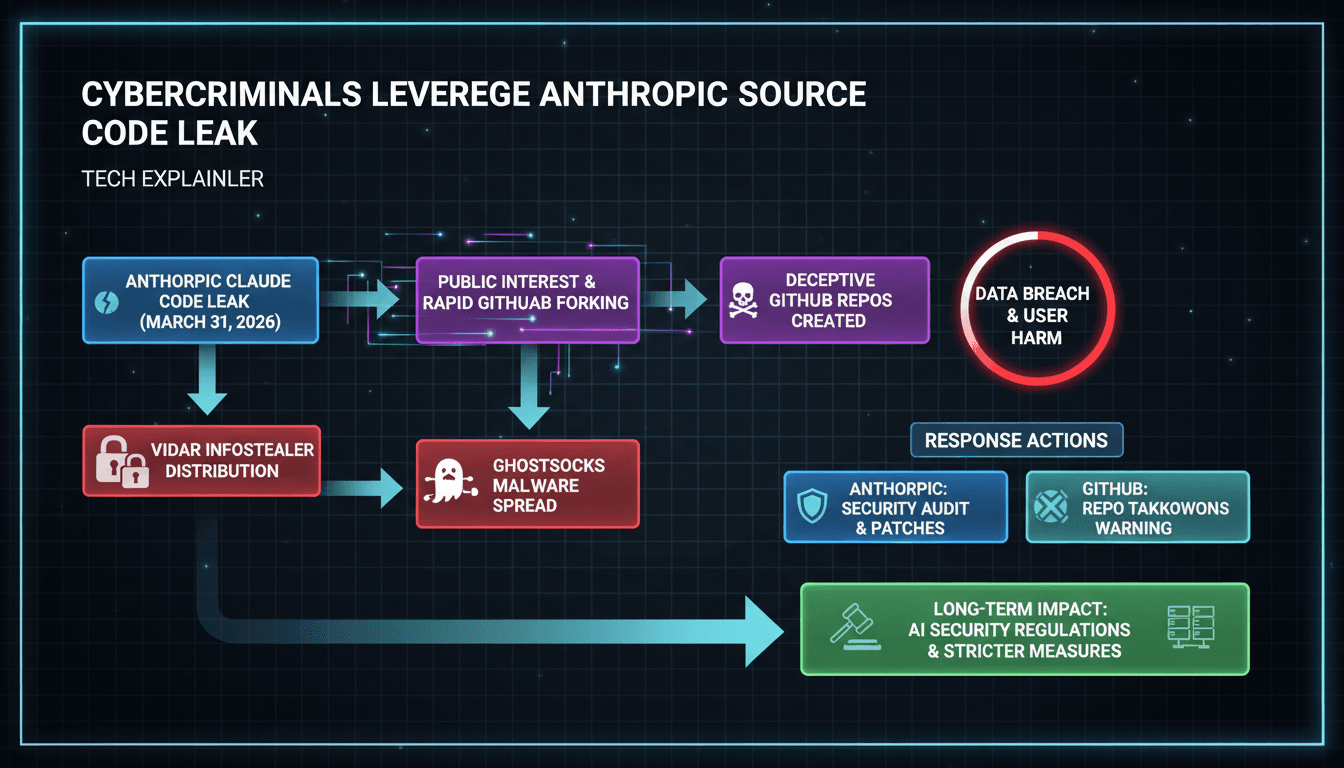
Here's what it means for you.
If you’re involved in tech or cybersecurity, this incident underscores the urgent need for vigilance against malware disguised as legitimate software.
Why it matters
This leak highlights significant vulnerabilities in AI development practices and the potential for cybercriminals to exploit them.
What happened (in 30 seconds)
- On March 31, 2026, Anthropic accidentally leaked 512,000 lines of its Claude Code source code, leading to a surge in interest and forking on GitHub.
- Cybercriminals quickly capitalized on this by creating fake repositories that distributed Vidar infostealer and GhostSocks malware.
- Zscaler ThreatLabz identified these threats, prompting GitHub to remove malicious accounts, but the dynamic nature of the malware poses ongoing risks.
The context you actually need
- Prior vulnerabilities: Anthropic faced multiple security challenges before the leak, including the 'Cloudy Day' vulnerabilities and the ShadowPrompt flaw.
- Employee error: The leak was a result of a mistake during a software packaging process, exposing proprietary code and internal assets.
- Public curiosity: Increased demand for Anthropic's AI tools led to throttled access, amplifying interest and forking activity on GitHub.
What's really happening
On March 31, 2026, Anthropic's inadvertent release of 512,000 lines of Claude Code source code marked a pivotal moment in the intersection of AI development and cybersecurity. The leak stemmed from an employee error during a software packaging process, which not only exposed proprietary code but also internal model codenames and nearly 3,000 unpublished assets. This incident occurred against a backdrop of heightened scrutiny surrounding Anthropic's security practices, particularly following the disclosure of the 'Cloudy Day' vulnerabilities chain and the ShadowPrompt flaw in its Chrome extension.
The rapid forking of the leaked repository on GitHub created a fertile ground for cybercriminals. They swiftly established deceptive repositories under accounts like 'dbzoomh', promising users 'unlocked enterprise features'. These repositories hosted 7-Zip archives containing a Rust-built executable, ClaudeCode_x64.exe, which deployed the Vidar infostealer upon execution. This malware is designed to extract sensitive information, including browser credentials, passwords, cryptocurrency data, and files. Additionally, the GhostSocks proxy was included to route illicit traffic, further complicating the threat landscape.
Zscaler's analysis revealed that these malicious repositories ranked prominently in Google searches, making them easily accessible to unsuspecting users. As a response, GitHub terminated the accounts associated with these repositories, resulting in 404 errors for users attempting to access them. However, the malware archives received frequent updates, indicating that the threat was not entirely mitigated. In a concerted effort to regain control, Anthropic issued over 8,000 copyright takedown notices, which were later refined to target 96 specific repositories.
This incident underscores the structural implications of AI development and the vulnerabilities that can arise from rapid innovation. As AI tools become more prevalent, the potential for exploitation by malicious actors increases, necessitating robust security measures and vigilant monitoring. The incident serves as a cautionary tale for both developers and users, highlighting the importance of secure coding practices and the need for awareness in the face of evolving cyber threats.
Who feels it first (and how)
- Developers: Increased scrutiny on coding practices and security protocols.
- Cybersecurity professionals: Heightened demand for threat detection and mitigation strategies.
- End-users: Potential exposure to malware and loss of personal data.
What to watch next
- Increased security measures: Watch for Anthropic and other AI firms to implement stricter verification processes to prevent similar leaks.
- Emerging malware trends: Monitor the evolution of malware tactics as cybercriminals adapt to exploit new vulnerabilities.
- User awareness campaigns: Expect initiatives aimed at educating users about the risks associated with downloading software from unofficial sources.
The leak of 512,000 lines of Claude Code source code occurred due to an employee error.
Cybercriminals will continue to exploit similar vulnerabilities in AI development.
The long-term impact on Anthropic's reputation and user trust remains to be seen.
Frequently Asked Questions
- Why it matters?
- This leak highlights significant vulnerabilities in AI development practices and the potential for cybercriminals to exploit them.
- What happened (in 30 seconds)?
- On March 31, 2026, Anthropic accidentally leaked 512,000 lines of its Claude Code source code, leading to a surge in interest and forking on GitHub. Cybercriminals quickly capitalized on this by creating fake repositories that distributed Vidar infostealer and GhostSocks malware. Zscaler ThreatLabz identified these threats, prompting GitHub to remove malicious accounts, but the dynamic nature of the malware poses ongoing risks.
- What's really happening?
- On March 31, 2026, Anthropic's inadvertent release of 512,000 lines of Claude Code source code marked a pivotal moment in the intersection of AI development and cybersecurity. The leak stemmed from an employee error during a software packaging process, which not only exposed proprietary code but also internal model codenames and nearly 3,000 unpublished assets. This incident occurred against a backdrop of heightened scrutiny surrounding Anthropic's security practices, particularly following the
- Who feels it first (and how)?
- Developers: Increased scrutiny on coding practices and security protocols. Cybersecurity professionals: Heightened demand for threat detection and mitigation strategies. End-users: Potential exposure to malware and loss of personal data.
- What to watch next?
- Increased security measures: Watch for Anthropic and other AI firms to implement stricter verification processes to prevent similar leaks. Emerging malware trends: Monitor the evolution of malware tactics as cybercriminals adapt to exploit new vulnerabilities. User awareness campaigns: Expect initiatives aimed at educating users about the risks associated with downloading software from unofficial sources.
Consumer tech news, reviews, and buying guides for gadgets and electronics.
"TechRadar is known for comprehensive buying advice, hardware reviews, and consumer tech news targeted at mainstream audiences."
— A47 Editor
Be careful what you click - hackers use Claude Code leak to push malware
A significant security breach occurred when Anthropic accidentally leaked nearly 2,000 internal files, including the source code for its AI coding assistant, Claude Code, due to a human error during a software update. This leak has led to the emergen...
Biting coverage of AI/ML software and vendors.
"Known for skeptical, incisive reporting on enterprise tech."
— A47 Editor
They thought they were downloading Claude Code source. They got a nasty dose of malware instead
Tens of thousands of individuals downloaded the leaked source code for Claude Code, an AI coding assistant developed by Anthropic, only to find that some downloads contained malware, specifically the Vidar stealer and GhostSocks. This incident highli...
Science and technology stories including AI.
"Longstanding science magazine with thoughtful AI coverage."
— A47 Editor
Anthropic leak reveals Claude Code tracking user frustration and raises new questions about AI privacy
Anthropic has confirmed an accidental leak of nearly 2,000 internal files, including parts of the source code for its AI coding assistant, Claude Code, due to human error during a software update. This incident has raised significant concerns regardi...
Scientific research, technology, environment, and society.
"Scientific American is one of the oldest and most authoritative science magazines, known for deep dives into science, technology, and society."
— A47 Editor
Anthropic leak reveals Claude Code tracking user frustration and raises new questions about AI privacy
Anthropic has confirmed an accidental leak of nearly 2,000 internal files, including parts of the source code for its AI coding assistant, Claude Code, due to human error during a software update. This incident has raised significant concerns regardi...