
U.S. Court Rules AI Chatbot Communications Not Privileged in Heppner Case
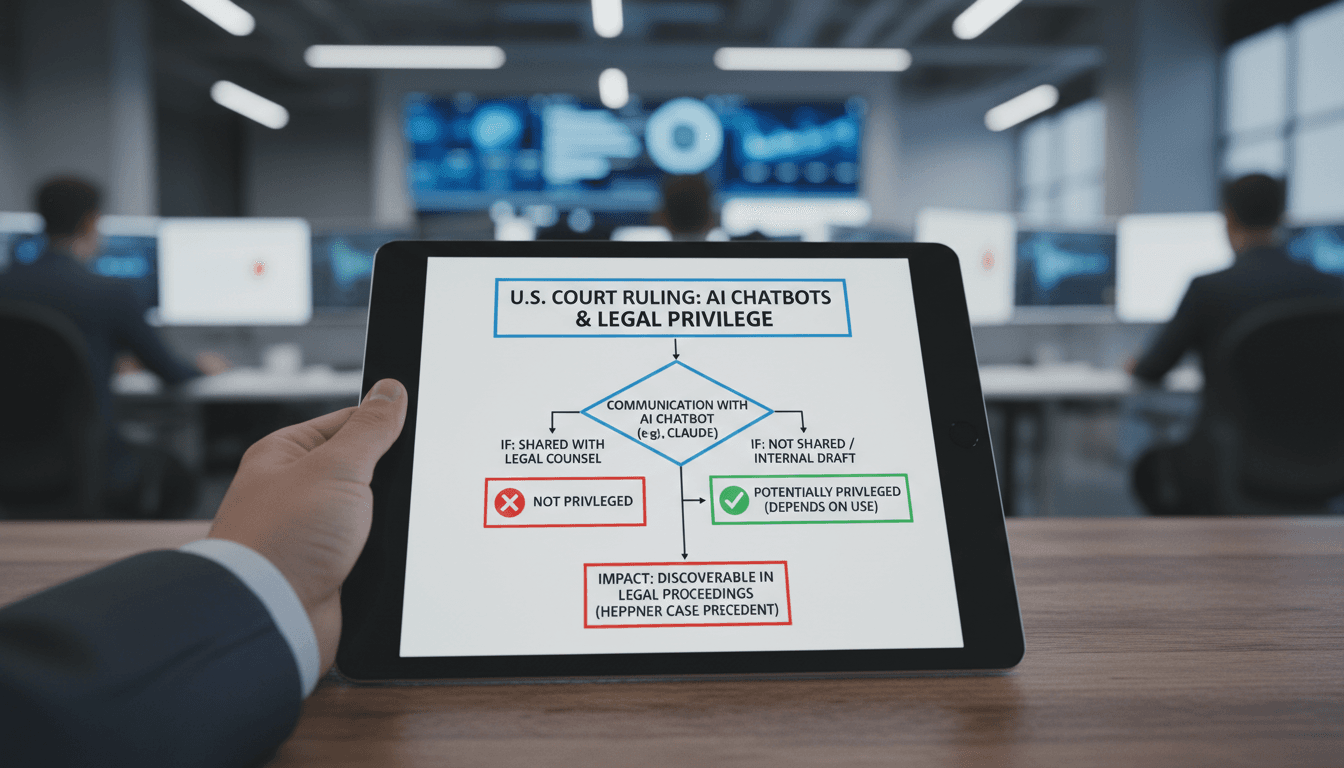
Here's what it means for you.
If you rely on AI tools for legal advice, you may be exposing yourself to risks that could undermine your confidentiality.
Why it matters
This ruling sets a precedent that could reshape how legal professionals and clients interact with AI technologies.
What happened (in 30 seconds)
- February 17, 2026: U.S. District Judge Jed S. Rakoff ruled that 31 documents generated by Anthropic's Claude AI must be disclosed, lacking attorney-client privilege.
- February 10, 2026: A contrasting ruling in Michigan protected ChatGPT records, highlighting inconsistent judicial approaches to AI in legal contexts.
- April 15, 2026: Major law firms issued advisories warning clients against using public AI tools for confidential legal discussions.
The context you actually need
- Growing use of AI: The rise of generative AI tools like Claude and ChatGPT has led many, including defendants, to seek preliminary legal analysis independently.
- Heppner's case: Bradley Heppner, indicted for securities fraud, used Claude to create documents that were later deemed non-privileged, prompting legal scrutiny.
- Judicial inconsistency: The differing outcomes in New York and Michigan illustrate the evolving and uncertain landscape of AI's role in legal proceedings.
What's really happening
The ruling in United States v. Heppner marks a significant moment in the intersection of technology and law, particularly concerning the use of AI chatbots in legal contexts. As generative AI tools become more prevalent, users—including individuals facing legal challenges—are increasingly turning to these platforms for preliminary legal analysis. In Heppner's case, the documents generated by Claude AI were deemed non-privileged because they were created using a public tool before being shared with his defense attorneys. This ruling underscores a critical point: communications with AI tools do not automatically carry the same protections as traditional attorney-client interactions.
Legal experts are now warning clients about the risks associated with using AI chatbots for legal advice. Major law firms have issued advisories recommending that clients utilize "closed" AI systems—those that do not share data with third parties—and implement contractual clauses to safeguard against privilege waivers. The ruling has prompted a reevaluation of how legal professionals and clients engage with AI technologies, as the potential for privilege loss looms large.
The contrasting ruling from Michigan, which protected a self-represented litigant's ChatGPT work product, highlights the inconsistency in judicial interpretations of AI's role in legal proceedings. This inconsistency could lead to confusion among legal practitioners and clients alike, as they navigate the evolving landscape of AI in law. As courts grapple with these issues, further rulings are anticipated to clarify the admissibility of AI-generated evidence, potentially leading to a more standardized approach across jurisdictions.
The implications of this ruling extend beyond individual cases; they signal a broader shift in how legal professionals must adapt to the integration of AI technologies. As the legal landscape evolves, practitioners will need to develop new strategies for managing client communications and protecting sensitive information in an era where AI tools are commonplace.
Who feels it first (and how)
- Legal professionals: Attorneys must adapt their practices to ensure client confidentiality when using AI tools.
- Criminal defendants: Individuals facing legal charges may need to reconsider how they seek legal advice and the tools they use.
- AI developers: Companies creating generative AI tools may face increased scrutiny and pressure to enhance privacy protections.
What to watch next
- Future court rulings: Keep an eye on upcoming decisions regarding AI-generated evidence, as they will shape the legal landscape and influence how AI tools are utilized in practice.
- Law firm advisories: Monitor how major law firms adjust their client advisories in response to this ruling, as they may implement new guidelines for AI usage.
- Legislative developments: Watch for potential legislative responses aimed at clarifying the legal status of AI communications, which could impact the broader tech and legal sectors.
The ruling in Heppner's case establishes that AI-generated documents may not be protected by attorney-client privilege.
Further court rulings will emerge, clarifying the admissibility of AI-generated evidence in legal proceedings.
The long-term impact on the use of AI tools in legal contexts remains uncertain, particularly as courts continue to grapple with these issues.
Frequently Asked Questions
- Why it matters?
- This ruling sets a precedent that could reshape how legal professionals and clients interact with AI technologies.
- What happened (in 30 seconds)?
- February 17, 2026: U.S. District Judge Jed S. Rakoff ruled that 31 documents generated by Anthropic's Claude AI must be disclosed, lacking attorney-client privilege. February 10, 2026: A contrasting ruling in Michigan protected ChatGPT records, highlighting inconsistent judicial approaches to AI in legal contexts. April 15, 2026: Major law firms issued advisories warning clients against using public AI tools for confidential legal discussions.
- What's really happening?
- The ruling in United States v. Heppner marks a significant moment in the intersection of technology and law, particularly concerning the use of AI chatbots in legal contexts. As generative AI tools become more prevalent, users—including individuals facing legal challenges—are increasingly turning to these platforms for preliminary legal analysis. In Heppner's case, the documents generated by Claude AI were deemed non-privileged because they were created using a public tool before being shared wi
- Who feels it first (and how)?
- Legal professionals: Attorneys must adapt their practices to ensure client confidentiality when using AI tools. Criminal defendants: Individuals facing legal charges may need to reconsider how they seek legal advice and the tools they use. AI developers: Companies creating generative AI tools may face increased scrutiny and pressure to enhance privacy protections.
- What to watch next?
- Future court rulings: Keep an eye on upcoming decisions regarding AI-generated evidence, as they will shape the legal landscape and influence how AI tools are utilized in practice. Law firm advisories: Monitor how major law firms adjust their client advisories in response to this ruling, as they may implement new guidelines for AI usage. Legislative developments: Watch for potential legislative responses aimed at clarifying the legal status of AI communications, which could impact the broade
Breaking news, politics, business, and entertainment from the U.S. and around the world.
"The New York Post is a tabloid-format newspaper known for its sensationalist headlines and conservative-leaning editorial tone."
— A47 Editor
AI chatbot conversations can be used against people in court, lawyers warn after federal ruling
Lawyers, including Alexandria Gutiérrez Swette from Kobre & Kim, have raised concerns following a federal ruling that allows AI chatbot conversations to be used as evidence in court. This development has prompted legal professionals to advise clients...
Key macro releases (CPI, jobs, PMIs), surprise indexes, and market implications.
"Great for data-print awareness and instant read-through to rates and risk assets."
— A47 Editor
AI ruling prompts warnings from US lawyers: Your chats could be used against you
A recent ruling regarding artificial intelligence has raised significant concerns among US lawyers, who warn that conversations held in chat platforms could potentially be used against individuals in legal proceedings. This development highlights the...
Tech startup news, programming trends, and discussions shared by the developer community.
"Hacker News is a community-driven source highlighting influential tech discussions, startup launches, and programming insights."
— A47 Editor
AI ruling prompts warnings from US lawyers: Your chats could be used against you
A recent ruling regarding artificial intelligence has raised concerns among US lawyers, who warn that conversations conducted through AI platforms could potentially be used against individuals in legal contexts. This development highlights the growin...