
Argentina's Congress Revises Glacier Law to Boost Copper Mining Investments
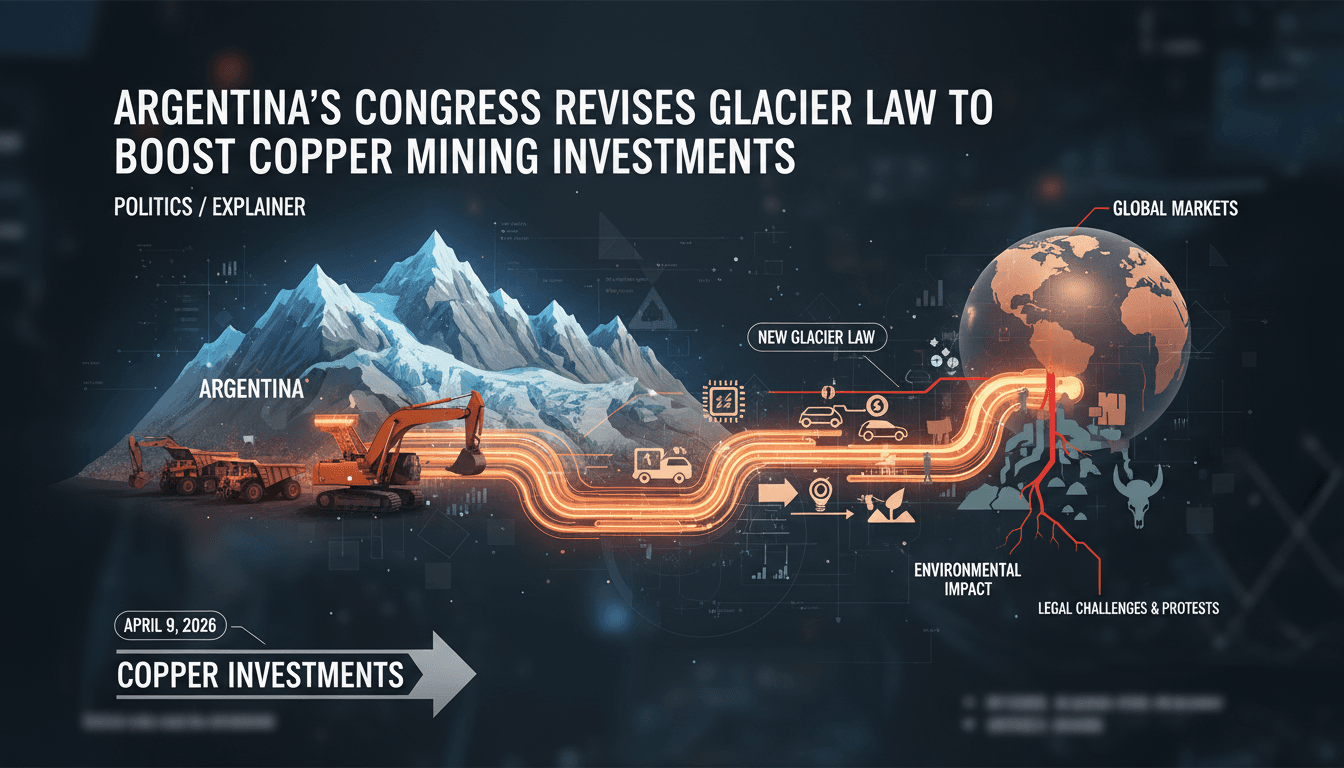
Here's what it means for you.
If you’re in the construction or commodities trading sectors, changes in global copper supply could affect your costs and pricing strategies.
Why it matters
This legislative shift could significantly impact global copper supply, influencing prices and availability for industries reliant on this critical metal.
What happened (in 30 seconds)
- On April 9, 2026, Argentina's Congress approved a revision to the glacier protection law, easing mining restrictions near glaciers.
- President Javier Milei shifted authority to provincial governments for glacier identification, aiming to attract $26 billion in copper investments.
- Protests erupted outside Congress as environmentalists voiced concerns over water resource protection amid the push for mining development.
The context you actually need
- The original glacier protection law, enacted in 2010, prohibited mining activities near glaciers to safeguard vital water resources in the Andes.
- President Milei's administration, elected in late 2023, is focused on free-market reforms, including a new incentive regime to attract foreign investment in mining.
- The economic backdrop includes Argentina's efforts to challenge Chile's copper dominance, fueled by recent midterm electoral gains and a U.S. bailout.
What's really happening
The recent approval of the glacier law revision marks a pivotal moment in Argentina's mining sector, reflecting broader economic strategies under President Javier Milei. The original glacier protection law, enacted in 2010, effectively halted copper mining activities near glaciers, which are crucial for maintaining water supplies in the region. This law was designed to protect the environment but also limited the exploitation of Argentina's vast mineral resources, particularly copper, which is essential for various industries, including construction and electronics.
Milei's administration has been aggressively pursuing deregulation to attract foreign investment, particularly in the mining sector. The introduction of the RIGI incentive regime, which offers 30-year tax stability and foreign arbitration, is part of this strategy. By shifting the authority to provincial governments for identifying protected glaciers, the administration aims to streamline the approval process for mining projects, thereby unlocking an estimated $26 billion in potential investments from global mining giants like Glencore, BHP Group, and First Quantum.
However, this shift has not come without controversy. Environmentalists and left-wing lawmakers have expressed strong opposition, fearing that easing restrictions on mining near glaciers could jeopardize vital water resources. Protests erupted outside Congress as the bill passed, highlighting the tension between economic development and environmental protection. The government’s move is seen as an elimination of "ideological barriers," according to Milei, who is keen on positioning Argentina as a competitive player in the global copper market.
The anticipated influx of investment is expected to lead to increased mining activity in the Andes, which could have significant implications for local ecosystems and communities. Mining firms are preparing scientific studies to assess the environmental impact, but legal challenges are likely to arise as opponents seek to contest the law's implementation. The provincial governments will now play a crucial role in determining the specifics of glacier protection, which could lead to inconsistencies in how the law is applied across different regions.
In summary, while the revision of the glacier law aims to stimulate economic growth through increased copper mining, it raises critical questions about environmental sustainability and the long-term impact on water resources in the Andes.
Who feels it first (and how)
- Mining companies: They will benefit from increased investment opportunities and regulatory clarity.
- Local communities: Residents near mining sites may face environmental risks and changes to water availability.
- Construction and commodities sectors: Industries reliant on copper could see fluctuations in supply and pricing.
What to watch next
- Legal challenges: Monitor the outcomes of anticipated lawsuits from environmental groups, as these could delay or alter the implementation of the new law.
- Provincial responses: Watch how different provinces implement glacier protection measures, which could lead to varying levels of mining activity across the country.
- Global copper prices: Keep an eye on copper market trends, as increased mining activity in Argentina could influence global supply and pricing structures.
The glacier law revision has been approved by Congress.
Legal challenges and protests will continue, potentially delaying mining projects.
The long-term environmental impacts of increased mining near glaciers remain to be fully assessed.
Frequently Asked Questions
- Why it matters?
- This legislative shift could significantly impact global copper supply, influencing prices and availability for industries reliant on this critical metal.
- What happened (in 30 seconds)?
- On April 9, 2026, Argentina's Congress approved a revision to the glacier protection law, easing mining restrictions near glaciers. President Javier Milei shifted authority to provincial governments for glacier identification, aiming to attract $26 billion in copper investments. Protests erupted outside Congress as environmentalists voiced concerns over water resource protection amid the push for mining development.
- What's really happening?
- The recent approval of the glacier law revision marks a pivotal moment in Argentina's mining sector, reflecting broader economic strategies under President Javier Milei. The original glacier protection law, enacted in 2010, effectively halted copper mining activities near glaciers, which are crucial for maintaining water supplies in the region. This law was designed to protect the environment but also limited the exploitation of Argentina's vast mineral resources, particularly copper, which is e
- Who feels it first (and how)?
- Mining companies: They will benefit from increased investment opportunities and regulatory clarity. Local communities: Residents near mining sites may face environmental risks and changes to water availability. Construction and commodities sectors: Industries reliant on copper could see fluctuations in supply and pricing.
- What to watch next?
- Legal challenges: Monitor the outcomes of anticipated lawsuits from environmental groups, as these could delay or alter the implementation of the new law. Provincial responses: Watch how different provinces implement glacier protection measures, which could lead to varying levels of mining activity across the country. Global copper prices: Keep an eye on copper market trends, as increased mining activity in Argentina could influence global supply and pricing structures.
Global political, business, and cultural coverage from WSJ international desks.
"The Wall Street Journal offers extensive international reporting with a reputation for financial insight and a center-right editorial stance."
— A47 Editor
Argentina’s Milei Eases Glacier Protections to Unlock Copper Investments
Argentina's lower house of parliament has approved a controversial bill that eases protections for glaciers, allowing mining activities in the sensitive regions of the Andes mountains. This legislative change, supported by President Javier Milei, aim...
UK and international business news, economics, and corporate coverage.
"The Guardian’s business section covers finance and markets with a progressive editorial tone."
— A47 Editor
Argentina approves Milei’s glacier mining bill amid environmental protests
Argentina's congress has approved a controversial bill that allows mining in ecologically sensitive glacier regions of the Andes, a move supported by President Javier Milei. This legislative change eases existing protections, facilitating the extract...
International coverage from The Guardian's global desks.
"The Guardian is known for its progressive editorial stance and in-depth analysis."
— A47 Editor
Argentina approves Milei’s glacier mining bill amid environmental protests
Argentina's congress has approved a controversial bill that allows mining in ecologically sensitive glacier regions of the Andes, a move supported by President Javier Milei. This legislative change eases existing protections, facilitating the extract...
News across North, Central, and South America including politics and economics.
"France 24 is viewed as a globally focused outlet with balanced coverage and a European perspective."
— A47 Editor
Argentine MPs approve Milei-backed bill to allow mining in glaciers
Argentina's lower house of parliament has approved a controversial bill supported by President Javier Milei, allowing mining activities in glacier regions of the Andes mountains. This legislation has raised significant concerns among environmentalist...