
Google launches Gemma 4 multimodal AI models for on-device inference
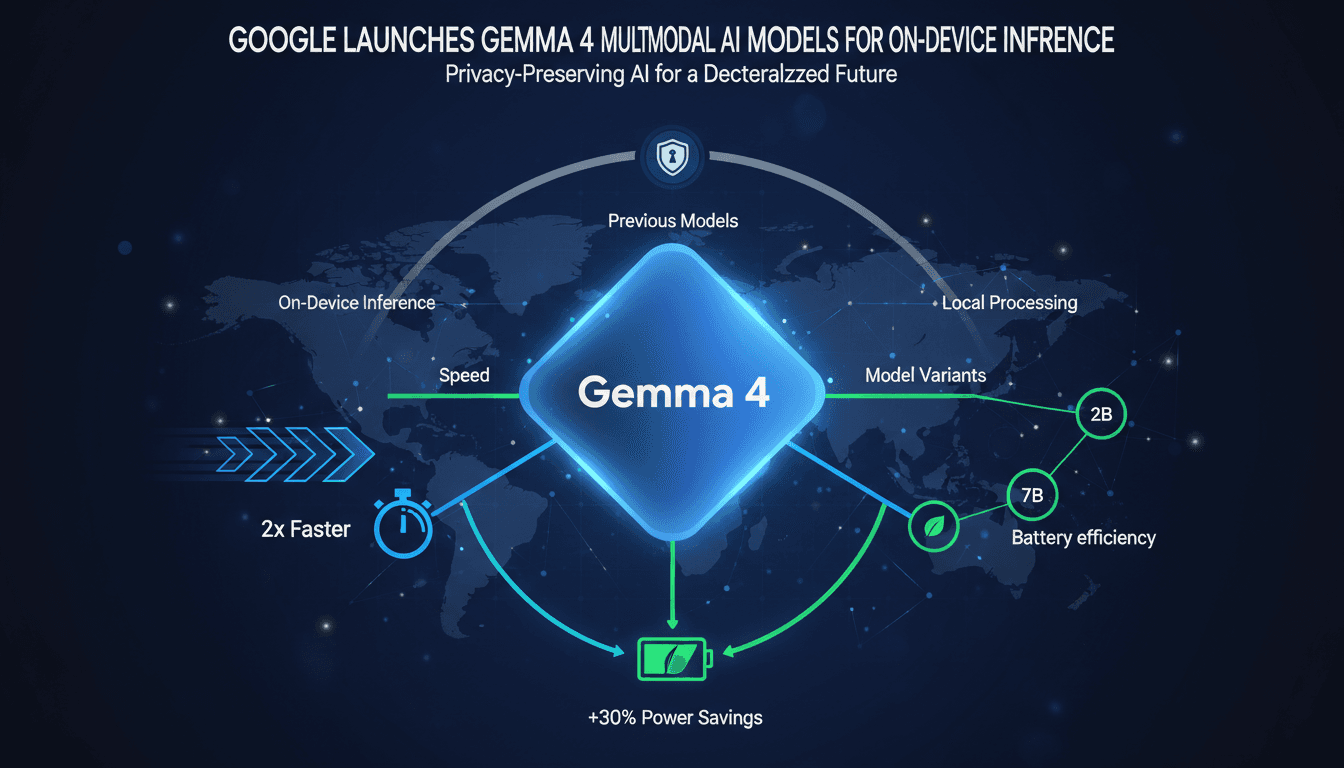
Here's what it means for you.
If you’re a developer or a business leveraging AI, Gemma 4's local-first approach could redefine how you build and deploy intelligent applications.
Why it matters
The shift to on-device AI models addresses critical privacy concerns while enhancing performance and reducing reliance on cloud infrastructure.
What happened (in 30 seconds)
- Google released Gemma 4 on April 2, 2026, introducing a family of open-weight multimodal AI models optimized for local on-device inference.
- Four model variants were launched, ranging from lightweight to powerful, enabling advanced reasoning and multimodal capabilities across text, image, audio, and video inputs.
- Developers quickly adopted the technology, with over 2 million downloads within days, signaling strong interest in local AI deployment.
The context you actually need
- Gemma 4 builds on previous models in the Gemma series, evolving from lightweight open models to sophisticated multimodal capabilities.
- Industry demand for on-device AI has surged due to privacy concerns, latency reduction, and the rising costs of cloud services.
- Google's focus on local inference aligns with global data regulations, making it a timely solution for developers facing compliance challenges.
What's really happening
Google's Gemma 4 represents a significant evolution in AI model architecture, emphasizing local on-device inference. This shift is driven by a confluence of factors, including increasing privacy regulations and the need for faster, more efficient AI applications. By enabling models to run directly on devices, Google is addressing the growing concerns around data privacy, particularly in regions with stringent data protection laws.
The Gemma 4 family includes four distinct model variants, each tailored for different use cases. The lightweight E2B model is designed for mobile applications, while the more powerful 31B dense model caters to advanced reasoning tasks. This flexibility allows developers to choose the right model based on their specific needs, whether they are building simple applications or complex AI-driven solutions.
One of the standout features of Gemma 4 is its impressive performance metrics. The models demonstrate up to 4x faster inference times compared to previous versions, alongside a 60% reduction in battery usage. This efficiency is crucial for mobile devices, where resource constraints are a significant consideration. The ability to process data locally not only enhances performance but also reduces latency, making applications more responsive and user-friendly.
Moreover, the integration of Gemma 4 into Android applications is seamless, thanks to support from the AICore Developer Preview and Android Studio. This allows developers to prototype and deploy applications quickly, fostering innovation in the Android ecosystem. The open-weight nature of the models encourages collaboration and experimentation, as developers can modify and adapt the models to suit their unique requirements.
The rapid adoption of Gemma 4, evidenced by over 2 million downloads shortly after its release, indicates a strong market appetite for local AI solutions. Developers are eager to leverage the capabilities of these models to create intelligent applications that respect user privacy while delivering high performance. As businesses increasingly prioritize data security and compliance, the demand for on-device AI is likely to grow, positioning Gemma 4 as a pivotal player in the evolving AI landscape.
Who feels it first (and how)
- Developers: They will benefit from enhanced tools for building intelligent applications without cloud dependencies.
- Businesses in tech: Companies focusing on mobile and edge computing will see improved performance and privacy in their applications.
- Consumers: End-users will experience faster, more responsive applications that prioritize their data privacy.
What to watch next
- Adoption rates: Monitor how quickly developers integrate Gemma 4 into their applications, as this will indicate market acceptance and potential growth.
- Performance benchmarks: Keep an eye on comparative studies that evaluate Gemma 4 against other AI models, particularly in real-world applications.
- Regulatory developments: Watch for changes in data privacy laws that could influence the demand for local AI solutions, particularly in regions like the EU and UAE.
Gemma 4 has been publicly released and is available for developers.
The demand for on-device AI solutions will continue to grow as privacy concerns and regulatory pressures increase.
The long-term impact of Gemma 4 on the competitive landscape of AI models remains to be seen.
Frequently Asked Questions
- Why it matters?
- The shift to on-device AI models addresses critical privacy concerns while enhancing performance and reducing reliance on cloud infrastructure.
- What happened (in 30 seconds)?
- Google released Gemma 4 on April 2, 2026, introducing a family of open-weight multimodal AI models optimized for local on-device inference. Four model variants were launched, ranging from lightweight to powerful, enabling advanced reasoning and multimodal capabilities across text, image, audio, and video inputs. Developers quickly adopted the technology, with over 2 million downloads within days, signaling strong interest in local AI deployment.
- What's really happening?
- Google's Gemma 4 represents a significant evolution in AI model architecture, emphasizing local on-device inference. This shift is driven by a confluence of factors, including increasing privacy regulations and the need for faster, more efficient AI applications. By enabling models to run directly on devices, Google is addressing the growing concerns around data privacy, particularly in regions with stringent data protection laws. The Gemma 4 family includes four distinct model variants, each t
- Who feels it first (and how)?
- Developers: They will benefit from enhanced tools for building intelligent applications without cloud dependencies. Businesses in tech: Companies focusing on mobile and edge computing will see improved performance and privacy in their applications. Consumers: End-users will experience faster, more responsive applications that prioritize their data privacy.
- What to watch next?
- Adoption rates: Monitor how quickly developers integrate Gemma 4 into their applications, as this will indicate market acceptance and potential growth. Performance benchmarks: Keep an eye on comparative studies that evaluate Gemma 4 against other AI models, particularly in real-world applications. Regulatory developments: Watch for changes in data privacy laws that could influence the demand for local AI solutions, particularly in regions like the EU and UAE.
News for senior developers on AI/ML and data engineering.
"Conference-linked outlet for practitioner news and Q&As."
— A47 Editor
Google Released Gemma 4 with a Focus on Local-First, On-Device AI Inference
Google has officially released Gemma 4, a new suite of open AI models designed for local-first, on-device AI inference, marking a significant update in its AI offerings. This release includes models that support various computing capabilities, from s...
Digest of new AI research, guides, and notable models.
"Curates model launches and practical guides for hands-on users."
— A47 Editor
Google’s Best Open Model Yet Has a Memory Problem
Google has released its latest AI model, Gemma 4, which features a 31B version with a 256K context window, highlighting its advanced capabilities but also raising concerns about the associated VRAM costs.
Daily AI news: models, tools, and policy.
"Independent outlet tracking the fast pace of AI."
— A47 Editor
Google's Gemma 4 puts free agentic AI on your phone and no data ever leaves the device
Google has launched Gemma 4, an open-source AI model that processes text, images, and audio entirely on-device, ensuring that no data leaves the user's device. This new model utilizes agent skills to access tools like Wikipedia and interactive maps w...