
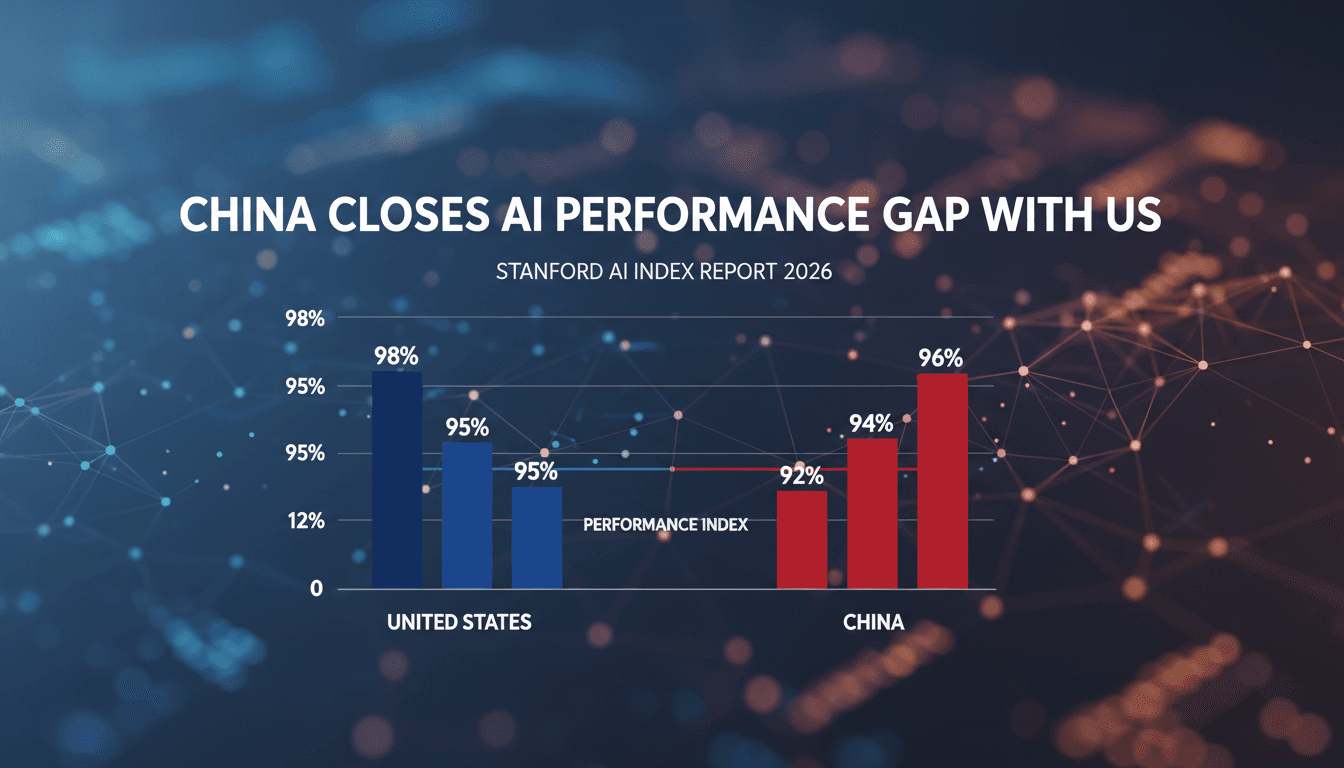
China Closes Performance Gap with US in AI Models According to Stanford Report
Here's what it means for you.
As AI capabilities converge globally, your access to cutting-edge technology and job opportunities in the sector may shift dramatically.
Why it matters
The closing performance gap in AI models between the US and China signals a new era of competition that could reshape global tech leadership.
What happened (in 30 seconds)
- China has effectively closed the performance gap with the US in leading AI models, with only a 2.7% difference as of March 2026.
- US private investment in AI remains significantly higher, totaling $285.9 billion in 2025 compared to China's $12.4 billion.
- China leads in AI publications and patents, holding 23.2% of global publications and 69.7% of patent grants.
The context you actually need
- Previous reports indicated a strong US lead in AI innovation, with American institutions consistently producing superior models.
- Chinese developers accelerated their progress through state-supported scaling and open-source contributions, particularly after US export controls on advanced chips.
- Geopolitical competition has intensified, with both nations prioritizing AI sovereignty and investing heavily in their respective AI ecosystems.
What's really happening
The Stanford AI Index 2026 Report reveals a significant shift in the global AI landscape, where the performance gap between US and Chinese AI models has narrowed considerably. This change is not merely a reflection of technological advancements but also a consequence of strategic investments and policy decisions made by both nations over the past few years.
Since 2024, Chinese developers have made remarkable strides in AI, leveraging state support to scale their operations and enhance their capabilities. The Chinese government has deployed an estimated $912 billion across various industries from 2000 to 2023, focusing on AI as a critical area for national development. This funding has facilitated the rapid growth of domestic AI companies, enabling them to compete effectively with their US counterparts.
In contrast, while the US maintains a significant edge in private investment—$285.9 billion in 2025 versus China's $12.4 billion—the gap in model performance is closing. The report highlights that top models from both countries have been trading places in rankings, with Anthropic's leading model only marginally ahead of its closest Chinese competitor. This convergence indicates that the US's historical advantage in AI innovation is being challenged.
Moreover, the report underscores the importance of data centers and high-impact research, where the US still holds an advantage with 5,427 data centers. However, China's dominance in AI publications and patent grants—23.2% and 69.7% of global totals, respectively—suggests a robust pipeline of innovation that could lead to future breakthroughs.
The implications of this shift are profound. As both nations vie for supremacy in AI, the competition will likely spur further investments and innovations. However, it also raises concerns about talent retention in the US, where inflows of AI researchers have declined by 89% since 2017. This trend could hinder the US's ability to maintain its leadership position in the long run.
As the global AI landscape evolves, the convergence of capabilities between the US and China will have ripple effects across industries, influencing everything from job markets to technological standards.
Who feels it first (and how)
- AI Researchers: Facing increased competition for funding and opportunities as both nations ramp up their AI initiatives.
- Tech Companies: Companies in the AI sector will need to adapt to a more competitive landscape, potentially affecting hiring and investment strategies.
- Consumers: Users in regions like Dubai, where AI adoption is high, will experience faster access to advanced AI technologies and services.
What to watch next
- Investment Trends: Monitor shifts in private and public investments in AI, particularly in the US and China, as they will indicate which country is prioritizing AI development.
- Talent Migration: Keep an eye on the movement of AI talent between the US and China, as changes could impact innovation and competitiveness.
- Regulatory Changes: Watch for new policies from both governments aimed at fostering AI development, which could reshape the competitive landscape.
The performance gap between US and Chinese AI models has narrowed significantly.
Increased competition will lead to accelerated innovation and investment in AI technologies.
The long-term effects on talent retention and market dynamics in the US remain uncertain.
Frequently Asked Questions
- Why it matters?
- The closing performance gap in AI models between the US and China signals a new era of competition that could reshape global tech leadership.
- What happened (in 30 seconds)?
- China has effectively closed the performance gap with the US in leading AI models, with only a 2.7% difference as of March 2026. US private investment in AI remains significantly higher, totaling $285.9 billion in 2025 compared to China's $12.4 billion. China leads in AI publications and patents, holding 23.2% of global publications and 69.7% of patent grants.
- What's really happening?
- The Stanford AI Index 2026 Report reveals a significant shift in the global AI landscape, where the performance gap between US and Chinese AI models has narrowed considerably. This change is not merely a reflection of technological advancements but also a consequence of strategic investments and policy decisions made by both nations over the past few years. Since 2024, Chinese developers have made remarkable strides in AI, leveraging state support to scale their operations and enhance their cap
- Who feels it first (and how)?
- AI Researchers: Facing increased competition for funding and opportunities as both nations ramp up their AI initiatives. Tech Companies: Companies in the AI sector will need to adapt to a more competitive landscape, potentially affecting hiring and investment strategies. Consumers: Users in regions like Dubai, where AI adoption is high, will experience faster access to advanced AI technologies and services.
- What to watch next?
- Investment Trends: Monitor shifts in private and public investments in AI, particularly in the US and China, as they will indicate which country is prioritizing AI development. Talent Migration: Keep an eye on the movement of AI talent between the US and China, as changes could impact innovation and competitiveness. Regulatory Changes: Watch for new policies from both governments aimed at fostering AI development, which could reshape the competitive landscape.
Tech startup news, programming trends, and discussions shared by the developer community.
"Hacker News is a community-driven source highlighting influential tech discussions, startup launches, and programming insights."
— A47 Editor
Stanford report highlights growing disconnect between AI insiders and everyone
A recent Stanford report has revealed a growing disconnect between artificial intelligence (AI) insiders and the general public, highlighting concerns about the implications of AI technologies and their acceptance. This gap indicates a significant di...
Real-time updates, analysis, and reports on the blockchain and cryptocurrency sectors.
"Crypto News delivers real-time updates, analysis, and reports on the blockchain and cryptocurrency sectors."
— A47 Editor
Latest AI News: Stanford’s 2026 AI Report Card Just Dropped and China Has Nearly Closed the Gap on the US in the AI Race
Stanford HAI released its 2026 AI Index, indicating that the United States' lead in artificial intelligence over China has significantly diminished, with Anthropic's leading model only slightly ahead of its closest Chinese competitor.
Startup news with frequent AI coverage.
"Covers launches, funding, and product updates in AI."
— A47 Editor
Stanford report highlights growing disconnect between AI insiders and everyone else
A recent report from Stanford's AI Index reveals a growing disconnect between artificial intelligence experts and the general public, highlighting increasing concerns regarding job security, healthcare, and economic stability as AI technology advance...