
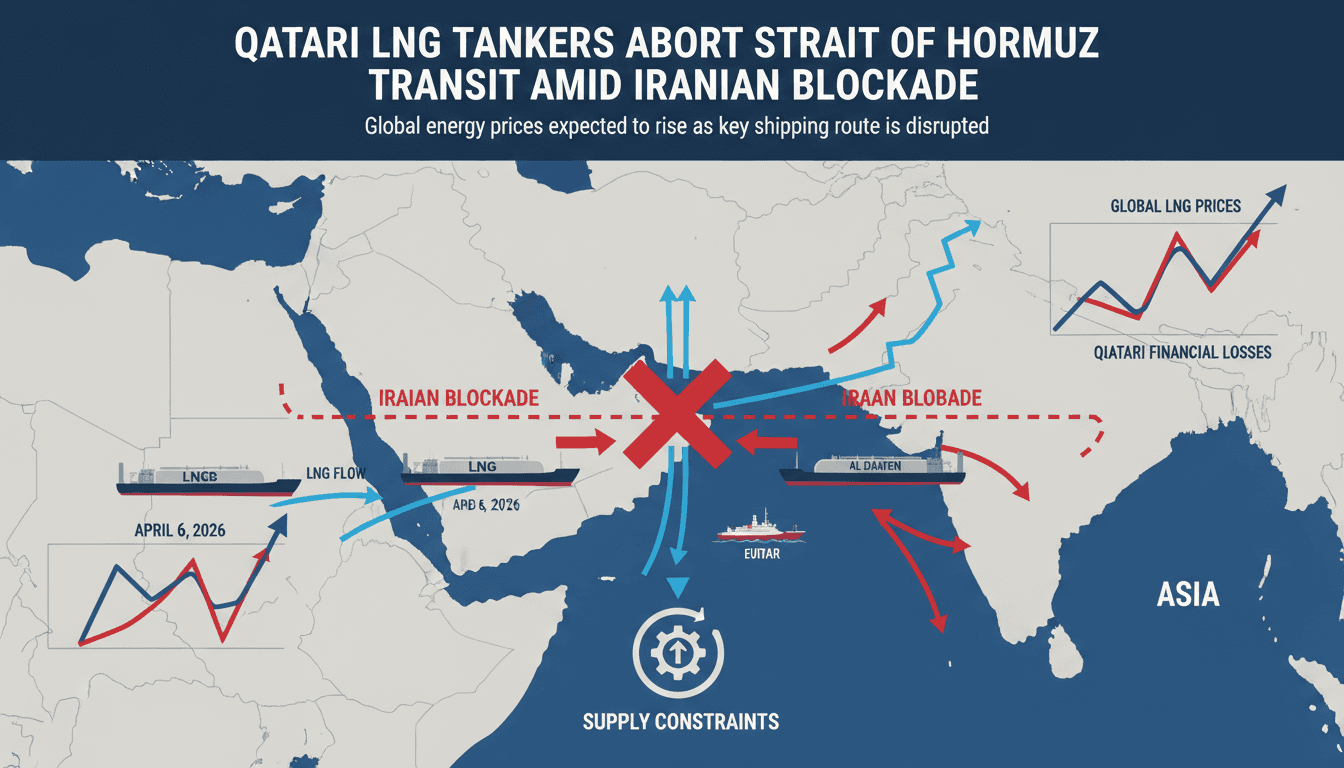
Qatari LNG tankers abort Strait of Hormuz transit amid Iranian blockade
Here's what it means for you.
If you rely on natural gas for energy, expect rising costs and potential supply shortages.
Why it matters
The Strait of Hormuz is a critical chokepoint for global energy supplies, and disruptions here can ripple through international markets.
What happened (in 30 seconds)
- Two Qatari LNG tankers, Rasheeda and Al Daayen, aborted their transit through the Strait of Hormuz on April 6, 2026.
- Iran's Revolutionary Guards Corps halted the vessels despite prior clearance, enforcing a selective blockade.
- Global LNG prices surged to multi-year highs as Qatar's exports, representing 20% of supply, remain frozen.
The context you actually need
- The US-Israel-Iran war, which began on February 28, 2026, has severely impacted regional stability and energy exports.
- Iran's blockade of the Strait of Hormuz has limited transit to select nations, exacerbating supply constraints for Europe and Asia.
- Qatar's LNG export capacity is projected to be reduced by 17% for the next 3-5 years due to Iranian strikes on its facilities.
What's really happening
The recent incident involving the Qatari LNG tankers Rasheeda and Al Daayen is a stark illustration of the escalating tensions in the Persian Gulf, particularly following the onset of the US-Israel-Iran war. This conflict has led to a significant shift in the operational landscape for energy exports, particularly liquefied natural gas (LNG), which is crucial for global energy security.
The Strait of Hormuz is a vital maritime corridor, through which approximately 20% of the world's LNG flows. The Iranian Revolutionary Guards Corps (IRGC) has implemented a selective blockade, allowing only vessels from certain 'friendly' nations to transit. This tactic is part of Iran's broader strategy to exert control over regional shipping routes and leverage its position in the ongoing conflict. The IRGC's decision to halt the Qatari tankers, despite prior clearance, underscores the precarious nature of maritime operations in this volatile region.
As a result of the blockade and the ongoing military actions, Qatar's LNG export capacity has been severely impacted. The Iranian strikes on the Ras Laffan LNG complex have knocked out 17% of its export capacity, which is expected to persist for several years. QatarEnergy has declared force majeure on multiple contracts, indicating that it cannot fulfill its export obligations due to circumstances beyond its control. This situation has led to a freeze in Qatari LNG exports, which is particularly concerning for countries in Europe and Asia that rely heavily on these supplies.
The immediate aftermath of the tankers' aborted transit has seen global LNG prices escalate to multi-year highs. Countries like India are already feeling the pinch, directing cuts in gas supplies that depend on Qatari imports. The economic implications are profound, with Qatar anticipating annual losses of around $20 billion as a result of the disrupted exports.
Moreover, the geopolitical ramifications are significant. The UN Security Council is preparing to vote on a resolution that would authorize defensive measures to secure shipping in the Strait of Hormuz, but faces opposition from key players like Russia and China. This highlights the complexity of international relations in the region and the potential for further escalation.
In summary, the incident involving the Qatari tankers is not just a localized event; it is a critical juncture that could reshape energy markets and geopolitical dynamics for years to come.
Who feels it first (and how)
- Energy consumers: Households and businesses relying on natural gas will face rising costs.
- Gas suppliers: Companies dependent on Qatari LNG will experience supply shortages and potential contract renegotiations.
- Governments: Nations reliant on LNG imports from Qatar may need to seek alternative sources, impacting energy security and pricing.
What to watch next
- Global LNG prices: Monitor fluctuations as supply constraints persist; higher prices could lead to inflationary pressures.
- UN Security Council actions: The outcome of the resolution vote could influence military engagement and shipping security in the region.
- Qatar's export recovery: Watch for updates on QatarEnergy's ability to restore production and fulfill contracts after the blockade.
The Strait of Hormuz is critical for global LNG and oil flows; Iran is enforcing a selective blockade.
Continued disruptions in LNG exports from Qatar will lead to higher global energy prices and potential shortages.
The long-term geopolitical implications of the US-Israel-Iran conflict on regional stability and energy markets.
Frequently Asked Questions
- Why it matters?
- The Strait of Hormuz is a critical chokepoint for global energy supplies, and disruptions here can ripple through international markets.
- What happened (in 30 seconds)?
- Two Qatari LNG tankers, Rasheeda and Al Daayen, aborted their transit through the Strait of Hormuz on April 6, 2026. Iran's Revolutionary Guards Corps halted the vessels despite prior clearance, enforcing a selective blockade. Global LNG prices surged to multi-year highs as Qatar's exports, representing 20% of supply, remain frozen.
- What's really happening?
- The recent incident involving the Qatari LNG tankers Rasheeda and Al Daayen is a stark illustration of the escalating tensions in the Persian Gulf, particularly following the onset of the US-Israel-Iran war. This conflict has led to a significant shift in the operational landscape for energy exports, particularly liquefied natural gas (LNG), which is crucial for global energy security. The Strait of Hormuz is a vital maritime corridor, through which approximately 20% of the world's LNG flows. T
- Who feels it first (and how)?
- Energy consumers: Households and businesses relying on natural gas will face rising costs. Gas suppliers: Companies dependent on Qatari LNG will experience supply shortages and potential contract renegotiations. Governments: Nations reliant on LNG imports from Qatar may need to seek alternative sources, impacting energy security and pricing.
- What to watch next?
- Global LNG prices: Monitor fluctuations as supply constraints persist; higher prices could lead to inflationary pressures. UN Security Council actions: The outcome of the resolution vote could influence military engagement and shipping security in the region. Qatar's export recovery: Watch for updates on QatarEnergy's ability to restore production and fulfill contracts after the blockade.
UAE-based English-language newspaper covering regional politics, economics, and global affairs.
"The National reflects Emirati policy perspectives while maintaining international editorial standards."
— A47 Editor
Qatari tankers abort Hormuz crossing in blow to first LNG shipment since war
Qatari tankers have aborted their crossing of the Strait of Hormuz, marking a setback for the first liquefied natural gas (LNG) shipment since the onset of regional conflicts. This decision reflects the heightened risks and tensions in the area, part...
Global markets, investing, and macroeconomics from a premier financial newsroom.
"Bloomberg is respected for in-depth financial reporting and data-driven analysis."
— A47 Editor
Qatar LNG Vessels U-Turn After Attempt to Pass Through Hormuz
Two tankers carrying liquefied natural gas (LNG) from Qatar have reportedly abandoned their attempt to exit the Persian Gulf through the Strait of Hormuz, marking a significant delay in what would have been the first exports to buyers outside the reg...
Arabic-language UAE newspaper coverage focused on domestic affairs, public institutions, business, society, and regional developments.
"Al Khaleej coverage generally reflects a mainstream UAE editorial lens with strong attention to public affairs, institutions, and regional developments."
— A47 Editor
ناقلتان محملتان بغاز قطري تفشلان في عبور «هرمز»
On Monday, ship tracking data revealed that two tankers loaded with liquefied natural gas from Ras Laffan in Qatar turned back after heading east towards the Strait of Hormuz.
Pan-Arab news coverage spanning politics, business, sports, and regional affairs.
"Asharq Al-Awsat reflects a broad Arab editorial perspective with strong attention to regional geopolitics."
— A47 Editor
سفينتان قطريتان محملتان بالغاز الطبيعي تراجعتا بعد اقترابهما من مضيق هرمز
On Monday, ship tracking data revealed that two Qatari vessels loaded with liquefied natural gas (LNG) from Ras Laffan reversed course after heading east towards the Strait of Hormuz.